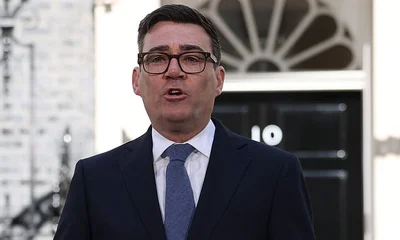
Andy Burnham was wafted into No 10 for the first time as Prime Minister yesterday on the same welter of vacuous cliches that propelled him to the Labour leadership.
He’s been in the national consciousness for only a couple of months but already we know his mantras by heart.
So once again we learned that his elevation to the top spot was a ‘circuit breaker’ (whatever that means), he represented a ‘new political model, a new economic model’ (they all say that on day one) and he offered ‘problem solving not point scoring’ (that won’t last long).
Then there was the promise of an uplift to ‘every postcode in the land’ (perhaps his signature cliche) and the ‘reindustrialisation of Britain’ (never going to happen as long as we have the highest industrial energy costs in the world).
There were two fresh announcements. He promised a new ten-year plan by the autumn. There’s nothing original about this. I seem to remember Keir Starmer and Boris Johnson both speaking of ten-year horizons. Much good did it do them: Both were gone in short order despite their landslide election victories.
Burnham, of course, cannot lay claim to any kind of general election victory. Which raises an intriguing issue: If his ten-year plan represents a break with the 2024 Labour manifesto (and what would be its point if it doesn’t?) then surely the demands of democracy require him to seek the endorsement of the people for it in an election.
Burnham also announced that his first ‘instruction’ as PM would be to end rough sleeping nationwide but his track record on this matter does not inspire confidence.
He was elected Greater Manchester mayor in 2017 on a pledge to end rough sleeping in the city-region. It fell at first, then started rising again, heading back towards the levels he’d inherited. But by then his sights were on other matters.
Andy Burnham was wafted into No 10 for the first time as PM yesterday on the same welter of vacuous cliches that propelled him to the Labour leadership, writes Andrew Neil
Burnham also had a pop at the 1980s, the decade in which he thinks Britain took a terrible wrong turn with ‘neo-liberalism’ – by which he means the Thatcher reforms.
This plays well with the more reactionary parts of the Labour tribe, but it is also arrant nonsense. The resurgence of Britain, after decades of post-war decline, began under Thatcher.
Tony Blair and Gordon Brown had the sense not to roll back the Thatcher reforms but to build on them for their own purposes, which is why, under them, the country enjoyed good growth and rising prosperity until the Great Financial Crash of 2008.
But Burnham doesn’t see it that way. I’m struck by how backward looking our new, young(ish) PM is. He hankers for the days when heavy industry – much of it state-owned – dominated our economy. The days when the unions ruled the roost, when class divisions were starker, taxes were cripplingly high, public spending rose relentlessly and the state was omnipresent.
It all came crashing down in the 1970s, the decade of over-mighty union barons, power cuts, the three-day week, millions and millions of working days lost to endless strikes, rubbish piling up in the streets, bodies unburied in graveyards, soaring inflation – and, of course, the humiliation of being bailed out by the IMF.
Just why Burnham is nostalgic for any of this escapes me. Yet implicit in almost everything he says is a longing for a better yesterday. It is a fool’s errand, impossible to achieve in a world which has long moved on. But he could do a lot of damage in trying. We must hope he quickly comes to his senses.
When he does, he needs to be bold in pivoting to those policies which will build a better tomorrow. This is what he should have said yesterday – and what should be embodied in his ten-year plan. He should have told us he was transferring the tens of billions earmarked for the mad march to Net Zero – a costly folly which will make almost no difference to global CO2 emissions – to defence spending and supply chain resilience. Both are essential in an increasingly dangerous world.
We need not just to rearm but to reduce our dependency on imports critical to our survival, and that means producing more of everything from food to energy to microchips.
We need a military-industrial supply chain capability that makes us more self-sufficient, creating tens of thousands of skilled jobs in the process (as opposed to Net Zero, which is mainly good for job creation in China).
In the same vein, he should be unleashing what’s left of North Sea oil and gas, which is still quite a lot. We will need oil and gas for the foreseeable future so it is madness not to drill for it in our own waters.
Prime Minister Burnham needs to realise that even a messiah can’t put the clock back
It will not necessarily reduce energy prices. But it will improve security of supply, create new jobs, help the balance of payments and increase tax revenues. If it means the resignation of Ed Miliband from the government, what’s not to like?
Burnham can cut energy bills by abolishing all the green levies that artificially inflate them for households and industry. Henceforth renewables should have to compete without subsidy with other forms of energy, including a new breed of gas-fired electricity generating stations and smaller nuclear reactors.
He also needs to implement the radical reform of planning laws – which Keir Starmer bottled – to allow much more infrastructure investment to take place. Parliament needs to assert its supremacy over nimbies, green zealots, lawyers, judges and courts whose combined resistance has made us a global laughing stock when it comes to major investment, public and private. No doubt local feathers would be ruffled. Compensate them well and insist the national interest comes first.
He also needs to put rocket boosters under a high-speed rail link between Leeds, Manchester and Liverpool, to create a single labour market in the North as large as London – the biggest levelling up step any government could take. He should brook no opposition or delay.
At the same time he should encourage more investment in the golden triangle – London, Oxford and Cambridge – which encompasses more world-class universities and high-tech industries than anywhere outside America. There should be no preference for North or South. Future success depends on massive investment in both.
All this will require determined tough love welfare reform to produce the necessary skilled labour. There are around 11million people of working age in the country who don’t work. Yet Skills England tells us we’re currently one million skilled people short of the number required to build the infrastructure and housing already in the pipeline.
That is a failure of the labour market on a grand scale: Burnham should regard it as his biggest challenge. For starters he should be quickly moving one million off welfare into work, equipping them with the required skills, while cutting the welfare bill and increasing the tax base in the process.
He should oversee a massive expansion of quality skilled apprenticeships – at least one world-class STEM skills school or college in every town and city in the land. If that means closing some useless universities and moving their funding, let it be so.
There are plenty more ideas where these came from. They would equip us for the world as it is and the world to come – not drag us back to the future in a forlorn attempt to recreate the past.
I don’t kid myself he has the stomach for it. Too much of it is out of his comfort zone. But Prime Minister Burnham needs to realise that even a messiah can’t put the clock back.