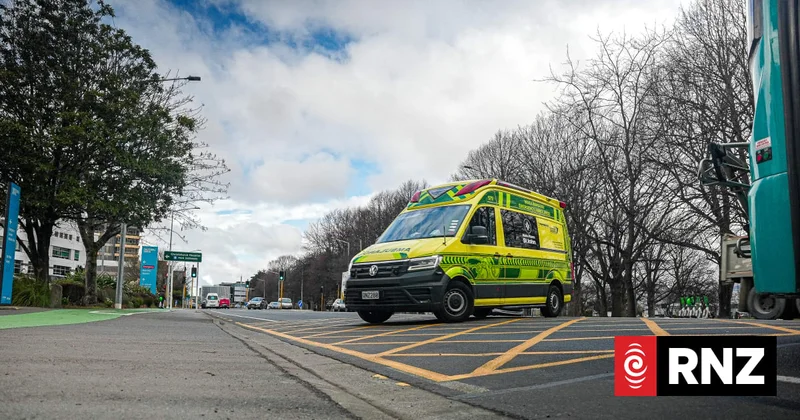
One call every 20 seconds: Current demand for ambulances 'unsustainable' - St John
Hato Hone St John experiences busiest day on record
A Hato Hone St John spokesperson says the current demand for ambulances isn't sustainable, with one call made every 20 seconds.
The ambulance service declared a major incident response on Sunday and activated its Emergency Operations Centre for the first time since Covid-19, citing extreme pressure from seasonal illness.
Saturday was St John's busiest day on record, receiving 2562 calls through 111, a 34 percent increase from a typical day. The service's daily calls record was also broken three times last week.
By Sunday, the ambulance service had received 16,008 calls for the week, breaking a record set just a week earlier.
Hato Hone St John's director of ambulance operations Doug Gallagher told Morning Report it had been coping until a sudden spike in calls.
"We'd had a mild winter and demand had been okay ... and a cold snap came, and demand went through the roof."
He said the system was robust and sought out priority systems, and asked those who could to see a GP or call Healthline to ensure they could respond to patients.
Gallagher hoped warmer weather would ease demand, but said ambulances were stretched responding to callouts.
"One call every 20 seconds speaks volumes, and that isn't sustainable," he said.
"You'd expect as the weather improves, we'd return to normal, but an ambulance service needs to be able to deal with this demand."
He said demand was driven by older people with chronic illness.
While patients with broken bones, those who had fallen, and those not in life-threatening pain could expect to wait several hours for an ambulance, Gallagher said response times for the sickest patients remained within safe limits.
But he said Mondays were typically their busiest days.
"Often, patients with chronic conditions are trying to manage themselves at home ahead of seeing their GP or primary carer on Monday.
"If they had been able to access primary care through some of the facilities that are available on weekends, that may have prevented their condition from getting to a point where on Monday, when they're being seen by their GP, they're actually needing to have an ambulance called."
He said ambulance staff were under significant strain, and staff were skipping breaks to keep up with increasing workloads.
"It does happen, and we have some quite robust procedures around that and times when we can break a break in order to respond to an emergency, but also when we can't break a break.
"Our staff, because they're driving, do have to meet the requirements of the NZTA [New Zealand Transport Agency] driving rules, which do put in place a set number of breaks."
Gallagher also said responders had been subjected to abuse by a small minority of people.
Meanwhile the union for ambulance workers says staff are under immense pressure and struggling to cope with an increase in calls.
Workers First Union spokesperson Fay McCann said call handlers are getting less and less down time between calls.
On busy shifts they don't always have capacity to stay on the line with someone who is waiting for an ambulance to arrive.
"It's terrible on their mental health. In the call centre itself you can see how many calls are waiting to have someone answer them and so they're all very aware that's someone there who is waiting for help who hasn't been able to speak to a call handler yet. It just really adds to the pressure," she said.
On busy shifts McCann said staff did not always have capacity to stay on the line with someone who was waiting for an ambulance to arrive.
"Call handlers often report to us they feel uncomfortable when they have to hang up on a caller to answer another call when ultimately they wanted to stay on the line with them but they never know what the next call is and if that could be a worse call," she said.
"That's an incredible lot of pressure to put someone under."
McCann said ambulance workers were calling for better pay and staffing.
"We already heard from our members, particularly our call handlers, that it has been extremely difficult even without these busy periods so I think they were already quite stretched," she said.
"They find it difficult to remain in the job when they're so stressed, when the pay levels are as they are so they want to see better pay, more staff and ultimately it just makes for a better environment to work in.
"While these call numbers couldn't be predicted we predicted recently in our ambulance report that the call volumes are going to be increasing, people's need for an ambulance is going to be increasing. Members already feel like the demand hasn't been kept up with so while this is a surprising number of calls it's not really a surprising position to be in."
Gallagher said they were "very thankful" for the government's investment over the last four years, but were currently in negotiations for further funding with Health NZ.
Associate Minister of Health Casey Costello told Morning Report that the government had invested $78 million - including $35m in this year's Budget - into ambulance services.
Costello said St John were responding to a major incident and 91 percent of calls were answered in 15 seconds.
She said she was confident in St John's workforce and funding to deal with the spike in demand.
But acknowledged contract negations were underway between Health NZ, ACC and St John to invest further.
Health NZ community and primary care funding director Martin Hefford said the ambulance system had responded appropriately to the significant amount of need they were experiencing.
"Health NZ supports Hato Hone St John's decision to activate the major incident response to ensure they have the structures in place to manage current high demand.
"Activating the major incident response gives Hato Hone St John a clear national structure for coordinating decisions and resources at pace.
It also supports closer coordination with Health New Zealand.
It said some hospitals' emergency departments [EDs] were also seeing increased demand, compared with the same time last year.
On average, the number of patients coming to EDs was up 0.4 percent last month from July 2025.
"While there are districts experiencing higher increases in demand, the overall picture remains well within our planning expectations and is not unexpected," Hefford said.
"Emergency Departments are busy, as is usual at this time of year. We have winter plans in place to respond to these demands.
"Health NZ are working closely with St John to support patient flow through hospitals and other services and to ensure people receive the right care, at the right time."
Both St John and Health NZ reiterated that anyone requiring emergency care should continue to call 111 or come to ED.