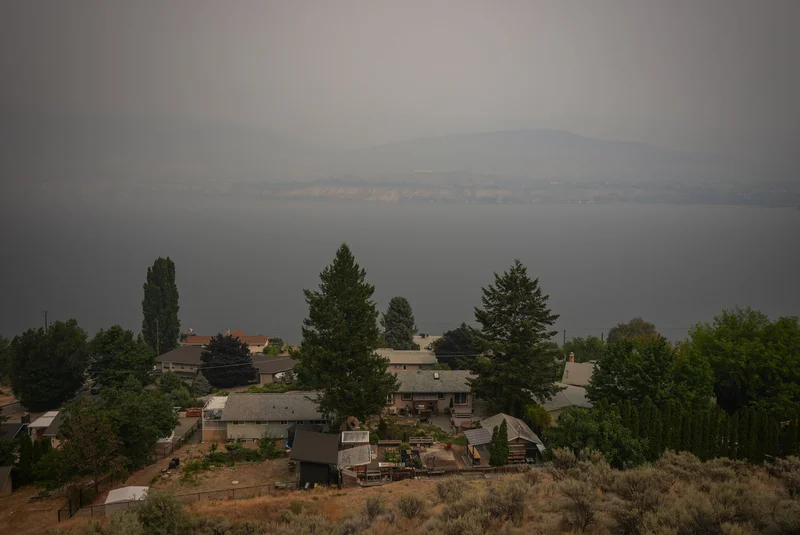
The provincial government has declared a state of emergency across British Columbia as a fast-moving wildfire rages near Summerland in the Okanagan.
More than 20,000 people were ordered to flee over the weekend, and evacuation alerts have been extended to the northern edge of Penticton, where many evacuees were sent.
The Bald Range wildfire was first reported at 4:29 p.m. Friday, but it grew in size, burning 50 square kilometres in a few hours. By Saturday afternoon, the fire had doubled, growing to 103 square kilometres.
Here’s what you need to know about the state of emergency.
Why did B.C. declare a state of emergency?
Premier David Eby said emergency management officials’ warnings that wildfire conditions were becoming volatile prompted the province to declare a state of emergency.
The Premier said the Bald Range wildfire was described to him in terms he hadn’t heard before, such as comparisons to a bomb going off where the fire raged, and reports of flames on a 100-foot tree rising 200 feet above that. He said the fire spread from its initial site to a thousand hectares in one hour at a press conference on Saturday.
The fire was moving so quickly that some residents got trapped while fleeing their homes and had to be rescued by helicopter, Mr. Eby said.
Experts advised the provincial government that they would need the state of emergency to help them fight the fire.
What does declaring a state of emergency let the government do?
When a natural disaster occurs, governments can opt to declare a state of emergency that enables them to use extraordinary powers that could otherwise be unlawful.
In the case of the Bald Range wildfire, the state of emergency allows officials to commandeer accommodations or enact localized travel restrictions if it becomes necessary, B.C. Minister of Emergency Management and Climate Readiness Kelly Greene said.
“We need to have [these powers] at our fingertips because the conditions are changing so quickly,” she said at a press conference.
On top of travel restrictions and creating emergency accommodations, provincial states of emergency also let governments prevent businesses from price gouging on essential items and rationed resources such as fuel, Mr. Eby said.
Will the federal government get involved?
The federal government will assist with the wildfires in B.C., Eleanor Olszewski, Minister of Emergency Management and Community Resilience, said on social media. She approved a request from the province asking for Ottawa’s help with providing shelter and accommodations for evacuees.
“The federal government is here to support British Columbia and everyone in the province impacted by this summer’s wildfires for as long as it takes,” she wrote.
With reports from Bianca Bharti, Andrea Woo, Temur Durrani, Ian Bailey, The Canadian Press and Reuters