'We need to be investing more into early childhood education', world's first Pacific ECE professor says
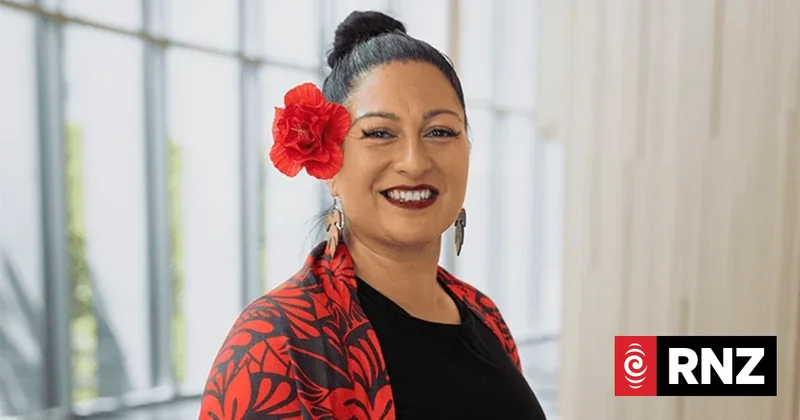
The world's first professor of Pacific early childhood education (ECE) says her desire is "to see Aotearoa New Zealand as the future Pacific hub for the whole region".
"We've got over 50 years of early childhood education legacy in New Zealand, and it started off in garages and church halls and in playgroups, just very grassroots," Fa'alogo Aganoa Jacoba Matapo, who is the inaugural Pro Vice Chancellor Pacific at Auckland University of Technology (AUT), said.
Pacific ECE has been built up over more than five decades of community efforts across Aotearoa, with Matapo pointing to pioneers such as Teupoko'ina Morgan and Jan Taouma.
"I wouldn't be here if it wasn't for the legacy of all of our pioneers who actually paved the way before me ... these are, majority are Pacific women," she said.
"They're our mātua, our elders, who saw the vision and value of sustaining language, culture, and identity, and the connections, back to ancestral lands and to villages, to sustain that … through their migration to New Zealand and retaining that as part of, a sort of an everyday practice that our Pacific children can access."
Matapo's own interest and dedication to early childhood education was a byproduct of her own upbringing.
"It started in my home from my own early years, the way in which my mother practised cultural healing methods within our home," Matapo said.
Her mahi (work) has spanned upwards of 20 years of dedication to the Pacific education space.
She grew up around infants and toddlers, and later pursued a teaching qualification in early childhood teaching, before gaining her Masters of Educational Leadership and a Doctorate of Education.
"I've really enjoyed this labour of love in Pacific early childhood education, especially as the first Pro Vice Chancellor Pacific at AUT, but also an alumni of AUT," she said.
"Being able to contribute in so many different ways to Pacific education, and specifically to Pacific early childhood education, from family ties and connection to culture and language, all the way through to my later years as a researcher … deeply tied to our Pacific communities and Pacific early childhood," Matapo added.
At the same time, she said the sector needs more attention and continuous investment to ensure Pacific languages and cultures continue to thrive - adding that, cultural grounding gives children the "strongest start to life."
Language as 'a point of access'
Matapo said New Zealand was in a unique position as "the first nation in the world to have a bicultural curriculum", laying the foundation to "build our Pacific early childhood education".
"I like to think of language learning not as subtractive, but as additive. If you are grounded in whichever your first language is, you are able to build on that foundation language as an additive language, and that gives you an advantage in later years to think differently in terms of building your abilities for inquiry, to understand the world differently, and to actually be open to other perspectives of meaning making in the world," Matapo explained.
"So, language is an access; it's a point of access to other worldviews and other knowledge systems."
Matapo added that the early years of a child's development are the most "fundamental building blocks for any academic success".
"For Pacific children, part of growing that confidence in who you are, that sense of wellbeing, as well as your belonging - not only in education, but to your community, to your society, to your nation, it is about understanding your positionality," she said.
"It's about the strengths of your uniqueness in your culture and the richness that that diversity brings into any learning context."
Matapo hopes the childhood sector does not stay an "afterthought" when it comes to policy, funding or direction.
"Again, I just want to say that the absolute foundation years cannot be underestimated.
"The power of early learning ... we need to be investing more into early childhood education, we need to be supporting our Pacific ECE and really leveraging the legacy before us."