“Radd karo, radd karo! JPSC pariksha radd karo!” (Cancel, cancel! Cancel the JPSC exam results!)
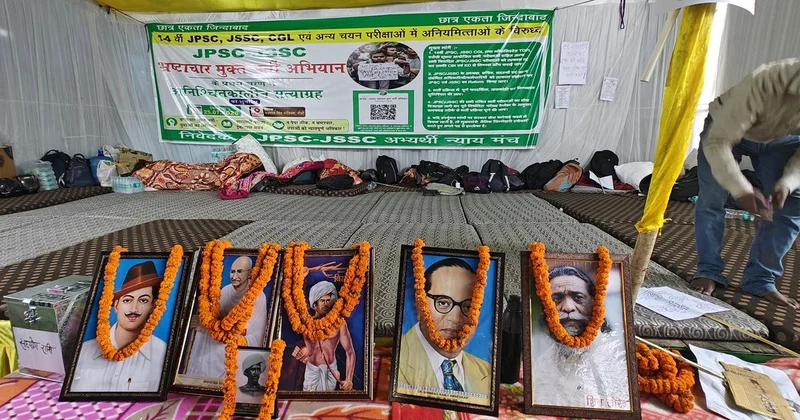
The cries of young protestors rang out at the Jaipal Singh Munda stadium in Ranchi on the evening of July 31. They had been at the site since July 29, protesting irregularities that had been found in the results of the fourteenth Combined Civil Services Examination, held by the Jharkhand Public Service Commission. The exam was to determine recruitment for several group A and B gazetted government service roles in the state, such as police superintendent and deputy collector.
The preliminary exam was held in April and the commission published its results on July 2. It shortlisted 2,204 candidates for the main examinations, which were to be held in July – they have now been postponed in light of the protests and an investigation ordered by the state government.
This was not the first protest against the exam – in early July, the Bharatiya Janata Party and the All Jharkhand Students Union Party, opposition parties in the state, had held multiple protests against the irregularities. But it was only towards the end of the month that a wider agitation gathered force, drawing aspirants from across the state without any specific ideological affiliation.
This protest began on July 25, at the Bapu Vatika garden, even as the protest against the NEET paper leak in Delhi was reaching the climactic point of the education minister’s resignation. From July 29, the Ranchi agitators began a sit-in protest at the stadium.
Gauri Kumari, a 25-year-old aspirant, stood at the protest ground with two friends, sloganeering to demand justice for the exam aspirants. “The system has gotten too corrupt,” she said. “I’ve been approached by book shopkeepers and paan shopkeepers, asking if I want their help to strike a deal and pay money to get a seat.”
In fact, Kumari had qualified for the main exam, but still wanted the paper to be cancelled. “The results have clearly been manipulated. I qualified but my friend did not,” she said. “I’m protesting because I think all the aspirants deserve a fair chance.”
On August 2, Devendra Nath Mahato, a student leader from the Jharkhand Loktantrik Krantikari Manch, announced an indefinite hunger strike to pressure the government to fulfill their demands. Several students also decided to joined Mahato on the hunger strike – as of August 9, the strike is still underway.
Chief Minister Hemant Soren told reporters in Ramgarh on August 5 that his government stood with the students, and would ensure that they get justice. The Jharkhand government also set up a four-member committee of cabinet ministers to speak to the protesting students and address their issues.
The committee held talks with student groups on August 9, in which it agreed to several of their demands, including the cancellation of the preliminary exam held in April. Three members of the Jharkhand Public Service Commission have also resigned.
But these moves have not cooled the protests down, which now include within their ambit the Jharkhand State Services Commission exams, which have also seen irregularities in the past.
The JPSC JSSC Reform Manch plans to march to the Vidhan Sabha on August 10. It is one of the two forums spearheading the protests. The other is the JSSC Abhyarthi Nyay Manch.
The irregularities
The young protestors in Jharkhand had pointed out several problems with the JPSC exam after the results were announced.
For one, they noted that the commission had not disclosed cut-off marks for passing the exam for different categories of candidates, such as those belonging to Scheduled Castes and Scheduled Tribes. They argued that this undermined the transparency of the selection process, because candidates had no way of assessing where they had ranked in the exam compared to their fellow aspirants.
Further, a picture of a filled-in optical mark recognition answer sheet, purportedly of a successful candidate, went viral – only 48 out of 100 questions in the paper had been attempted. Aspirants pointed out that the combined qualifying score for the two preliminary papers was around 145, which would be nearly impossible to obtain with less than 50 attempted answers in one.
Aspirants also pointed out that there appeared to be an anomaly in the published list of successful candidates. The list, which contains roll numbers of candidates in sequential order, showed names of candidates up to a certain number, but then jumped more than 800 roll numbers before listing the next successful candidate.
Another key concern pertained to the fact that the agency that had been selected to conduct the exam, TSR Data Processing, had been blacklisted in May 2025 for non-compliance with the agreement with JPSC.
In response to these concerns and the protests, the state government directed the Criminal Investigation Department to investigate the matter. Police conducted raids at the JPSC office and the chairman L Khiangte’s residence. On July 22, Khiangte resigned from his post. So far, 19 people have been arrested in connection with the case.
The protestors and their demands
Kumari had also sat for the exams in 2024, but did not clear them then. She said that government jobs remained one of the very few viable career options in the state. “There are no other decent employment options in Jharkhand,” she said. “If I don’t make it through the exams, my next option is to start practising goat husbandry.”
Indeed, Jharkhand remains one of the poorest states in India. Despite its abundant mineral wealth, its people face high levels of multidimensional poverty, distress-driven migration and a dire lack of formal employment.
“The large majority of people sitting for these exams are from working class families,” said Anil Agrawal, who runs a popular coaching academy for government exam aspirants in Ranchi. “Their parents earn money through agriculture or daily wage labour. They sacrifice a lot so that their children can study and make something of themselves.”
Rajesh Mundro, an aspirant from Hazaribagh, was one such individual. “My entire family is dependent on agriculture for our livelihood,” he said. “They have invested a lot in my education. I study very hard for these exams, thinking I’ll uplift my family economically. But every time, something or the other goes wrong in how they are conducted.”
He noted that at least 70% of his peers who had written the exam also came from similar backgrounds. “We don’t have enough to eat and live well,” he said. “These exams are our only ray of hope, which the government keeps breaking. We are losing our morale.”
At the stadium in Ranchi, protestors’ current demands are listed on a banner. There are five in all. They include that all controversial exams of the Jharkhand Public Service Commission and the Jharkhand State Service Commission that have been conducted by the blacklisted agency be cancelled, and that independent investigations into them be conducted by the Central Bureau of Investigation and the Enforcement Directorate. They also demand that all members of the current commission be removed from their posts, and that it be reconstituted.
Not an isolated incident
Protestors’ anger is particularly acute because inordinate delays and controversies have dogged the exam for years.
“Ever since the state of Jharkhand was formed in 2000, there is perhaps not a single JPSC exam which hasn’t been mired in some controversy or the other,” said Shambu Nath Choudhary, president of the Ranchi Press Club, who has been keenly observing the JPSC exams for decades. “From exam cancellations, result revisions, additional merit lists being added, errors in answer keys, controversy over implementation of reservations, to the very selection process being challenged in court.”
He added, “Irregularities with the exam has become the norm rather than an exception.”
Indeed, the first exam, held in 2003 and the second one, held in 2005, became mired in allegations of malpractice, including that relatives of commission members and political leaders were being favoured. Both exams were investigated by the Central Bureau of Investigation – the cases that were filed in connection with them remain pending before the courts even today.
The delays that these and other years’ exams have seen have meant that some people spend several years of their lives trying to clear them.
Fifty-year-old Seteng Barla, who is from Jamshedpur, appeared for the 2003 exam. Though she was trained as a lawyer, Barla was eager to qualify as a civil servant and serve her state. “The very first time, I gave the exam without preparation,” Barla said. “But I prepared really hard after that, and even took coaching classes.”
She went on to write the exam “four to five times”, she recounted, adding, “I would clear the preliminary exams, but never pass the mains.”
Barla is uncertain whether she genuinely failed the exams, or was eliminated because they were rigged. She will never know, and today, also regrets not having been able to focus on her legal career. “I could not become a civil servant, nor could I become a good lawyer,” she said. “My attention was always focused on the exams – there were so many cancellations and date changes. Who can focus on a job in such conditions?”
Others gave up even more steady careers in the private sector to write the exam. In the late 2000s, 39-year-old Ashima Lakra, who is from Ranchi, enrolled for an MBA outside Jharkhand, and afterwards, landed a well-paid job in an investment bank in Bengaluru. “I was happy at my workplace and saw a promising future ahead of me,” Lakra said. “But my mother reminded me it was my duty to return to Jharkhand and give back to my state. I also believed that I would be contributing my bit by working here, amidst our own people, and see Jharkhand develop.”
So, Lakra returned and began preparing for the JPSC exams.
The fifth exam, in 2013, was the first that she appeared for. She recounted that after the final exams were held, the commission announced that aspirants’ scores in the preliminary exams would count towards their final rankings. This was in violation of the commission’s own rules, she pointed out.
The results were also delayed. “It took three whole years for the results to be declared,” she said. “I remember giving the prelims in December 2013, and the final results were declared in early 2016.”
She added, “There is a common saying here in Jharkhand about the JPSC, that it’s a panch varshiya yojana”, a five-year plan.
Lakra did not clear the fifth exam. The sixth preliminary JPSC exams were held in October 2016. “I remember close to 35,000 students had qualified for the mains, even though the vacancies were only a little over 300,” she said. “They held protests back then too.” She did not clear that exam either.
After this, for several years, the exams were not held at all. In 2021, a combined exam was held for the seventh, eighth, ninth and tenth exams – candidates were competing for only 252 vacancies.
That exam, too, was marked by problems. Lakra recalled that aspirants who had opted for the Nagpuri language paper alleged that they had been marked very stringently, and thus struggled to qualify, while candidates who had opted for other regional languages, like Khortha, had qualified in larger numbers. Protestors had also raised concerns about errors in answer keys, and about all candidates from particular exam centres qualifying en masse.
In 2024, the eleventh, twelfth and thirteenth JPSC exams were held together. The answer sheets were marked digitally, and students were not given the option of checking their marked answer sheets. “We aspirants usually file RTIs to see their marked answer sheets and understand where we went wrong, but they are unavailable for those exams,” Lakra said. “This raises concerns about transparency.”
That year, aspirants also raised concerns about the qualifications of those who marked the papers. According to JPSC rules, evaluations must be conducted by teachers with at least ten years of experience at the undergraduate level, or five years of postgraduate teaching experience – but aspirants noted that the markers included contractual teachers who did not fulfil these criteria.
They saw this was a sign of official apathy towards their anxieties. “Many of us have been studying these subjects for more than a decade,” Lakra said. “We have more experience than those teachers with a few years of teaching experience.”
We welcome your comments at letters@scroll.in.