igeria’s 2026 Appropriation Act is decidedly a can of worms. This chilling reality seized national consciousness with the discovery in July of ₦1.3 billion allocated to a fake agency – the Presidential Foreign Intervention Promotion Council. A media report that ₦780 million was expended on musical equipment for churches in the Bende Federal Constituency of Abia State from the same budget – with this unabashedly rationalised as originating from the 2025 budget – dropped more jaws.
A civic tech platform, Tracka, which scrutinised the budget, revealed details that exacerbated the public’s fury. There is the ₦962.83 billion set aside for the procurement of Sports Utility Vehicles (SUVs) and empowerment projects that are not national priorities. A total of 78 ministries, departments and agencies (MDAs) of government are being used to perpetuate this rip-off. So far in this Fourth Republic, no national budget has been as huge in frivolities and lacking in transparency as this year’s document.
According to Tracka, “…only 70 per cent of 2,579 empowerment projects have clearly identified implementation locations.” This means that the remaining 30 per cent deal with phantom or ghost projects. Besides, many projects subsumed under the allocations of MDAs are outside their core mandates. This deception thus makes it easier for the funds to be siphoned.
The use of the National Mathematical Centre, Abuja, to purportedly construct a Sociology Department building at Ahmadu Bello University, Zaria, is striking. Deployed for this budgetary abuse too is the National Building and Roads Research Institute, Lagos. It is supposedly to build the palaces of traditional rulers at Sarkin Wuse, Osokodoko and Osana in Rivers State, and also refurbish the palace of the Agbana of Isanlu in Kogi State. It is equally contrived to build an international market in Birniwa, Jigawa, and a village hall in Akokwa, Anambra State. More so, five mosques are also to be remodelled by the agency, with locations in Ikole, Ekiti State; Izalla and Zawiya Centre, in Kebbi State; in addition to Mangadu and Samani in Jigawa State.
| | |
|---|
Given the items in the Exclusive Legislative List of the 1999 Constitution, as amended, the building of churches, mosques, abattoirs, markets, town halls, and palaces for traditional rulers with federal allocations is a serious constitutional violation. Furthermore, ₦15.13 billion is to be splurged on 39 SUVs, and with the 2027 elections being around the corner, it cannot be ruled out that these exotic cars are essentially for political patronage.
The budget is a critical tool for economic development that should encapsulate national priorities. Hence, opaque provisions are robbing the current budget of this essence, amid a mélange of dilapidated healthcare, education, transportation, and other public infrastructure. The total budget this year is ₦68.32 trillion, which has a 46 per cent deficit, to be financed through borrowing.
How the Budget Office dropped the ball in the insertion of ₦1.3 billion for a fake agency, and this was overlooked by the parliament, smacks of complicity. This is so because, as a rule, each expenditure line item – more so when in billions of naira – is defended by the MDA responsible for it at the relevant Appropriation sub-committee, before it is approved.
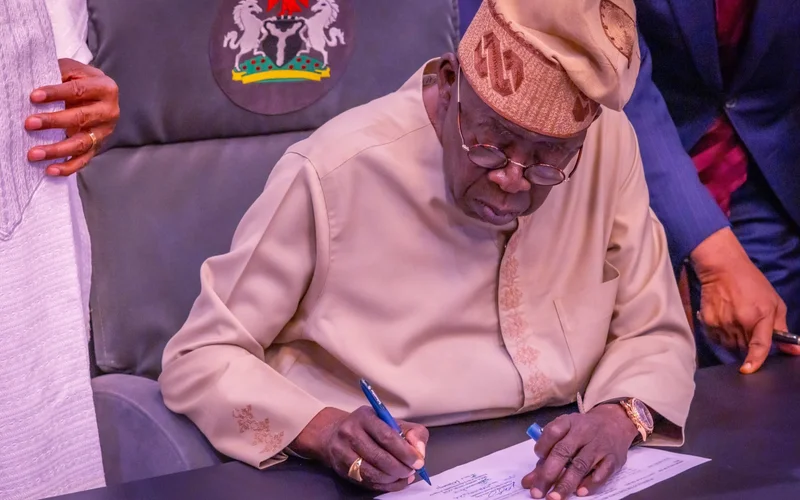
Even more concerning is the failure of President Tinubu to vet the appropriation document after it was submitted, before signing it into law. This gate-keeping process is usually done through the office of the minister of finance and the budget office. Besides, ministers do the same to see if what was passed aligns with their ministries’ fiscal expectations. Mr Tinubu is the only president, since 1999, yet to see any sleaze brought to bear on the budget annually by the National Assembly, in his three years in office.
Through vetting, Presidents Olusegun Obasanjo, Umaru Yar’Adua, Goodluck Jonathan and Muhammadu Buhari were able to discover numerous mutilations, which resulted in the withholding of their accents. In Mr Obasanjo’s case, a ₦2 billion padding of the budget in 2000 convinced him not to sign it. In 2011, on account of a ₦40 billion insertion for the jumbo allowances of lawmakers, Mr Jonathan withheld his assent from the document.
With hindsight, former ministers in charge of Health; Works, Power and Housing respectively, under the Buhari Presidency in 2016 and 2017, Isaac Adewole and Babatunde Fashola, openly rejected the allocations to their ministries. Mr Fashola disowned a strange ₦2 billion insertion in his ministry’s budget, under the expenditure line of a regional housing scheme. He protested, claiming, “That is not what we submitted. We did not submit that proposal.” On his part, Mr Adewole withdrew his ministry’s budget, following the diversion of ₦15.7 billion for capital projects to areas for which no final decisions had been taken.
This point should be made clear: the 2579 projects captured in the ₦962.83 billion expenditure lacked designs and genuine cost value before their insertion; and there wouldn’t be tenders and other bidding processes for the few that may be executed, which are all in breach of the public procurement law. These explain why 2,399 of the so-called constituency projects were abandoned halfway in 2013 alone, according to the Minister for Special Duties, Tanimu Turaki. Hence, billions of naira were siphoned!
When lawmakers constitute themselves as predators of the public treasury, exemplified in this sort of shambolic budgeting, Nigerians should loudly protest. The silence of the Executive on this rogue banquet makes the matter worse. We hold the President, the National Assembly and the Budget Office responsible for this bizarre budgeting.
From all accounts, it raises a serious moral question for the Federal Government to claim to be fighting corruption, while it looks the other way as the budget is turned into a graft bazaar. For goodness’ sake, the legislators are some of the highest paid in the world with taxpayers’ money, and they are vested with the constitutional powers to protect the treasury.
As such, public funds should not be frittered away in the way the 2026 budget is structured. We believe that the “zero budgeting” system, which deals with the MDAs on a needs basis, rather than the “envelope system,” will help in curbing this craze of annual budget racketeering.
To assuage the public angst over this, PREMIUM TIMES demands a critical review of this budget to excise its glaring dubious provisions. Otherwise, it would remain an indelible pointer to insensitive and profligate governance, robbing citizens of their taxes, and deepening the perverse culture of public treasury looting.