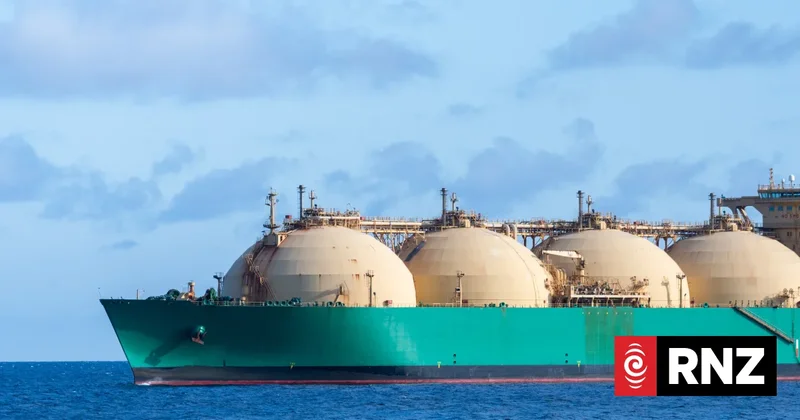
Consumer and climate groups have asked the Auditor-General to launch an inquiry into the government's plans to build an LNG import terminal.
The signatories - including Consumer NZ, Lawyers for Climate Action and the Sustainable Business Network - say the process is being "rushed towards an artificial deadline" and there are clear questions about whether it is worth the money.
Three Taranaki advocacy groups have also signed the letter, which said there had been a lack of consultation with the local community despite environmental and safety concerns.
The government confirmed in June it was proceeding with plans for a facility in Taranaki, saying importing liquefied natural gas was the best option to see off a "dry year" risk while more renewable energy was developed.
Modelling commissioned by the Ministry for Business, Innovation and Employment (MBIE) concluded there was "low need" for the facility.
Auditor-General Grant Taylor has previously turned down a request from the Labour Party for an inquiry into the procurement process, but said his office would monitor the process carefully.
The latest letter said it was now necessary for the office to begin an inquiry.
Led by Lawyers for Climate Action, its other signatories were: World Wildlife Fund New Zealand, the Sustainable Energy Association, the Green Building Council, Consumer New Zealand, Rewiring Aotearoa, the Bioenergy Association, Taranaki Energy Watch, Community Energy Taranaki, Climate Justice Taranaki, and the Sustainable Business Network, which has 400 member organisations.
The urgency of the the decision-making and procurement process was not warranted, value for money had not been demonstrated and the local community had not been adequately consulted of informed, the signatories said.
By the government's own assessment, the project could cost up to $2.7 billion.
Despite that, "lower cost alternatives have not been fully considered [and] it is unclear if the LNG import facility will actually reduce electricity prices", they wrote.
"A number of alternatives were identified and immediately dismissed, or only subject to perfunctory consideration."
The Infrastructure Commission raised similar concerns in advice to MBIE late last year, warning the ministry to take the time to develop "the right solution, not the most expedient one".
The government has said it plans to sign contracts for the facility before the election in November, in time for it to be operating by winter 2028.
It aims to fill what it says is a 1.5 terawatt gap in power generation if hydro lake levels are low, with solar and wind power not reliably "on" all the time.
Energy Minister Simeon Brown told RNZ earlier this year that "with rapidly declining natural gas, we need an alternative back up and we need it quickly".
"No other option" could be stood up as quickly, he said.
The letter to the Auditor-General said the risk the government was trying to address not longer existed to the same extent as it had in 2024.
Concept Consulting, which carried out the original modelling for MBIE, had published another independent report since then, the letter said.
"[That] finds that, even in a stretched scenario (with low gas production, high demand and no new gas storage) there is no shortfall that would require LNG before 2030."
That left plenty of time for the government to run a more comprehensive process.
"There is no need to procure and contract for an LNG import facility prior to these steps being taken."
That should include "proper consultation with the local community", which had so far been lacking, the letter said.
Several community meetings have been held in New Plymouth this year about the proposed facility, with residents raising concerns over how close it will be to residential areas.
A similar terminal in Port Kembla, New South Wales - which MBIE said it was talking regularly with - was located two kilometres away from residential areas for safety.
Community groups said thousands of people lived and went to school within a 2km radius of the proposed location at the main breakwater at Port Taranaki.
The request for an inquiry said very little information had been published about the safety of the proposed terminal, with an initial safety assessment withheld for reasons of commercial sensitivity.
A factsheet on MBIE's website said LNG was safe, with many terminals operating in urban areas overseas. The terminal would be subject to "rigourous" health and safety standards.
Cabinet papers have suggested that, in order to complete the facility quickly, the process for approving the facility could bypass even the government's own fast-track legislation.
Special legislation could help to expedite consents, and lock in plans ahead of a potential change of government after the election, one paper said.
Once the Auditor-General's office receives a request for an inquiry, it typically makes a decision on whether to proceed within four weeks.