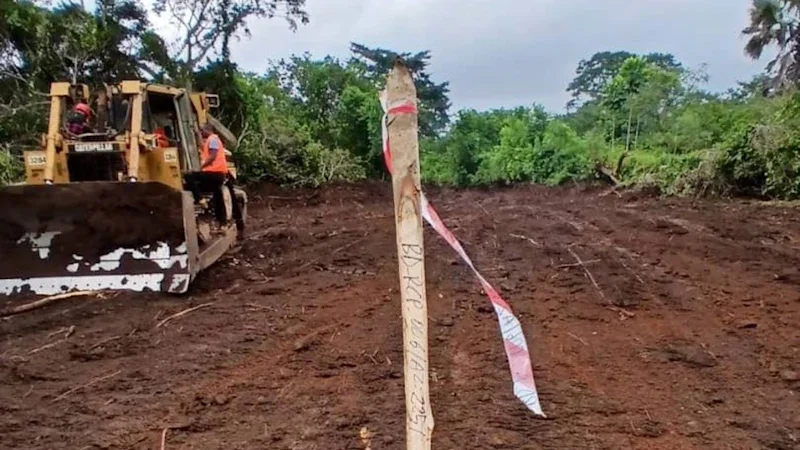
Dalaroo Metals has cleared the final hurdles in its preparation to kick-start a major maiden drilling campaign at its Bondoukou Gold Ridge project in Côte d’Ivoire, with all drill pads and access routes now complete.
Following a recent 2.5 million capital raise, the company has expanded the planned reverse circulation, or “RC”, drilling program to 12,000 metres from 10,000m, allowing for a more systematic test of three priority gold targets dubbed Mag, Wilfred and Ali. The three targets are evenly arrayed along a more than 5.25 kilometre stretch of a 7km-long northwest-southeast anomalous gold trend.
The move comes as the West African nation continues to attract exploration capital, with investors favouring the region’s near-surface, structural gold systems in underexplored belts. Côte d’Ivoire has cemented its reputation as one of Africa’s most active gold jurisdictions, with a pipeline of discoveries ensuring new drill programs remain on the market’s radar.
The numbers are hard to ignore. According to S&P Global Market Intelligence’s World Exploration Trends’ 2026 report, Côte d’Ivoire attracted $186 million in mineral exploration investment in 2025, the single largest increase anywhere on the African continent. That figure is up from $102 million in 2024, an 82 per cent hike in a single year.
‘The success of our recent capital raising has allowed us to expand Phase 1 from 10,000 metres to 12,000 metres.’Dalaroo Metals chief executive officer John Morgan
Dalaroo’s campaign is designed as a phased, geology-led strategy to unlock the potential of the Bondoukou project in the demonstrably prospective Birimian Greenstone Belt which extends across five West African nations. The company’s exploration work to date has included soil sampling which uncovered a compelling result of 23.26 grams per tonne (g/t) gold along the 7-kilometre-long gold corridor.
The 12,000m Phase 1 program, poised to swing into action within a week, will be the opening stage of a more extensive 20,000m drilling strategy, with initial work to consist of 24 orientation holes for 4200m, averaging 175m deep.
The company will use a “scissor-drilling” approach which uses opposing angles to cross-examine the target zone from two directions. This strategy mitigates the risk of drilling parallel to the geology, which can distort results. By cutting across the structure from both sides, Dalaroo can more accurately determine the true width, orientation, and continuity of the mineralisation, delivering a markedly more reliable geological model.
Dalaroo Metals chief executive officer John Morgan said: “Completion of the initial drill pads and access routes is a significant milestone for Dalaroo, positioning the Company to commence its maiden drilling campaign at Gold Ridge. This will be the first time the extensive surface gold anomalies at Mag, Wilfred and Ali are directly tested at depth, representing an important step in determining the discovery potential of the broader Gold Ridge corridor.”
Based on geological observations from the initial holes, Dalaroo plans to launch into a 78-hole follow-up fence drilling program for a further 7800m. In total, the phase one campaign is expected to comprise 102 holes across eleven drill fences. The program is designed to be flexible, allowing holes to be relocated, extended or reoriented as the geological picture becomes clearer.
Drilling is slated to begin no later than August 15, with initial assay results expected roughly four to six weeks after the first samples are delivered to the Intertek laboratory. The company plans to deliver samples progressively, on a weekly basis, to ensure a consistent flow of results.
The campaign will be the first time the extensive surface gold anomalies at the company’s Mag, Wilfred and Ali targets are tested at depth. Dalaroo is aiming to establish the orientation and geometry of the mineralisation before designing subsequent phases of drilling.
The program will integrate data from previous soil and auger geochemistry, geological mapping, magnetic interpretation and the distribution of artisanal workings. Geological logging, structural observations and assay results from the RC drilling will be fed into an evolving 3D geological model to guide future work.
With the program fully funded and the drill rigs about to mobilise, Dalaroo appears to be on the cusp of a defining period of exploration. As the rods start to turn in one of West Africa’s premier gold belts, all eyes will be on the assay results to see if the high-grade surface anomalies translate into a significant discovery at depth.
Is your ASX-listed company doing something interesting? Contact: mattbirney@bullsnbears.com.au