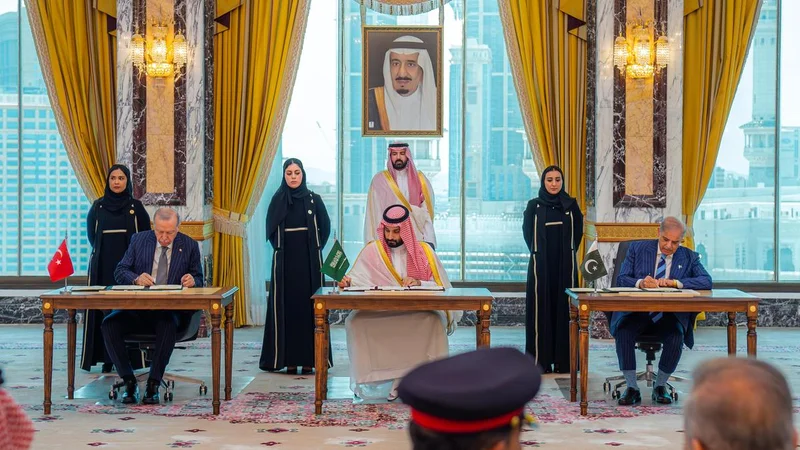
The Makkah Joint Defence Agreement (MJDA), signed on August 7, 2026, by the top leaders of Saudi Arabia, Türkiye and Pakistan, is the first regional realignment since the geostrategic tsunami of the United States-Iran war. While the MJDA text has not been revealed, the joint statement issued specifically states that “any armed attack against any one of the three states shall be regarded as an attack against them all”.
This echoes infamous Article 5 of the North Atlantic Treaty Organization (NATO) — never invoked — leading speculators to claim that the MJDA was a harbinger of a “Muslim NATO”. It appears to be part of a jerky Saudi response to specific security challenges, including a Strategic Mutual Defence Agreement (SMDA) with Pakistan last year and a 14-country Multinational Maritime Defence Alliance (MMDA) in the last week of July.
Shifting alignments, uncertain stakes
Any analysis of the MJDA faces multiple uncertainties, including ongoing regional turbulence, partners’ previous karma, and their varied expectations. This hazy context creates a push-pull effect: from anticipation of the MJDA having profound cascading implications to it being a seemingly desultory, inconsequential response to their asymmetric defence and security challenges. Some also see it as inducing counter-polarisation and alarming other stakeholders from Iran and its non-state allies, Israel, Kurds, and Greece to the United Arab Emirates and India. To walk back, the Saudi Deputy Foreign Minister has clarified that it is neither an effort to establish a military axis nor a sectarian bloc. He denied any link to nuclear ambitions or an arms race.
This denial is unlikely to pierce the statement’s conspicuous silence about the precise threats that the MJDA is geared to confront, the U.S.-Iran war roiling the region, Israeli aggressiveness, threats from the non-state actors, and the impact of choke point constrictions. It also refrains from either inviting like-minded regional powers to join in or an uplink with the existing collective security architectures provided by the Arab League, the Organisation of Islamic Cooperation and the Gulf Cooperation Council (GCC).
Observers point out that the Arab-Muslim world has remained divided against Israel for close to eight decades. Hence, the prospect of the MJDA being a precursor to a Muslim NATO polarised against Iran and its Arab proxies appears far-fetched at this stage. Moreover, even as all three MJDA signatories are allies of the U.S. (which remains suspiciously silent), it is unclear if it is meant to substitute the regional Pax Americana or to serve as a surrogate for the ancien régime. In the same vein, if the proposed Muslim NATO in future decides to confront Israel, the U.S. would have scored its own goal.
Moreover, the MJDA is beset by various snags. The Saudis have bitter memories of the Ottoman rule, which brutally suppressed the Al-Saud. For similar reasons, from Türkiye, Ankara’s boots on the ground have been shunned by most post-independence Arab regimes.
Till recently, Türkiye promoted the Sunni outfits such as the Muslim Brotherhood, Hamas and motley Syrian militias, many of which are anathema to the Gulf regimes. Türkiye’s President Recep Tayyip Erdoğan’s Neo-Ottoman ambitions to lead the Sunni Islamic world collide with the Kingdom’s self-image of being the Custodian of Islam’s Two Holiest Shrines. Riyadh does not continence playing second fiddle to Turkey or any other Muslim power. President Erdoğan had a testy relationship with Saudi Crown Prince Mohammed bin Salman (MbS) over the 2018 murder of Jamal Khashoggi, a U.S.-based Saudi journalist, in the Saudi consulate in Istanbul. Turkish leaks on this episode sullied MbS’s image, making him a western outlier.
On the other hand, Pakistani troop deployments in Saudi Arabia in the past resulted in frictions due to chain of command disputes, Islamabad’s refusal to have its troops shorn of Shias and its reluctance to confront Iran or Yemen. Armed forces in Türkiye and Pakistan have a long-standing tradition of Bonapartism. Saudis have kept armed forces and the National Guard, both with an American-styled set up, out of politics since the Ikhwan militia insurrection (the late 1920s) and the Makkah siege of 1979. Both Türkiye and Pakistan have an active border with Iran — offering a potentially lucrative post-war economic bonanza that they would be loath to forego. Pakistan’s enthusiasm for the MJDA is circumscribed by its 900 kilometre-long border with Iran, a large Shia minority, internal security challenges and hostility with India and Afghanistan. In a typical doublespeak, last week, Pakistan began formal discussions on a Free Trade Agreement with Iran, notwithstanding the U.S. sanctions, the MJDA and the SMDA.
Riyadh’s security needs
The MJDA is clearly fulcrumed around Saudi security requirements, which Riyadh expects Türkiye and Pakistan to mitigate as part of a “friends with benefits” arrangement. However, the current threats faced by Saudi Arabia are complex and asymmetric, ranging from air attacks on its vital and vulnerable oil and civil infrastructure by Iran and its proxies, the closures of the Strait of Hormuz and Bab al-Mandeb and the possible insurrection by the restive Shia minority. It is unclear if Türkiye and Pakistan can meet such challenges, where the U.S. Central Command, with its large, long-standing presence and state-of-the-art equipment, failed. The new allies could perhaps upstage the U.S. in having more boots on the ground in Saudi Arabia, but the Kingdom is unlikely to face a ground invasion. Moreover, relying on foreign forces to address internal security challenges would be bad optics for the Kingdom. The foregoing is not to deride the MJDA as merely a cosmetic exercise. It symbolises the congruence of the three large Sunni powers with considerable complementarity: the Saudi $83 billion defence budget, Türkiye’s booming military industrial complex exporting $10 billion annually and Pakistan’s 6,60,000-strong armed forces. Their defence and security cross-pollination through military exercises, interoperability of weapon systems and co-production and development of hardware would be beneficial to them all. Additionally, Türkiye and Pakistan could gain political influence in the Kingdom and enrich themselves.
At this stage, the MJDA’s future appears uncertain. It may flourish if a low-burn attrition war continues to ripple through the region. Ironically, if an all-out shooting war breaks out, Türkiye and Pakistan may be hesitant to commit forces against Iran, their neighbour. At the other end, if peace prevails, the MJDA would become superfluous. A market share scrimmage among the oil exporters would create a glut, affecting the Saudi capacity to bankroll the MJDA partners.
Having suffered Iranian doggedness and Trumpian tantrums, Saudi Arabia and other Gulf Arabs are currently experimenting with various security alternatives. The Saudis began the SMDA with Pakistan last year and have felt the need for an MMDA and MJDA. They do not appear to be playing a zero-sum game between semi-reliable Pakistan and India. U.S. President Donald Trump’s unreliability was on full display to the Saudis recently in his last-minute Abraham Accords rider to the recent nuclear agreement with the Kingdom. The Saudis may not wish to further complicate their dependence on Uncle Sam by deepening their entanglement with Ankara and Islamabad, both ultimately subject to Washington’s dictates.
The implications for India
Depending on various scenarios panning out, the MJDA can impact India’s interests in multiple ways. While India needs to keep a steely eye on Pakistan’s attempt to align the MJDA partners with it against India, New Delhi should not overreact. As the world’s third-largest crude oil importer, India is slated to drive global demand for the next 15 years. India has been the Kingdom’s third-largest market and second largest trading partner. Like Saudi Arabia, India has been both a consistent and moderate pro-status quo power amenable to simpler paradigms of economic complementarity.
Riyadh finds ties with India uncluttered by extraneous considerations. India is a geo-strategically safe bet for the turbulent Gulf. Riyadh, facing a huge paradigm shift, is most unlikely to wade into supporting Pakistan’s adventurism against India. So, while the MJDA may give Islamabad an adrenaline high, Pakistan’s quest to match India’s rise through military fluster in West Asia is unlikely to succeed.
Mahesh Sachdev is a retired Indian Ambassador, specialising in the Arab world and oil issues
Published - August 10, 2026 12:08 am IST