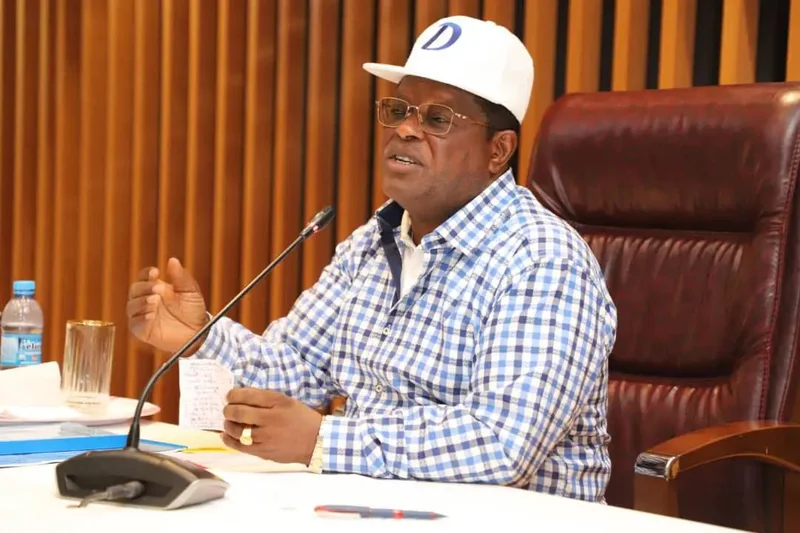
Minister of Works, Senator Dave Umahi, has appealed to Lagos State governor, Babajide Sanwo-Olu to support the Federal Government in funding the construction of service lanes and drainage infrastructure along the Lagos-Calabar Coastal Highway.
Umahi made the appeal on Sunday during a stakeholder engagement on the coastal highway and other federal infrastructure projects in Lagos.
Addressing the governor, the minister said additional funding from the state would be necessary to deliver the service lanes and drainage channels required to complement the main highway.
“You have to bring money, Governor, to do the service lanes, and also to do the drainage channels. We must join hands to solve this problem for the sake of our people,” Umahi said.
He commended the Lagos State Government for its cooperation and support for federal infrastructure projects across the state, describing the partnership as important to the successful delivery of major projects.
Umahi also announced that construction of the service lane for the coastal highway would commence soon.
According to him, plans for service lanes and secondary drainage channels along Sections 1 and 2 of the project were accelerated following the heavy rainfall and flooding recently experienced in parts of Lagos.
Providing an update on the progress of the coastal highway, the minister said Lot 1 had been completed, while work on Lot 2 had reached more than 80 per cent completion.
“We have done over 30 per cent of the job in Calabar and Akwa Ibom. We have started the largest section, 180km by two,” he said.
Umahi expressed confidence that the project would be delivered within the projected timeframe and urged residents, stakeholders and Nigerians who stand to benefit from the highway to continue supporting the initiative.
“We want everybody on this corridor, the entire Nigerians that are benefitting and will benefit from this coastal highway construction to continue to pray for and support the President,” he said.
The minister, however, expressed concern over the vandalism of federal infrastructure and other national assets, describing the practice as unacceptable.
He argued that those involved in damaging public infrastructure could instead channel their efforts into productive activities and earn legitimate income.
“It is very disheartening. The effort they are putting to destroy national assets, if they put it in labour in all construction sites of state governments and the Federal Government, they will make more money,” Umahi said.
He called for greater collaboration among government authorities, residents and other stakeholders to protect public infrastructure, warning that the destruction of newly constructed roads and facilities could undermine years of investment.
“It is devilish, wickedness and unacceptable; so, we have to come together to protect our national assets,” he said.
Umahi added that properly constructed roads could serve the country for decades, but warned that vandalism and deliberate destruction could return communities to the challenges the projects were designed to address.
“When these roads are built under the President, it will last for a hundred years but when the roads are excavated and removed, we will be back to square one,” he said.