The US cybersecurity agency CISA has urged federal agencies to immediately patch a critical-severity vulnerability in Progress Kemp LoadMaster that has been exploited in the wild.
Tracked as CVE-2026-8037 (CVSS score of 9.6), the flaw is described as an OS command injection that could be exploited without authentication for remote code execution (RCE).
According to Progress’ advisory, a remote attacker could exploit the bug through unsanitized API inputs to execute arbitrary commands on the LoadMaster appliance.
Disclosed on June 4 alongside CVE-2026-33691, the security defect also affects ECS Connection Manager, Connection Manager for ObjectScale, and MOVEit WAF.
“The specific flaw exists within the handling of the apiuser parameter provided to the accessv2 endpoint. The issue results from the lack of proper initialization of memory prior to accessing it. An attacker can leverage this vulnerability to execute code in the context of root,” a ZDI advisory reads.
In-the-wild exploitation likely started on June 29, when attack surface management company watchTowr published technical information and proof-of-concept (PoC) code.
The issue exists because the escape_quotes() function in LoadMaster GA version 7.2.63.1 and older and LoadMaster LTSF version 7.2.54.17 and older did not handle user-supplied input properly.
According to watchTowr’s analysis, the function allocates an uninitialized heap buffer with malloc(), but did not write a null terminator after escaped output, leading to out-of-bounds reads from neighboring freed memory.
The company discovered that an unauthenticated attacker could spray command injection content into the adjacent memory targeted by the out-of-bounds read, which would lead to command execution via the system() function.
On June 30, cybersecurity firm eSentire warned that hackers started exploiting CVE-2026-8037 immediately after the technical analysis was published. However, the initial exploitation attempts were not successful, the company said.
“Because LoadMaster appliances are frequently positioned at the network edge and often have visibility into critical internal services, compromise of the device could facilitate initial access and further malicious activity within the environment,” eSentire warned.
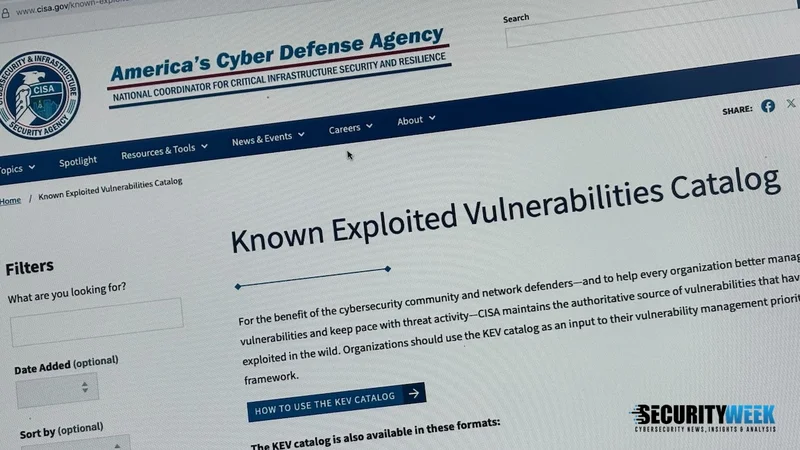
On Friday, CISA added the CVE to its Known Exploited Vulnerabilities (KEV) catalog, giving federal agencies only three days to patch it.
Related: Critical Flaws Discovered in Belgian eID Software Used by 2 Million People
Related: Critical One-Click Vulnerability in Atlassian’s Rovo AI Exposed Enterprise Data
Related: Microsoft, Apple Release Fresh Security Updates
Related: Critical Vulnerabilities Patched With Chrome 151 Update