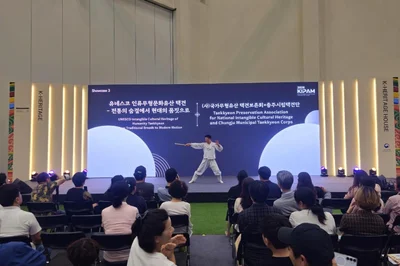
A member of the Taekkyeon Preservation Association demonstrates the traditional Korean martial art at BEXCO in Busan, Monday. Courtesy of National Intagible Heritage Center
Through ongoing daily performances, the 48th World Heritage Committee meeting is proving a valuable forum for showcasing Korea's intangible cultural heritage at Busan's BEXCO.
The National Intangible Heritage Center's (NIHC) new production, "Hexagram 22" — inspired by the 22nd hexagram of the I Ching — is the key event, with performances already sold out.
Visitors and committee participants at the meeting have the opportunity to experience a wide range of traditional performing arts through the Korea Intangible Cultural Heritage Performing Arts Market Showcase.
The showcase runs at 1 p.m. every day except Wednesday at the Korea Stage in Exhibition Center 1. With the last events scheduled next Monday, each day features two to four performances by practitioners and preservation organizations for Korea's intangible cultural heritage.
A performance of the "Yowangmaji" ritual / Courtesy of National Intangible Heritage Center
July 23
The showcase opens Thursday with "Yowangmaji," presented by the Jeju Chilmeoridang Yeongdeunggut Preservation Association for National Intangible Cultural Heritage. The ritual from Jeju was performed to pray to the sea gods for protection and an abundant catch.
It will be followed by traditional music group Pan performing a percussion piece titled "IMPRESSION"; the Namhaean Byeolsingut Preservation Association for National Intangible Cultural Heritage performing "Namhaean Byeolsingut: Ollim Chum \& Subu Sinawi," a shamanic ritual praying to village gods and spirits for peace; and the Suyeong Yaryu Preservation Association for National Intangible Cultural Heritage presenting "Suyeong Yaryu," a traditional mask dance drama that originated in Suyeong in Busan.
July 24
Friday's program will feature "Seonsori Santaryeong," a performance of traditional mountain folk songs by the Seonsori Santaryeong Preservation Association for National Intangible Cultural Heritage; "Miryang Baekjung Nori," a set of traditional summer festival activities from Miryang, South Gyeongsang Province, by the Miryang Baekjung Nori Preservation Association for National Intangible Cultural Heritage; "Halmi and Yeonggam Gwajang," a mask dance drama about an old man and woman presented by the Dongnae Yaryu Preservation Association for National Intangible Cultural Heritage; and "Birth: My Innermost Rite," a contemporary dance performance portraying a woman's longing for a child by BLUECHANT, a troupe of shamans and musicians.
"Eunyul Talchum" / Courtesy of National Intangible Heritage Center
July 25
The program will begin on Saturday with "Eunyul Talchum," presented by the Eunyul Talchum Preservation Association for National Intangible Cultural Heritage. The mask dance originated in Hwanghae Province in what is now North Korea.
Next will be "Cheoyongmu," a court dance dating to the Silla era that symbolizes the cyclical nature of life. Presented by the Cheoyongmu Preservation Association for National Intangible Cultural Heritage, it is inscribed on UNESCO's list of Intangible Cultural Heritage.
The day's lineup also includes "Classical Music of Joseon Scholars," to introduce audiences to the music enjoyed by the aristocracy of the Joseon era, presented by the string ensemble Iri Hyangje Julpungnyu Preservation Association for National Intangible Cultural Heritage. The last performance will be "Donghae VIbE," inspired by East Coast shamanic rituals, by the Donghaean Byeolsingut Preservation Association for National Intangible Cultural Heritage.
July 26
The program for Sunday will open with "Korea, Where Folk Songs Live," featuring regional folk songs performed by singer Nam Kyeong-woo.
The lineup continues with "Goseong Ogwangdae," a traditional mask dance drama from Gangwon Province presented by the Goseong Ogwangdae Preservation Association for National Intangible Cultural Heritage, and "Gudeuk Mangkkae Sori," communal work songs to ease the hardship of labor, presented by the Gudeuk Mangkkae Sori Preservation Association. The tradition has been designated Busan Intangible Cultural Heritage since 2001.
"Jindo Dasiraegi: Sublimating the Sorrow of Death into Humor" / Courtesy of National Intangible Heritage Center
July 27
The final day begins with "Jindo Dasiraegi: Sublimating the Sorrow of Death into Humor," presented by the Jindo Dasiraegi Preservation Association for National Intangible Cultural Heritage. "Dasiraegi" is a folk play from Jindo that traditionally comforted bereaved families on the eve of a funeral procession.
Monday's program continues with the Jinju Geommu Preservation Association for National Intangible Cultural Heritage presenting the "Jinju Sword Dance," which was designated National Intangible Cultural Heritage in 1967, followed by "The Song of Rijin," a performance of traditional music by the vocal ensemble Rijinga.