MOSCOW, August 10. /TASS/. The EU seeks to extend the conflict in Ukraine; NATO readies for offensive operations in the Arctic; and Turkey, Saudi Arabia and Pakistan form a NATO-like defense alliance. These stories topped Monday’s newspaper headlines across Russia.
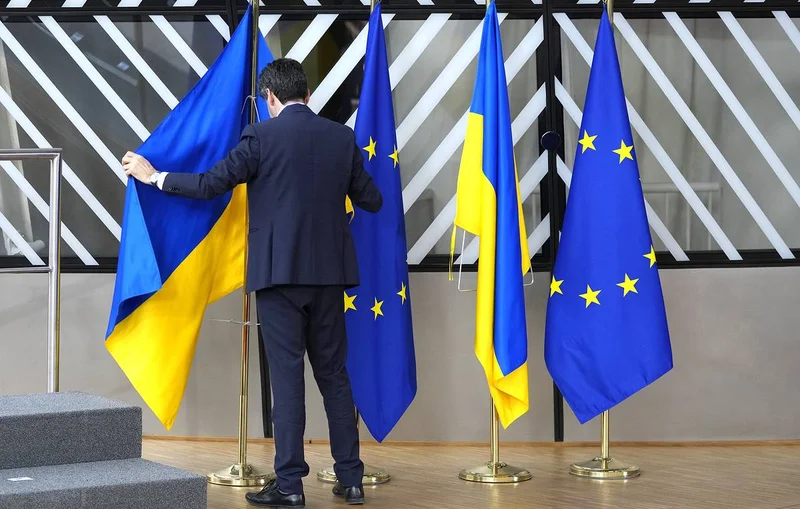
The European Union seeks to prolong the conflict in Ukraine by restricting temporary protection for newly arriving Ukrainian refugees while continuing to supply military support to Kiev, Russian Deputy Foreign Minister Mikhail Galuzin told Izvestia. Meanwhile, the United States persists in attempts to restart negotiations between Moscow and Kiev.
"The Europeans are bent on militarization, and their thinking is clear: they believe that Ukrainians returning home will prolong the conflict and, for a while, heighten the damage inflicted on Russia. In addition, European elites, who are facing significant drops in public support, are trying to persuade their voters that the expansion of the Ukrainian armed forces through returning refugees is one of their own achievements," Galuzin noted.
The European Union is seeking "to gain time to boost its defense capabilities, citing plans to prepare for an armed conflict with Russia, which it previously announced," the diplomat added.
According to Rodion Miroshnik, the Russian Foreign Ministry's ambassador-at-large, the EU wants Ukrainian men of military age to return home from Europe and enter the armed forces as Brussels continues to finance Kiev.
Meanwhile, Washington continues efforts to revive the negotiation process. In July, Vladimir Zelensky discussed the possibility of resuming talks with US envoys Steve Witkoff and Jared Kushner. The Kremlin has confirmed that communication with the United States is ongoing and that another visit to Russia by Witkoff and Kushner is likely. Moscow has also shown willingness to consider new US proposals.
As a result, Europe and the United States are increasingly diverging in their approaches to the Ukraine conflict. While the European Union is focused on maintaining Ukraine’s military capabilities and strengthening its own defense potential, Washington is seeking to bring the parties back to the negotiating table.
NATO continues to pursue a policy of military buildup in the Arctic. Experts interviewed by Izvestia believe that in the event of a conflict, NATO would try to target Russia’s Kola Peninsula and restrict the Northern Fleet. In response, Moscow is bolstering its military presence in the country’s northwest and bringing new ships into operation.
NATO continues to practice offensive scenarios during its Arctic exercises, primarily to demonstrate its readiness to conduct combat operations against Russia in the High North, Pavel Anisimov, deputy director of the Institute of International Relations and Political Science at the Russian State University for the Humanities, told the newspaper. According to him, the alliance views Finland and Norway as staging grounds for the stationing of troops and strike weapons capable of hitting Russia’s key defense and industrial facilities on the Kola Peninsula. At sea, one of NATO’s key objectives is to create barriers to block the Northern Fleet from gaining access to the Atlantic Ocean.
In response to NATO's militarization of the region, Russia continues to reinforce its forces stationed in the northwest. The Leningrad Military District was reestablished not so long ago, and its combat capabilities are being gradually upgraded, Nikita Lipunov, junior researcher with the Institute for International Studies at the Moscow State Institute of International Relations, noted. In addition, the Northern Fleet remains the Russian Navy’s most formidable fleet, while the Arctic hosts most of the country’s strategic nuclear forces.
The situation is further complicated by the actual paralysis of regional institutions. The Arctic Council’s activities have been largely suspended since March 2022 due to the position of Western Arctic states. Among those, only Norway and the United States maintain military contacts with Moscow. There is little prospect of restoring effective communication as long as the active stage of the Ukraine conflict continues, Lipunov said.
The militarization of the High North and the suspension of multilateral institutions are turning a region that was once a zone of peaceful cooperation into another potential hotspot for military and political confrontation. The West’s refusal to engage in dialogue and attempts to increase its presence along the Northern Sea Route raise the risk of unintended incidents. Reducing the likelihood of escalation requires restoring contact between the militaries and fully resuming operations of the Arctic Council.
The Joint Defense Agreement signed by Saudi Arabia, Turkey and Pakistan in Mecca is essentially comparable to NATO’s Article 5, Turkish Foreign Minister Hakan Fidan said. The provision states that an armed attack against one NATO member is considered an attack against all members, Vedomosti reports.
Notably, Ankara, Riyadh and Islamabad maintain strong relations with Washington in various formats. The three countries are key members of the Islamic world: Turkey has NATO’s second-largest army, Saudi Arabia is home to the Muslim holy sites in Mecca and Medina, while Pakistan is the only Muslim nuclear power.
The trilateral pact between Turkey, Pakistan and Saudi Arabia comes as a continuation of the recent NATO summit in Ankara, as it would have been impossible to conclude without either a US initiative or consent, Ikbal Durre, associate professor at Moscow State Linguistic University, pointed out. That said, the new regional organization could serve as a template for military and political reconstruction amid the emergence of a new world order. However, the alliance will cooperate with NATO and act in its interests, the analyst stressed.
The Mecca Agreement is an example of the broader shift toward the creation of a new security architecture, Murad Sadygzade, president of the Center for Middle East Research, said. "The Middle East crisis has, to a certain extent, shown the weakening of US hegemony not only in the Middle East but in other regions as well. This is why countries in the region are beginning to reassess and diversify their defense ties, with an emphasis on expanding cooperation with new partners. Still, this in no way means that Turkey plans to leave NATO anytime soon or that Saudi Arabia will stop purchasing US weapons," the expert noted.
Record-high sulfur prices, a key raw material for phosphate fertilizer production, have compelled EuroChem’s Lifosa plant in Lithuania to halt operations, further lifting fertilizer prices in Europe, which were already high. Market participants do not expect the situation to improve markedly until shipping through the Strait of Hormuz resumes, as the waterway used to account for almost 50% of maritime sulfur shipments, Kommersant writes.
The global sulfur shortage, which has developed over the past two years, has been worsened by the blockade of the Strait of Hormuz and the suspension of supplies from the Middle East. In addition, the Russian government has also paused sulfur exports, and China’s restrictions on sulfuric acid exports have added further strain on the global market.
The American company Mosaic has reduced phosphate fertilizer production in Brazil and the United States after a sharp rise in raw material costs affected its profits. Morocco’s OCP has cut its output by half, while Canada's Nutrien has announced a decrease in phosphate mining capacity due to high commodity prices.
Rising commodity costs have pushed up phosphate fertilizer prices, which rose by 27% in the global market in March and April and have stayed above $800 per metric ton. The shutdown of output from the Lithuanian facility has pushed prices even higher.
Artyom Suvorov, head of the Consumer Sector and Agricultural Industry practice at Strategy Partners, believes that limited global sulfur supplies are unlikely to trigger large-scale production shutdowns in the short term but will raise costs and lower the profitability of chemical companies. However, according to the expert, if sulfur prices remain high for an extended period, some facilities may opt to reduce production. Companies may also seek alternative sources of supply, which could lessen the negative impact in the medium term, the analyst added. Still, market participants believe that only a restoration of supplies from the Middle East can fundamentally alleviate the shortage and bring down sulfur prices.
The current boom in data center construction is generating a new challenge for power grids. Sudden spikes in electricity consumption during artificial intelligence (AI) training are harming data centers. These fluctuations not only place additional pressure on equipment but also disrupt the wider power system. One unexpected solution is to build data centers in orbit, Nezavisimaya Gazeta reports.
Voltage fluctuations at data centers can impact the entire power grid. According to Schneider Electric power-quality expert Sreemant Roy, if the problem is not controlled, sudden changes in electricity demand could potentially lead to supply disruptions and blackouts.
A possible solution is to use modern power management systems capable of reducing load peaks, balancing electricity consumption among different sources and responding more quickly to changes within server clusters.
According to estimates, data centers could represent 12% of total energy consumption in the United States alone. Russia, too, is facing the problem of increasing power-system loads due to the operation of data centers. Neural networks significantly alter the load on the power grid, Tamara Merebashvili, a board member of the Inter RAO energy company, emphasized.
Industry experts are increasingly discussing the possibility of building data centers near nuclear power plants and developing separate generation capacity. Russia may need an additional 2 to 2.5 gigawatts of power generation capacity for data centers alone by 2030, which is comparable to building a new nuclear power plant.
Analysts at the Center for Macroeconomic Analysis and Short-Term Forecasting see orbital data centers as a possible solution to power capacity shortages and maintenance challenges. They estimate that deploying and operating a 40-megawatt orbital data center would amount to $8.2 million over 10 years, compared with $140 million to build and operate a similar facility on Earth over the same period.
TASS is not responsible for the material quoted in these press reviews