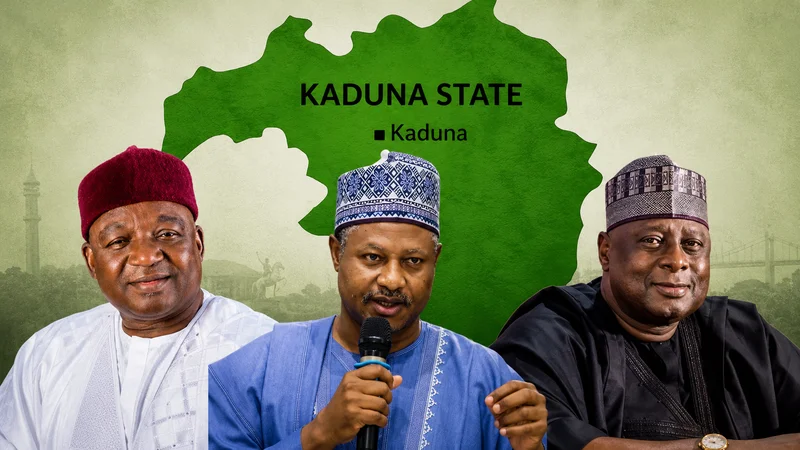
The 2027 election season is entering a new phase, and in Kaduna State, the political battle is already taking shape.
The Independent National Electoral Commission (INEC) has fixed 19 August for the commencement of campaigns for the presidential and National Assembly elections, while campaigns for governorship and State House of Assembly elections will begin on 9 September 2026. The governorship election will hold on 6 February 2027, with campaigns ending 24 hours earlier.
For Kaduna, the countdown has added urgency to an already fluid contest.
Governor Uba Sani of the All Progressives Congress (APC) is seeking a second term against a familiar challenger, Isah Ashiru of the African Democratic Congress (ADC), while former senator Danjuma La’ah has emerged on the platform of the Nigeria Democratic Congress (NDC).
| | |
|---|
The three men represent different political calculations.
Governor Sani enters the race with incumbency, government machinery, federal alignment and an increasingly dominant APC structure.
Mr Ashiru has statewide name recognition, two previous governorship campaigns and a substantial political network.
Mr La’ah brings two terms in the Senate, a strong Southern Kaduna identity and a powerful argument that the governorship should now go to Kaduna South.
But the biggest question may be whether the opposition can turn its combined strength into a single electoral force.
New phase in Kaduna politics
Kaduna has always been politically complex. Its three senatorial zones have distinctive political identities, while religion, ethnicity, geography, insecurity and longstanding regional grievances influence political behaviour.
But perhaps the most important feature of Kaduna politics is that alliances rarely remain permanent. The current contest illustrates that perfectly.
Mr Sani was once closely associated with former Governor Nasir El-Rufai. He succeeded activist politician Shehu Sani as senator for Kaduna Central and later became former governor El- Rufai’s preferred successor in 2023.
Today, the two are political opponents.
Mr El-Rufai has since left the APC for the ADC, while elements of his political network have increasingly aligned with Mr Ashiru.
That development has transformed the political calculations for the 2027 election.
Mr Sani and the advantage of incumbency
Governor Sani remains the candidate with the strongest institutional advantage.
He controls the government machinery and leads a ruling party that has expanded its influence considerably since 2023.
He also secured the APC governorship ticket unchallenged, receiving 459,393 affirmation votes at the party primary.
More importantly, the governor has succeeded in attracting politicians from outside the APC.
Former governor Ramalan Yero, former senators Shehu Sani and Suleiman Hunkuyi, among others, moved into the APC camp in 2025. Mr La’ah was also among those who joined the ruling party before eventually leaving it for the NDC.
Twelve opposition lawmakers subsequently defected to the APC, further strengthening the ruling party’s structure in the state.
The significance is not merely numerical.
Mr Sani is building a political machine that reaches beyond traditional APC supporters.
But the governor’s strength also presents a possible vulnerability.
A dominant ruling party can become complacent, particularly when politicians begin to assume that victory is inevitable. Opposition parties will attempt to turn that confidence into an argument for change.
Ashiru: The familiar challenger
For Mr Ashiru, 2027 represents another attempt to reach Sir Kashim Ibrahim House.
He contested the governorship in 2019 against El-Rufai and again in 2023 against Mr Sani.
His second-place finish in 2023 demonstrated that he has a substantial statewide following.
His move to the ADC has also placed him at the centre of the broader opposition realignment.
The emergence of Mr El-Rufai within the ADC has created an unusual political situation.
Mr Ashiru once campaigned against Mr El-Rufai.
Now, elements of the former governor’s political network are sympathetic to his candidacy.
Bashir El-Rufai’s public support for Mr Ashiru after the ADC primary reinforced speculation about the new alignment.
But Mr Ashiru also faces a difficult question: this is his third attempt.
The ADC must therefore convince voters that 2027 is different from 2019 and 2023.
The party must also resolve internal disagreements surrounding its governorship primary, which have already raised questions about cohesion.
The El-Rufai factor
No discussion of Kaduna 2027 can ignore Mr El-Rufai.
The former governor built one of the state’s most formidable political structures during his eight years in office.
His break with his successor, Mr Sani, has consequently become more than a personal disagreement.
It has become part of the larger political struggle over who controls Kaduna’s future.
The feud has involved disputes over governance, finances and insecurity.
Mr El-Rufai has criticised aspects of Mr Sani’s approach to banditry, while the governor has defended his combination of security operations, dialogue and socio-economic interventions in tackling the menace.
Mr Sani has argued that insecurity cannot be defeated through military force alone.
That disagreement could become a campaign issue.
For the opposition, Mr El-Rufai’s political influence is potentially valuable. But it is also a double-edged sword.
Too much association with the former governor could help mobilise his supporters while simultaneously reviving memories of controversies surrounding his administration.
MrbAshiru will therefore need to benefit from the El-Rufai network without allowing the election to become simply another referendum on Mr El-Rufai.
La’ah and the Southern Kaduna calculation
Danjuma La’ah has introduced a different dimension into the race.
A former two-term senator representing Kaduna South, he remains a significant political figure in Southern Kaduna.
His political journey has also been unusually fluid.
He once opposed Mr El-Rufai’s administration in the Senate, later joined the APC under Uba Sani and subsequently left after losing the APC senatorial primary.
He is now seeking the governorship under the NDC. His central argument is one of political rotation.
Mr La’ah says Kaduna North has produced governors including Namadi Sambo, Ramalan Yero and Mr El-Rufai, while Uba Sani comes from Kaduna Central.
Southern Kaduna, he argues, should now produce the governor.
That message could resonate strongly in the region. But winning Kaduna requires more than Southern Kaduna votes.
Mr La’ah must demonstrate that he can build support in Kaduna North and Central districts and become a statewide candidate rather than a regional one.
The third-force problem
Mr La’ah’s emergence could be decisive even if he does not win.
The question is whether he will divide the anti-APC vote.
Mr Ashiru has an established statewide base.
Mr La’ah has a potentially strong Southern Kaduna constituency. Both could attract voters dissatisfied with APC.
If they remain separate, Governor Sani could benefit from the fragmentation.
That is the central arithmetic of the election.
The opposition does not necessarily need to become more popular than APC. It needs to become more coordinated.
Insecurity remains the biggest issue
Security will almost certainly dominate the campaign.
Kaduna has suffered years of banditry, kidnapping and communal violence.
Mr Sani’s administration can point to security initiatives, negotiations that helped secure the release of abducted residents and efforts to reopen access to farms and communities.
But attacks have continued.
Recent killings and abductions in Birnin Gwari and other parts of the state demonstrate that insecurity remains a daily concern for many rural communities.
The political argument will therefore be straightforward.
The government will say the situation has improved and that its strategy is producing results. The opposition will argue that improvement is insufficient while farmers remain afraid to access their farms and travellers remain vulnerable.
For a farmer, the issue is unlikely to be theoretical:
Can I leave home, go to my farm and return safely?
That question could matter more than any campaign slogan.
The cost of living and everyday governance
Security is not the only issue.
Residents are also dealing with housing costs, unemployment, water shortages and the broader cost-of-living crisis.
These issues will test Governor Sani’s development narrative.
The administration can point to infrastructure, healthcare, water-sector investments and other programmes.
The opposition can ask whether those investments are translating into tangible improvements in the lives of ordinary Kaduna residents.
The priorities of a civil servant in Kaduna metropolis may differ significantly from those of a farmer in Birnin Gwari or a trader in Southern Kaduna. That makes a statewide campaign especially difficult.
What Kaduna voters are saying
Ordinary Kaduna residents who spoke to PREMIUM TIMES complained of also dealing with the consequences of inflation, unemployment, housing costs and access to basic services.
PREMIUM TIMES has reported rising rents in Kaduna metropolis, with residents complaining about sharp increases that have made housing increasingly difficult for low- and middle-income families.
Water supply remains another concern in the state
These issues could weaken the government’s development narrative if voters feel that large infrastructure investments have not sufficiently translated into improvements in household welfare.
There is currently no credible statewide opinion poll establishing a clear favourite.
Mr Sani himself has warned against confusing social-media popularity with electoral strength.
He argued that a candidate could lose on social media and still win at the polling units, stressing that the real test is grassroots mobilisation.
That is particularly important in Kaduna.
The election will ultimately be fought at ward and polling-unit level.
The ability to recruit agents, mobilise voters, reach rural communities and protect the vote may matter more than online popularity.
Mr Ashiru’s previous campaigns give him an advantage in this area.
The APC’s established structure gives Governor Sani an even larger one. Mr La’ ah of the ADC must now build one of his own.
APC’s power and its limits
The APC currently has the stronger political machinery.
It has incumbency, federal backing, lawmakers, local structures and a growing network of former opposition politicians.
But political dominance does not automatically guarantee voter loyalty.
Mr Ashiru’s evolution from Mr El-Rufai’s opponent into a politician who could benefit from sections of the former governor’s political network is perhaps the clearest example of Kaduna’s changing political geometry.
The campaign officially begins, but the real contest has started
INEC’s revised timetable gives the parties a clear electoral clock.
Presidential and National Assembly campaigns begin on 19 August, while Kaduna’s governorship campaign officially opens on 9 September.
Campaigns must end 24 hours before polling day, with the final day for governorship campaigning fixed for 4 February 2027. The governorship election follows on 6 February.
That compressed timetable means candidates cannot afford prolonged internal disputes.
For APC, the task is to maintain cohesion and convince voters that Governor Sani deserves another four years.
For ADC, the priority is to consolidate behind Mr Ashiru and resolve its internal questions.
For NDC, the immediate challenge is to settle the dispute surrounding its governorship ticket and give La’ah a stable platform.