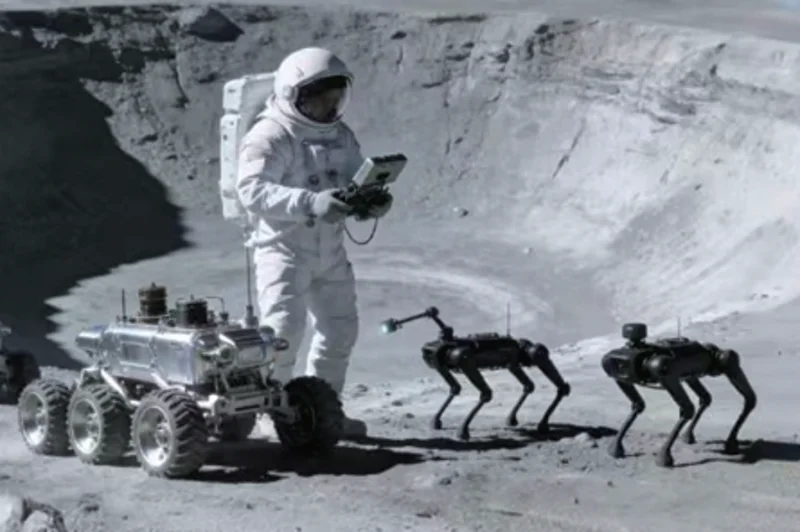
Chinese scientists are mulling the use of robot dogs to guard the country’s future bases on the Moon, alongside wheeled and other humanoid robots built for finding resources on the lunar surface.
Researchers working on a blueprint for China’s lunar base revealed that one of the core concepts would be astronauts working alongside robots, according to a new study published in the journal Chinese Space Science and Technology.
One of the concepts proposes a base staffed by three astronauts exploring the lunar surface with two robot dogs accompanying them, collecting rock samples and carrying out chemical analysis.
The concept also envisions four-legged robots, popularly called “robot dogs”, conducting daily patrols, environmental sensing, and cleaning astronauts’ living spaces.
“China is extending the frontier of human space flight from Earth orbit to the Moon,” scientists from the China Academy of Space Technology wrote.
“The proposed human-robot collaboration mode can exploit the complementary strengths of humans and robots, providing a reference for the future construction and efficient operation of China’s lunar research station,” they wrote.
Hostile conditions on the Moon, including low gravity, intense radiation, and extreme temperature swings, make human-only and robot-only missions inefficient, the study argues.
Since the Moon is about 380,000 km from Earth, radio signals take up to 2.5 seconds for a round trip.
Scientists argue that this delay calls for the physical presence of humans on the lunar surface to operate robots.
Humans on the Moon would also be able\ to guide robots when they encounter something they’ve never seen before.
Broadly, scientists envision a collaborative system where robots take on the physical execution of tasks, leaving only higher-level judgement and decision-making for astronauts.
The study argues that such an approach could enable lunar base operations for much longer periods, covering larger areas than is possible by operating with humans or robots alone.
Citing an example, researchers say a mission could have an astronaut directing unmanned robots to conduct sensing and exploration, while another astronaut performs more detailed investigation and sampling.
A third astronaut would be inside a pressurised mobile cabin, remotely operating a robot to assist them, scientists said.
China plans to build an International Lunar Research Station (ILRS) near the Moon’s south pole in collaboration with Russia and other international partners, and says it wants to land astronauts on the Moon by 2030.
In the latest study, researchers envision a modular lunar base design, with each module sharing standardised structures but different equipment to suit their functions.
A module could be about three metres in diameter, approximately 16 cubic metres of internal volume, and around 10 tonnes in mass, scientists say.
The modules would be made using materials resistant to radiation, extreme temperatures and lunar dust, and connected with each other through docking corridors, the study notes.