On Saturday, 2,339,233 eligible voters, according to the updated final voter register presented by INEC, will file out across 332 wards in the 30 local government areas of Osun State to elect a new governor.
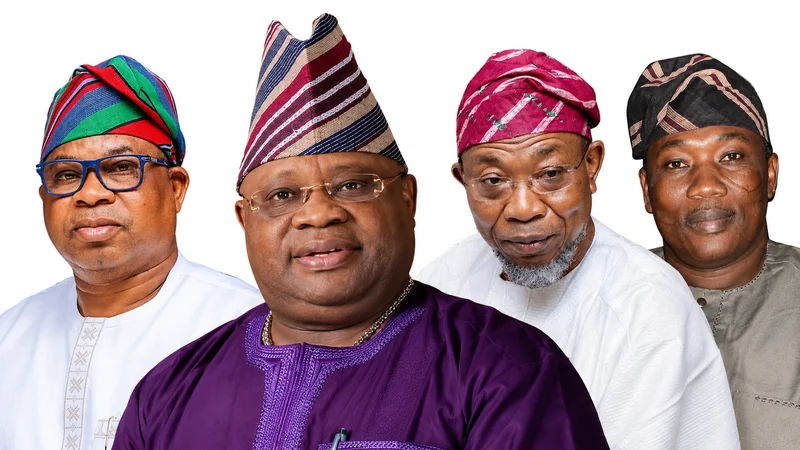
The voters, spread across 3,763 polling units, have a choice to either re-elect incumbent governor Ademola Adeleke of the Accord Party (AP) or choose another from the pool of candidates fielded by the All Progressives Congress (APC), the African Democratic Congress (ADC), the Zenith Labour Party (ZLP), and 10 others.
In all, 14 political parties are participating in the election.
Although on the surface, the governorship tussle seems to be a two-horse race between Mr Adeleke and Bola Oyebamiji of the APC, a third dark horse is lurking in the corner: the ADC’s flagbearer. The ADC is considered by many in the state as the third force, given the status and relevance of its major backer in the state, Rauf Aregbesola, who governed the state between 2010 and 2018, first on the platform of the defunct ACN, and then the APC, which he helped found in 2013.
| | |
|---|
Mr Aregbesola was a pillar of the APC in Osun State until a bitter struggle for the control of the party in the state with his successor, Gboyega Oyetola, on one hand, and his estranged political godfather, President Bola Tinubu, on the other hand, made him part ways with the party in July 2025, before emerging as the national secretary of the ADC. By the way, Mr Aregbesola continues to claim that he and his supporters were forced out of the APC in the state.
According to some political observers in the state, the rift between Messrs Aregbesola and Oyetola was one of the significant factors that contributed to the latter’s loss in the 2022 gubernatorial election to Mr Adeleke of the PDP, now of the AP.
They contended that had they reconciled ahead of the election, it might have been difficult for the PDP to dislodge the APC from retaining the governorship seat of the state.
Be that as it may, the 2026 election will be a litmus test on Mr Aregbesola’s political influence in Osun State and more or less on the ADC ahead of the general elections in 2027. This is so because there will be no major election in the country again in 2026 to qualitatively assess the strength of the party before the general elections.
The performance of the ADC in the recent Ekiti governorship election was subpar, despite party leaders, including Mr Aregbesola, David Mark and Atiku Abubakar, visiting the state to campaign for its candidate, Dare Bejide. Mr Bejide polled 12,872 votes to come a distant third, behind the PDP’s Oluwole Oluyede and APC’s Abiodun Oyebanji, who emerged as the winner with 319,224 votes, according to the results released by INEC.
Before the Ekiti governorship election, the ADC did not win in any of the bye-elections conducted by INEC in August 2025. Four parties dominated the results: APC won 12 constituencies, APGA won 2, PDP won 1, and NNPP won 1.
The ADC did not win any constituency.
Some commentators attributed the party’s poor showing in the elections to its relative newness, having been adopted by some opposition elements only recently as the platform to confront the APC-led national government.
If the ADC was emerging from a prolonged hibernation in the August 2025 bye-elections, some observers felt it should have done better, having gained some mileage within the country’s political nautical miles in 2026, and hence must be able to amass some political fortune in the elections held so far in the year.
Contrary to these observers’ expectations, the results from the bye-elections again showed a party yet to gain the momentum it needs before 2027. The party failed to win any of the bye-elections held in June across six states, including the Dawakin Kudu/Warawa Federal Constituency bye-election in Kano State (2026), which the APC won.
In the February FCT Area Council election, the ADC also failed to make a good showing. The APC won five of the six area councils, namely AMAC, Bwari, Kuje, Abaji and Kwali, while the PDP got Gwagwalada, leaving ADC with none.
The party’s below-par performance in the 2025/2026 elections held so far is why the Osun election will be a major test of its strength. It has to demonstrate that it is capable of challenging for power to get the buy-in of the Nigerian electorate.
Ahead of the election, the dominant question on the lips of many people is: Does Mr Aregbesola have the mettle and reach to deliver Osun State to the ADC?
Yet another question closely related to the first: Does the ADC have the name recognition to win the coveted seat in the state?
The preponderant response to the first question is that it would be a tall order for Mr Aregbesola to deliver the state to the ADC because his political strength has waned considerably, against his recurring claim that he enjoys the goodwill of voters of the state and that they will deliver their votes to his new party – the ADC.
For the second question, the ADC in Osun is Mr Aregbesola; Mr Aregbesola is the ADC in the state. Whatever happens to one also happens to the other. For now, they are two identical and inseparable twins.
The perceived diminishing return in Mr Aregbesola’s political net worth in the state, some local commentators said, is significantly tied to his parting ways with the ‘progressive family’ and Mr Tinubu, with whom he was a political associate for over three decades. The APC claims to be the party of the progressive family in the state.
Mr Aregbesola’s perceived waning political capital in the state aside, the ADC does not have strong institutional support, organisational depth, mass appeal and the financial clout the likes of AP and the APC enjoy in the state, which are key determinants that drive election victory or loss, as the case may be.
The ADC’s choice of candidate – Najeem Salaam- also created a mess that the party has not been able to clean up completely. Moshood Adeoti, a grassroots politician with supporters across the state, was initially thought to be favoured by Mr Aregbesola to fly the ticket, until the pendulum swung in favour of Mr Salaam, a former speaker of the Osun State House of Assembly and ex-lawmaker representing Ede North/Ede South/Egbedore/Ejigbo Federal Constituency in the House of Representatives.
Mr Adeoti, popularly known as ‘Sheu’, has since distanced himself from the ADC and also broken ranks with Mr Aregbesola. The former Secretary to the State Government was the SDP candidate in the 2022 governorship election. He defected to the SDP after losing the APC ticket to then-incumbent Mr Oyetola. Mr Adeoti enjoyed Mr Aregbesola’s support in the election because of his fallout with Mr Oyetola.
Mr Salaam is from Ejigbo in the same senatorial district – Osun West- as Governor Adeleke, who is believed to be enjoying massive home support, plus the well-oiled Adeleke political dynasty domiciled in Ede, the governor’s hometown, but with tentacles across the state. It would be a Herculean task for the former speaker and, by extension, the ADC, to torpedo Mr Adeleke in the district in Saturday’s election. It is believed that voters in Osun East and Central would prefer to vote for Mr Adeleke, who has another four years to serve if re-elected, rather than Mr Salaam, who is constitutionally entitled to two terms of eight years, assuming he wins, so that gubernatorial power can shift to the other districts.
However, Mr Aregbesola’s diehard loyalists, who are spread across the state, believe it will be political hubris for the AP and the APC to deny his influence in the state where he was governor for eight years, with an extensive grassroots network of foot soldiers who are always ready to do his political bidding, come rain, come shine.
For Mr Aregbesola, Nigeria’s immediate past interior minister, the 15 August election is another chance to prove to his detractors, cynics and adversaries that he remains a political force in Osun State.
For his part, Mr Aregbesola is not shy to flaunt his political credentials and those of the ADC. “We are the main, principal and only political force in Osun and in Nigeria,” he said at a rally.
One way to prove this and silence his critics is to deliver Mr Salaam on Saturday as the next occupant of the Bola Ige House in Osogbo, the state capital. Otherwise, a poor showing at the election may well eclipse his political star in the state he once governed.
The challenge is clear for the ADC, too: win Osun and send a signal to the rest of the country that it is battle-ready against the APC at the national level in 2027. A loss in the election may altogether erase its seemingly marginal chances.