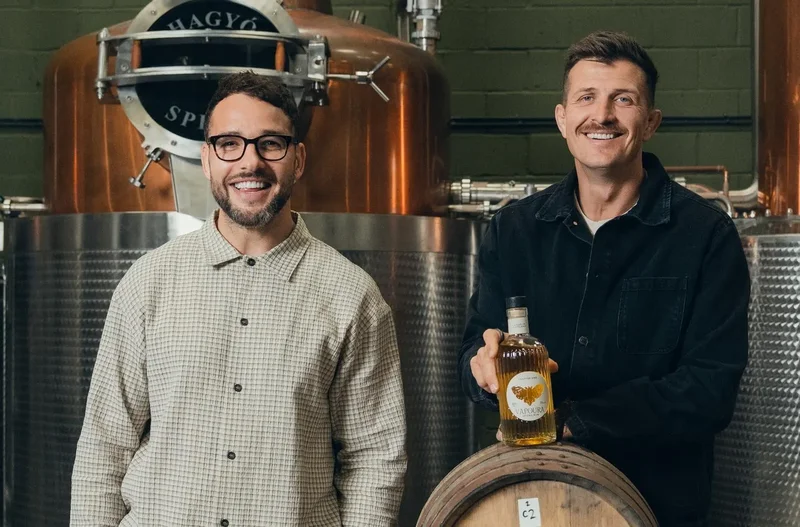
Rum has always been good at fantasy, conjuring sunshine in a bad bar, smuggling a little heat in the cold, and making the most sensible drinker briefly vulnerable to the pull of a paper umbrella. But it’s also a category that carries serious freight: sugar, trade, colonial history, Caribbean expertise, naval myth, cocktail culture and a long, uneven journey from sweet party spirit to something collectors and bartenders increasingly treat with the same reverence once reserved for whisky.
So when an English rum brand arrived with luxury ambitions, a gold-tinged bottle, and two former professional rugby players among the people telling its story, scepticism wasn’t unreasonable. English sparkling wine has just about done the hard work of becoming credible, but English rum still has a lot to prove.
And that, according to former pro rugby player Olly Barkley, was exactly the point.
Vapoura, the brand he launched alongside Ed Jackson and their wider founding team in 2023, is not trying to out-Caribbean the Caribbean, nor is it leaning too heavily on the easy story of two sportsmen moving into spirit (even if that might have made the early sell rather simpler).
“The rugby connection is probably the least interesting thing about what we’ve built,” he says. “What’s actually interesting is the timing. England has earned real credibility in whisky and in wine over the last decade—nobody blinks at English sparkling wine now—and we think rum is next.”
Its sell, here, is about what Englishness can mean in a rum context: not sugar cane grown in the wrong climate, but control, proximity, transparency and a contemporary flavour profile made in England from the start. “For us it comes back to wanting Vapoura to stand on its own for the right reasons,” says Barkley. “Being an English rum is an authenticity story—it’s about having close contact with our distillers, being hands-on in product development, and controlling quality at every stage.”
While Vapoura’s molasses derives from sugar cane produced in Mauritius, the preparation, fermentation, distillation, maturation, blending and bottling all happen in England. And, sure, that could feel inside-baseball for most casual drinkers, but it’s essential to the brand’s credibility for its founder.
“It would have been the easy thing to do—lean on our own profiles, sell to an existing audience, take the quick wins,” Jackson says. “We chose not to, because we wanted the quality of the liquid and the brand to earn their place entirely on their own. That felt like the only way to build something that lasts.”
For Jackson, that restraint is especially striking. In 2017, after diving into the wrong end of a swimming pool, he suffered a catastrophic spinal injury.
“There’s no doubt that if I hadn’t dived into the wrong end of a swimming pool, I wouldn’t be sat here with Vapoura today,” he says. Before the accident, he imagines he might have finished his rugby career and taken “a fairly well-trodden path” into finance, insurance or commercial property. Instead, he says, he ended up “running a charity, climbing mountains, and building a super premium alcohol brand,” but he’s careful not to turn that into product copy. “That experience is relevant to me as a person and to everything I do, but it’s not really relevant to Vapoura as a product,” he says.
What it did change was his appetite for risk. “Once you’ve been resuscitated a few times and realised you shouldn’t really still be here, you adopt a bit of a ‘why not give it a go’ mentality—you don’t want to die wondering.”
Vapoura began, as many indulgent ideas did, in lockdown. Barkley, Jackson and Ross Stirling spent time tasting through higher-end rums from the islands they already loved, then trying to work out what a domestic expression could be if it was not simply an imitation of something older, hotter and more established.
They had benchmarks. Jackson mentions Plantation XO as a rum they loved, though he’s quick to say replication was never the brief. “Practically, you can’t replicate a 12-year barrel age from a standing start anyway,” he says. Instead, Vapoura had to find depth elsewhere: through spice, oak, texture and a flavour profile that could feel distinctive without becoming gimmicky. “What we agreed on across both was depth of flavour and real uniqueness—we got there with the cardamom character—plus a well-rounded mouthfeel, which is where the oak comes in.”
The first bottle, Chapter One, is a spiced rum finished in bourbon casks, sitting in a category that’s commercially useful but not always taken seriously. Spiced rum can be excellent; it can also be sticky, overblown and built for fizzy drinks rather than enjoyment. Barkley describes Vapoura’s version as “spiced rum done properly, in a craft-led, quality-first way,” with a natural botanical mix and a profile intended to work in serious cocktails as well as simpler serves.
“Chapter One needed to shine and stand up in a spirit-forward cocktail,” he says. “On serves, my go-to is a sour, a bit sweeter, a bit more fun. Ed drinks his as neat as possible.”
That difference in palate explains Chapter Two, Vapoura’s gold rum. It’s richer and more deliberately aimed at drinkers who might otherwise reach for whisky. “Chapter Two is built for people who like to sip—people having it neat or on the rocks, which is how I drink it personally,” Jackson says. “It’s not the bottle to lose in a tiki serve; it’s more of a fireside, quiet-serving-moment kind of drink.”
For Barkley, Chapter Two is also where Vapoura asks to be judged more seriously. He points to a Pedro Ximénez cask expression due in September, describing it as “a single-cask rum that goes into the PX with nothing added and nothing diluted afterwards.” He is careful about the claim that follows: “We’re not aware of another rum being aged this way—certainly not another English one.”
“But what’s really in the liquid, and how it’s made,” he says, are still the questions serious buyers ask. That scepticism, he argues, is not the irritation it might be for other people. “Producing on home soil means we’re close to every stage, so there’s nothing we can’t account for and nothing we need to obscure. We didn’t choose to make it here to tell a nice English story—we chose it because it’s the only way to stand behind every drop with complete confidence.”
The real question is whether that confidence can scale. Vapoura’s seeking private seed investment to grow the team, support product development and, eventually, test export markets, but they’re aware of the contradiction built into the plan. Luxury may need patience, but investors need movement. “We need pace, because you need revenue to support what you’re doing, but there also needs to be real protection of the brand alongside that, because this is a long-term vision,” he says. “It’s not about hitting numbers on a page month to month.”
Jackson’s answer is culture. Partly, he means the ethics of the business—Vapoura is B Corp certified—but also something more human. “We want to keep it fun and a nice place to be, so that people who work with us go away thinking they enjoyed it,” he says. “That’s the thing I’d hate most to lose as we grow.”
Understandably, it’s a very different world from professional sport, where both men built their first careers. Jackson says rugby prepared him for plenty, but not for selling. “It doesn’t come naturally to me,” he says. Nor did it prepare him for the disorder of startup life. “Professional sport is about as structured an environment as you can be in: you’re told where to be, what to eat, what your gym session is, your kit’s laid out for you in the morning, your whole year is mapped out in advance. Running a startup is the complete opposite.”
Barkley found the shift similarly disorienting. “One minute you’re thinking about strategy, the next you’re dealing with operations, finance, recruitment or sales,” he says. “There are always multiple plates to spin and it took me a while to get comfortable with that.”
What has helped, significantly, is on-trade. “A bartender recommending your rum is one of the biggest accolades there is—it carries a trust no amount of marketing can buy,” Barkley says. He points to relationships with venues including The Mandrake and Daylesford, where the liquid is not simply placed on a back bar but worked into the life of the venue. “That only ever works as an ongoing relationship, not a one-off placement.”
The brand’s After Stories series began with the Fitzrovia hotel, pairing cocktails with original music inspired by the venue and pressed to vinyl—the sort of thing that could sound insufferable if the drink were not good enough, but Jackson sees it as central to the long game.
“From the start we’ve taken inspiration from how the great luxury houses build their world: the idea that the product is the heart of it, but the culture around it is what makes people fall in love,” he says. “That’s what our new After Stories series is really about. It goes beyond a music activation—it’s a collaboration with landmark venues, where we create an original body of music for each one, pressed to vinyl, that captures the spirit of that place.”
Still, Vapoura’s walking an unusually challenging tightrope. Too much brand world, it risks looking like a product. Too much liquid geekery, it loses the people it needs to seduce. Too much Englishness, it becomes novelty. Not enough, and the whole proposition’s lost.
For now, its founders seem unusually aware of those traps. Barkley says success in ten years would mean “real global distribution” and a brand that resonates beyond the liquid itself, through music, design and collaborations outside drinks. Jackson wants Vapoura recognised globally as “a progressive, luxury British brand—one that’s understood to be about far more than what’s in the bottle.”
Whether English rum can become a serious luxury category is still in question, and Vapoura isn’t the only brand trying to answer it, but it’s an especially useful test case for what that answer might require: not simply a better bottle, or a better story, but a more precise understanding of where provenance ends and persuasion now begins.