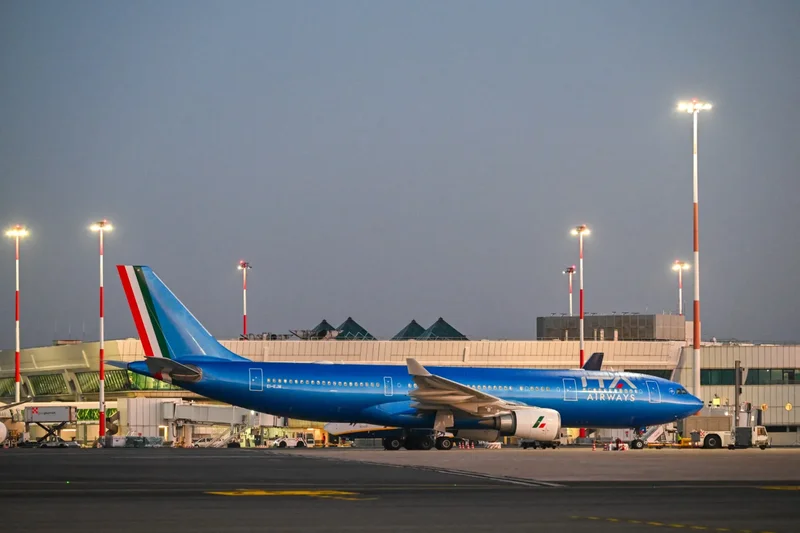
Spain brought in border checks on arrivals from Italy on Sunday August 10th in what the Spanish Interior Ministry said was a "response to similar measures imposed by Rome following the massive influx of migrants in Ceuta."
Italy had suspended its Schengen agreement with Spain on August 1st, after some 72,000 people entered Ceuta, a Spanish enclave bordering Morocco.
Spanish authorities put the death toll from the crossing at 80, while Moroccan rights groups say the true figure is at least 141, according to AFP.
Italy said the reintroduction of checks was an "extraordinary measure" needed to protect national security, while Spain said the move was "unfair, contrary to the EU's interests and discriminatory for the Spanish population."
As the tit-for-tat row between the two governments deepened this weekend, passengers travelling between Spain and Italy found themselves facing document checks for the first time in more than three decades.
READ ALSO: Can an EU member state be kicked out of Schengen zone?
"It was really strange," one Italian passenger arriving in Barcelona told Spanish public broadcaster TVE on Sunday after landing on the first flight from Rome, “On the plane, the crew told us we couldn’t get off without showing our documents to police.”
The Schengen Area allows passport-free travel across 29 European countries, but member states can temporarily reintroduce border controls in "exceptional" situations.
What this means for travellers
The reintroduction of border controls means that more - though not all - travellers entering Italy from Spain and vice versa now have to show their documents on arrival.
Spanish police say the controls target non-EU nationals specifically, carried out as spot checks on a sample of between 5 and 15 percent of passengers on selected flights, Sky TG24 reports.
Italian, Spanish or other EU citizens only need to carry a valid identity card or passport to travel, as before, the Italian interior ministry confirmed.
Italian passengers arriving in Spain on Sunday described varying controls depending on which airport they arrived from.
Passengers arriving in Barcelona from Rome were split into groups and asked for identification, while several travellers on a flight from Bologna passed through with no checks at all, according to Ansa.
Checks were first introduced at Madrid-Barajas and Barcelona-El Prat airports, before being extended over the course of the day to Malaga, Seville, Bilbao, Alicante and Valencia, as well as the Balearic and Canary Islands, according to Spain's RTVE.
The main Italian departure airports affected are Fiumicino and Ciampino in Rome, Malpensa in Milan, Naples, Venice and Florence, with more airports expected to be added in the coming days.
READ ALSO: Were the US and Israel involved in migrant rush to Spain's Ceuta?
Ferry passengers are also subject to checks. RTVE reported that a cruise ship arriving from Italy at Barcelona's cruise terminal was the first to face random checks under the new measures.
What happens next?
"We'll see after August 15th," Interior Minister Matteo Piantedosi said on August 7th, saying the date was chosen due to a "new alert" flagged by Spanish intelligence over another potential mass crossing attempt predicted at Ceuta.
Rome will reassess whether the checks can be lifted once it's clearer whether the security risk has passed, Piantedosi said.
The Spanish government has said their reciprocal checks will run until September 7th, unless the conditions that led to them change before then.
Will this cause longer queues at airports?
Italy's police union voiced concerns on August 1st that the reintroduction of border checks in the middle of summer "risks paralysing the operations of national air and sea terminals and placing a heavy burden on the men and women of the state police."
So far, Spanish police sources say checks haven't caused queues or disruption at Italian or Spanish airports, with document controls carried out directly at aircraft steps rather than diverting passengers to separate control areas.
Travellers themselves have described the checks as "lax" and "random", according to Spanish media. Not every flight arriving from Italy has been checked, and in many cases passengers only had to show they were holding a passport, without it being examined closely.
Around 86,000 air passengers a day are affected by the checks, with roughly 500 direct flights daily connecting 29 Italian airports to 22 in Spain.