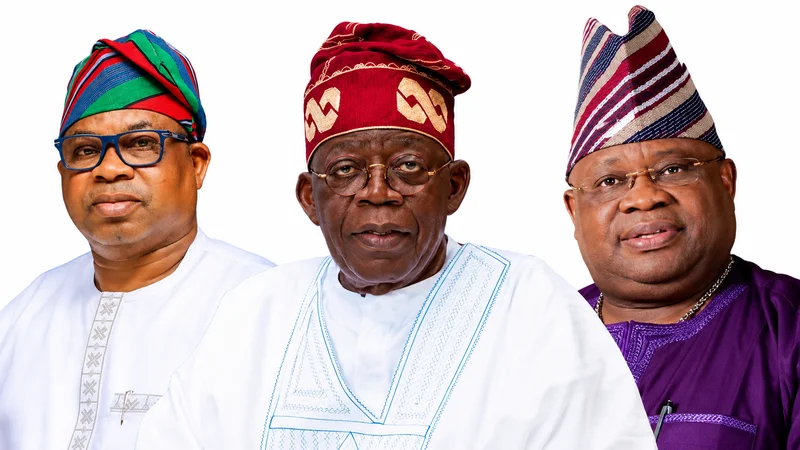
A few days to Saturday’s governorship election, one question keeps circling back in Osun’s political conversations: where does President Bola Tinubu actually stand?
The election is, on the surface, another off-cycle contest between the ruling All Progressives Congress (APC), the president’s party, and incumbent governor Ademola Adeleke of the Accord Party, seeking a second term.
In reality, it has become something larger. The election has become a test of President Tinubu’s authority within the APC, his personal relationships, and his ability to manage competing interests within the ruling party.
Unlike previous off-cycle elections, Osun presents the president with an unusually delicate political equation.
| | |
|---|
Mr Tinubu’s ancestral roots are widely traced to Iragbiji in Boripe Local Government Area of Osun State, the hometown of former governor Gboyega Oyetola, his cousin and one of his closest political allies. Mr Oyetola remains a key figure in the APC and now serves as Minister of Marine and Blue Economy.
Ordinarily, there would be little doubt about where the president stands. The APC has nominated former Commissioner for Finance Bola Oyebamiji to reclaim the state after Governor Adeleke defeated Mr Oyetola in 2022. Party members expect the president to deploy the full weight of the federal government behind the APC candidate.
However, politics in Osun has become more complicated.
A relationship beyond party lines
Governor Adeleke has maintained cordial relations with President Tinubu despite belonging to the opposition.
The relationship drew greater attention last year when members of the Adeleke family met the president in Lagos after the governor explored joining the APC.
The move generated intense debate before collapsing amid resistance from influential APC leaders in Osun, who argued that admitting a sitting opposition governor would disadvantage loyal party members who had remained in opposition since 2022.
APC chieftains in Osun, at various points led by former Speaker Timothy Owoeye and state chairman Tajudeen Lawal, publicly said that the governor was trying to defect and that the party would not have him.
Mr Lawal called him a Trojan horse, adding that there was no space for him in the APC. By April this year, the Osun APC campaign organisation was claiming Mr Tinubu himself had rejected efforts to “smuggle” Mr Adeleke into the party. It had reaffirmed Mr Oyebamiji as Tinubu’s man.
In June, Mr Oyebamiji felt the need to go on record again, telling supporters in Ifedayo, Ila, and Boluwaduro that he remained Mr Tinubu’s only anointed candidate, and that claims of a presidential endorsement for the governor were false.
Mr Adeleke is contesting a second term under the Accord Party, having left the PDP after months of speculation about his political future and amid the PDP’s national leadership crisis.
Campaign billboards have paired President Tinubu with the governor, despite the APC fielding its own candidate. The images have fuelled political debate and invited different interpretations.
Governor Adeleke has never claimed the president’s endorsement. The presidency has also never suggested that Mr Tinubu is backing the Accord Party candidate.
Still, the ambiguity has become part of the political conversation.
“Adeleke is not just dancing; he is organising. He connects emotionally with people, and that is something APC has failed to match,” said political analyst Olaniyi Oyekanmi.
Political watchers close to the contest, including journalist Babafemi Ojudu, have also argued that Mr Tinubu’s public posture toward Mr Adeleke has softened in recent weeks, not hardened.
Mr Ojudu, a former senator and presidential aide, pointed to a reported phone call between the two men and to security agencies apparently easing off the governor as the vote nears, reading into it a coded signal rather than an open one.
EFCC intervention shifted attention
Any lingering questions about the relationship between the president and the Osun governor took a new turn last week.
The Economic and Financial Crimes Commission (EFCC) had frozen the Osun State Government’s bank accounts as part of an ongoing investigation into the state’s handling of public funds. The opposition immediately accused federal authorities of using state institutions to weaken Governor Adeleke’s administration on the eve of the election.
“I have endorsed you. That should be enough. Stop the bloodshed in Osun State and call your brother, Oyetola, to order,” Governor Adeleke said in a speech addressing the president.
President Tinubu responded to the freezing of the Osun State government’s account within hours.
In a personally signed statement, he directed the EFCC to return to court and vacate the freezing order.
The president did not challenge the commission’s legal authority. Instead, he questioned the timing.
“I must state that I feel deeply embarrassed not by the EFCC’s exercise of its mandate backed by a court order, but by the timing of the agency’s action,” Mr Tinubu said.
He added, “Osun State is only a few days away from its gubernatorial election. Therefore, nothing ought to be done to give an impression that the EFCC or indeed any other agency of the federal government is being used to interfere with the election.”
Presidents rarely publicly question investigative actions already backed by a court order.
Mr Tinubu also acknowledged that although anti-corruption agencies are expected to operate independently, actions taken close to elections can easily be interpreted as reflecting the wishes of the presidency.
The statement changed the tone of the debate.
Rather than focusing on claims that the presidency was working against Governor Adeleke, attention shifted to Mr Tinubu’s insistence that federal institutions should avoid any action that could undermine confidence in the electoral process.
The president later reinforced that position during a telephone conversation with Governor Adeleke, informing him that he had directed the EFCC to withdraw the freezing order. Presidential spokesperson Bayo Onanuga said the call followed the president’s public directive to the anti-graft agency.
Analysts said the sequence projected the president was determined to avoid any suggestion that federal power was being used against the Osun governor.
Blocked Osun local councils’ funds
Before EFCC froze the state’s account, PREMIUM TIMES reported how governance has been stalled in Osun State’s 30 local government areas for more than a year following a political and legal dispute between the APC and the PDP over control of the councils and their statutory allocations.
The dispute began with the October 2022 local government elections conducted by the administration of former Governor Oyetola, shortly after he lost the governorship election to Mr Adeleke. The APC won all 30 chairmanship positions and 332 councillorship seats. Still, after Mr Adeleke assumed office on the PDP platform, he dissolved the councils and conducted fresh elections in February 2025, in which the PDP swept all the positions.
The rival parties have since battled over which set of officials is legally entitled to administer the councils, with the dispute producing conflicting judgements from the Osun State High Court, the Federal High Court, and different divisions of the Court of Appeal.
The federal government decided to withhold the councils’ statutory allocations, leaving grassroots governance paralysed and turning the matter into a contest in which partisan interests appear to have outweighed the public interest and legal principles.
The dispute eventually reached the Supreme Court, which last December strongly criticised the federal government and the Attorney-General of the Federation, Lateef Fagbemi, over the withholding of the councils’ funds, describing it as “a grave breach of the Constitution.” In a 6-1 judgement delivered by Justice Mohammed Idris, the apex court ordered that the allocations be “directly channelled to the local accounts.”
Although the judgement did not resolve the substantive question of which of the rival council administrations is the lawful occupant of office, the court’s pronouncement on the funding issue is clear and, under the rule of law, should be complied with without delay.
The continued impasse has therefore left Osun’s local governments caught between political rivalry and legal uncertainty, with the dispute not only consuming judicial attention but also depriving the councils of the resources needed to perform their basic governance responsibilities at the grassroots.
Not a few had blamed President Tinubu for the lingering face-off, alleging that he was preparing the ground to discomfort Mr Adeleke ahead of the governorship poll. But the president’s friendly tone after the EFCC’s action last week may change the narrative.
APC enters from a position of strength
Nationally, the APC approaches the election with considerable political momentum.
Since the 2023 general election, the party has expanded its control of state governments through both elections and defections. It now governs about 31 of Nigeria’s 36 states, strengthening its position ahead of the 2027 general election.
By that measure, Osun should represent another opportunity to deepen the party’s dominance.
Instead, it has become one of the most politically sensitive gubernatorial elections before 2027.
Osun is more than another opposition-controlled state.
It is widely regarded as the president’s political backyard. It is the state where two of his closest allies – Rauf Aregbesola and Mr Oyetola – previously served as governor.
Pressure on the APC candidate
For APC candidate Bola Oyebamiji, the task extends beyond defeating an incumbent governor.
He must also reassure party supporters that there is no uncertainty about the president’s commitment to the APC ticket.
Within the party, expectations are straightforward. The president is expected to campaign for, mobilise support behind, and help deliver victory for the APC candidate.
Anything short of that is likely to fuel speculation that personal relationships have blurred partisan lines.
That helps explain why campaign materials featuring Governor Adeleke alongside President Tinubu have attracted so much attention.
In politics, perception can be as influential as formal endorsements. Even without an explicit declaration of support, repeated visual association can shape public opinion.
Adeleke’s political calculation
Governor Adeleke has little reason to discourage those perceptions.
For an incumbent seeking another term, projecting a cordial relationship with a president from another party broadens his appeal beyond his party’s traditional support base.
It also strengthens a message his administration has quietly promoted: that cooperation with the federal government is possible despite partisan differences, whether voters accept that argument remains to be seen.
What is clear is that it has complicated the APC’s effort to frame the election as a straightforward contest between the ruling party and the opposition.
Tinubu’s defining test
The Osun election has placed President Tinubu in an unusual position.
As the leader of the APC, he is expected to do everything politically possible to secure victory for his party’s candidate. As president, he must also protect the credibility of the electoral process.
His intervention over the EFCC’s freezing of the state’s accounts illustrates that balancing act. By directing the Commission to vacate the court order, Mr Tinubu sought to remove any perception that federal institutions were influencing the election.
At the same time, he has remained firmly behind the APC’s campaign and has not withdrawn support for his party’s candidate.
That leaves one question hanging over the election. Can President Tinubu deliver victory for the APC in a state many regard as his ancestral home? Or will Governor Adeleke show that a relationship with the president does not necessarily translate into electoral advantage for the ruling party? The answers will be known after Saturday’s poll.