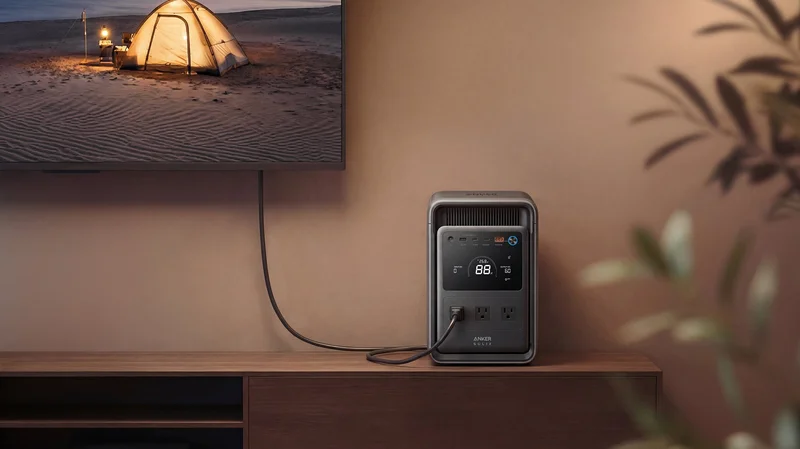
Anker SOLIX says most portable power stations waste up to 30% of their stored energy
Aug 10, 2026 — 8:27 AM ET
Anker SOLIX has called out an entire industry over how it measures battery efficiency, and it’s using its own product to make the point. The company has published discharge efficiency data for its S Series portable power stations across a range of real-world loads, something it says makes it the first portable power brand to disclose this level of detail. Anker has also shared its testing methodology alongside the results.
The issue, according to Anker, is how efficiency gets advertised in the first place. Most portable power brands quote a single efficiency figure, typically between 89 and 92%, measured near full load under ideal conditions. But that’s rarely how these devices actually get used. During a real outage, you’re more likely running a fridge, a CPAP machine, a router, and some lights, all of which draw under 300W, well below 15% of a typical 2,000W unit’s rated output. Anker says efficiency at those lighter loads commonly drops to 70 to 80%, meaning a meaningful chunk of stored energy never makes it to your devices.
The industry’s own numbers back part of this up
Anker isn’t the only one pointing this out. In its own technical blog, Bluetti acknowledges that the peak efficiency figures brands advertise reflect ideal lab conditions rather than everyday use, and separately notes that inverters run least efficiently at low partial loads. A reviewer at Fstoppers who independently tested a mainstream power station found light-load efficiency fell to 77%, well under the advertised number, and noted that advertised efficiency figures tend to reflect higher loads and ideal conditions rather than everyday use. Testing group HomePowerLab has reported similarly, finding that under mixed real-world use, only around 65 to 75% of a power station’s rated capacity typically reaches AC outlets.
Anker also points out that the solar inverter industry already uses a more rigorous approach: the California Energy Commission’s efficiency standard, which tests at multiple load levels rather than one. According to Anker, no portable power brand currently applies anything similar to its own products.
Anker’s internal testing names EcoFlow specifically
Anker’s technical materials go a step further than the original release, laying out internal test results that directly compare the Anker SOLIX S2000 against EcoFlow’s Delta 2 Max and Delta 3 Max across more than 30 load points, from 10W up to 1,500W. It’s worth noting this is Anker’s own internal testing, not independently verified. Anker describes its methodology as preconditioning each unit with a full charge-discharge cycle, then measuring AC output energy against nominal energy using a power meter.
The gap Anker reports is largest at low wattages. At a 10W load, Anker’s data shows the S2000 at roughly 69% efficiency, against roughly 36% for the Delta 2 Max and 32% for the Delta 3 Max. That gap narrows considerably at higher loads. By 1,000W, Anker’s figures put the S2000 at around 94%, with both EcoFlow models close behind in the low 90s. At the very top of the tested range, 1,500W, Anker’s own numbers actually show the Delta 3 Max slightly ahead, at roughly 92% versus the S2000’s roughly 92%, essentially a dead heat.
At 400W, a more typical household load, Anker’s detailed test data shows the S2000 at roughly 96% efficiency, against roughly 90% for both EcoFlow models — consistent with the 96% figure and industry comparison in Anker’s original announcement.
How OptiSave 2.0 works
Anker says OptiSave 2.0 builds on the same underlying principle behind variable frequency air conditioning, which has reshaped that industry over the past decade. Anker applied a similar idea to portable power, where, unlike a single-mode AC compressor, the loads plugged in at any given time are far more varied and unpredictable.
According to Anker, the system works in two stages. First, it senses what’s plugged in, classifying it as a cyclical load like a fridge, a steady low-draw device like a CPAP or router, or a heavy, short-burst load like a microwave, while continuously tracking its actual power draw and duty cycle. Then it delivers power accordingly, switching between three modes:
- Performance modekicks in for high-power appliances, delivering full output with minimal conversion loss.
- Eco modehandles steady low-power devices, like a router or CPAP machine, by lowering the inverter’s operating frequency to cut self-consumption without affecting output.
- Smart standby modeactivates when something like a fridge cycles off, dropping the system to near-zero standby and responding within milliseconds once the compressor kicks back on. Anker says this is the main reason its S2000 can deliver up to 35 hours of refrigerator backup on a 2kWh charge.
Anker’s technical materials describe that restart moment in more detail: when a cyclical appliance like a fridge kicks back on, the system fires a brief peak pulse to get it running immediately, then fine-tunes output back down to exactly what the appliance needs, rather than holding at the higher overshoot level. Anker illustrates this with an oscilloscope-style waveform diagram, though the company notes it’s a conceptual illustration of the behavior rather than an actual captured test waveform.
Anker also says the S2000 has earned a TÜV SÜD A+ energy efficiency certification (report No. 68.188.26.03573.01), the highest runtime performance grade under the PPP:CCB07041A:2026 standard.