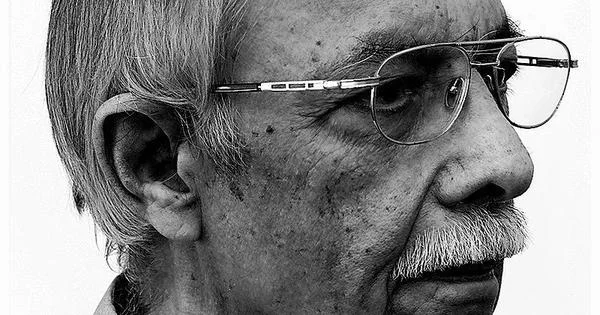
It feels only right to begin with an admission: I don’t think I understood what Gieve Patel’s translations meant to him until he died.
And yet, he offered clues. He once said that his translations had come into his life as a replacement for his own poetry. On another occasion, he said that he would sometimes spend an entire day looking at a translation in much the way he contemplated a painting in his studio. At the end of it, he would often do no more than delete a comma. He frequently said that the work was almost done, that he was “months away from closure”. But then, he seemed to have been saying that for almost as long as I have known him.
I will admit I had my own theories about Gieve’s reluctance to publish his translations. I attributed it to a hyper-self-critical strain, a perfectionist’s pride. Or writer’s block. I thought he was overthinking things. At times, I wondered if he felt he had lost his earlier sure-footedness. Perhaps he was simply preoccupied with his painting? Or was he just too much of a technophobe? Is that why he abandoned the lubricated ease of a computer for the arrhythmia of a typewriter? When he said he had to be seized by “inner necessity” in order to write, I wondered if he was quoting Kandinsky to rationalise some of his own inertia. In short, I wondered if Gieve was hiding behind a somewhat dubious pile of pretexts.
That is, until I witnessed the sheer physical evidence of this project.
A few months after his death, as his daughter, Avaan, began clearing his papers, she excavated what can only be described as staggering archaeological debris. Here were days, and months, and years, and decades, of paper. Great dizzying silos. Shuddering maelstroms of paper. Paper as testimony to a lifetime of attentive practice and practised attention. A lifetime of looking.
We were stunned into silence.
It now became apparent why Gieve had deferred publication. This was not a mere literary enterprise. This was nothing short of a life journey – and one that couldn’t possibly have a timeline. It could, if anything, have a deadline – one that could apply only to the traveller, not the work.
The poems are few. The drafts, however, are innumerable. The incompleteness of this work is its badge of honour. Completion would have spelt curtains. Paul Valéry comes to mind: “A poem is never finished; it is only abandoned.” Publishing these translations would have proclaimed, for Gieve, a spurious completeness; it would also have meant an act of abandonment, a final forsaking. He needed to leave them unfinished, so he could pick them up again the next day, and then the next. He needed to meld into their insights, align with the wisdom of their bones, get under their skin. Invite them under his own.
In their jaggedness is their vitality, their sap. They are drafts, because that kept them moist. Trussed up in a book, their greenness, their inspired mayhem would be lost. Mess would become museum. The tentative would turn terminal. Exploration would become endgame.
And still, Gieve, as translator, wanted resolution, even if Gieve, as sadhaka, as seeker-practitioner, knew there could be none.
When we met over coffee seven months before he died, I asked Gieve if he felt he had any unfinished business.
“The translations,” he said briefly, ruminatively.
There was a pause. Nothing I could say would accelerate the journey. I was aware of that. Gieve’s obduracy was also his integrity. I sipped my coffee and said I looked forward to them.
Later, when it was clear that his illness was terminal, I asked Avaan if there was anything about which he seemed anxious. Was there anything that could be done to ease those concerns?
“The translations,” he said again.
We’ll make the book happen, I said. She conveyed the message. “He gave a big smile. He would love it if you could write the preface,” she reported.
And that is why this book exists. Not because the translations are any readier. Or shinier, or dandier. But simply because the translator said yes. And he left behind the gift that every translator aspires to offer the poet he translates: the gift of his absence. Gieve needed to lift his restless fingers off the keyboard for this book to be birthed. I believe, in a sense, he simply stepped out of his own way.
This is no longer just about two Gujarati poets. Perhaps Gieve once saw it that way. But even he was aware that this had deepened into something more. And once the avalanche of papers came to light, it was clear that this was not just another translation project. This is now an archive of a poet’s engagement with language, with the business of learning to live and write in deepening trust and integrity. It is a palimpsest, a map of a literary journey with its own roadblocks and rabbit-holes – sometimes darkly groping, sometimes lit with sun. We may not know very much about Akho and Vasto. But we are offered a fascinating glimpse of the process by which these translations were cooked, stirred and allowed to marinate in their own juices, for over five decades.
This book is Gieve’s homage to two long-dead Gujarati mystics. This introduction is my homage to a man whom I was privileged to call a friend.
Akho
Where the creature is
there is the Creator,
but you wander elsewhere,
search in faraway places.
The first false step, says Akha,
was that you forgot
to look within.
So you forgot.
Go then, study
with a saint. What’s gained
by shows of piety:
one day all whiskers and beard,
the next day tonsured, sheared?
Turban tilted rakishly
to hide the bald spot,
but how will that mask
the godlessness in your heart?
Such dandy twirled whiskers!
Such fancy tripping speech!
Fool! Death tomorrow
thumps on a slackened drum.
Your charade goes poof,
a miserable fart.
Akha says: Rotted doors
fall apart.
The Dude! Bathed, scrubbed,
perfumed, tucking in
eats till he bloats
stud-size.
Battening on
each pleasure on earth,
a germ of maya sits concealed
in that bulk.
That pampered carcass
believes maya to be his friend.
But maya will chew him down
to his entrails.
Vasto
Conceive, O my friend, the pure self-interest in His move
Shaking me awake He rises at my side. In
flesh and blood He arrives, coaxes me from rest,
roils and caresses my breast. Yet listen to sages
discoursing: “He is Intangible. Unattainable.
Transparent, like air.” “Unimaginable,” echoes mankind.
What can I say? I am all simplicity. Why split
hairs when His own is grass in my hand?
Could it be deeds I have performed? My reward
to match? Some past leading to this high delight?
I ride triumphant. Then He topples me swiftly
and I merely allow Him His right. The night
quickly deepens to the mesh of our limbs.
My sorrows spurt and perish in flame.
I am all supple now and my movements are
volcanic – attributable to this
gift from His thigh. Oh, don’t mistake me, my friend,
I am a giddy streaming flood of bliss containing
all that you call He and I.
Excerpted with permission from the Introduction by Arundhathi Subramanian to Where the Creature Is, There Is the Creator: Poems by Akho and Vasto, translated from the Gujarati by Gieve Patel, Speaking Tiger Books.
We welcome your comments at letters@scroll.in.