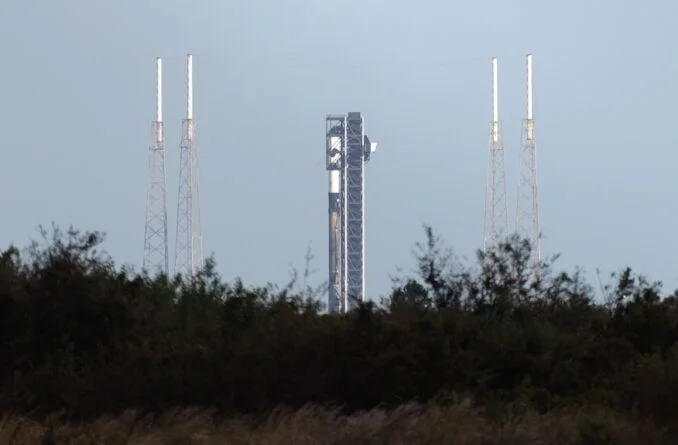
SpaceX is kicking off the work week with a Falcon 9 flight from Cape Canaveral Space Force Station to deliver another batch of its Starlink V2 Mini Optimized satellites to low Earth orbit.
The Starlink 10-19 mission represents the 72nd flight of these broadband internet satellites this year. Following this launch, SpaceX will have flown 93 Falcon 9 rockets in 2026.
Liftoff from Space Launch Complex 40 is scheduled for 12:20:09 p.m. EDT (1620:09 UTC). The rocket will fly on a northeasterly trajectory upon leaving the launch pad.
Spaceflight Now will have live coverage beginning about an hour prior to liftoff.
The 45th Weather Squadron forecast a 90 percent chance for favorable conditions near the opening of the window, which drops to 75 percent as the window progresses.
“By [Monday] morning, the low-level Atlantic ridge axis will remain just north of the Spaceport, bringing south-southeasterly flow. This light onshore flow, dry air aloft, and mid-level ridging will lead to generally favorable conditions at the opening of the window,” launch weather officers wrote.
“However, the probability of a weather violation does increase in the early afternoon as isolated, locally forming showers become possible along the developing sea breeze boundary. This introduces a Cumulus Cloud Rule concern, primarily towards the end of the launch window.”
SpaceX will launch this mission using the Falcon 9 first stage booster with the tail number B1085. This will be its 18th flight with a flight history that includes NASA’s Crew-9, GPS III-7, and Fram2.
Nearly 8.5 minutes after liftoff, B1085 will target a landing on the droneship, A Shortfall of Gravitas, positioned in the Atlantic Ocean off the coast of South Carolina. If successful, this will be the 163rd landing on this vessel and the 647th Falcon booster landing.