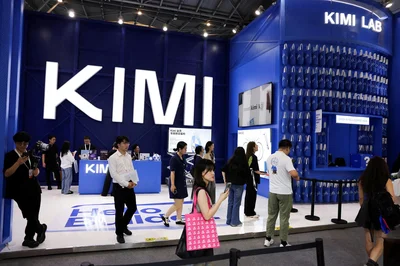
People walk past the Moonshot booth promoting its Kimi K3 AI model, during the World Artificial Intelligence Conference (WAIC) in Shanghai, China, July 17. Reuters-Yonhap
Chinese start-up Moonshot AI has suspended new subscriptions for its groundbreaking new model Kimi K3 as surging demand squeezes its computing power, underscoring the challenges Chinese AI labs face in serving their products to global users.
"Over the past 48 hours, demand has pushed close to the limits of our current capacity," Beijing-based Moonshot AI said in a statement posted on X on Sunday. "Our GPUs [graphics processing units] are feeling it."
It had "temporarily paused new subscriptions", adding that existing subscribers were not affected. "We're adding capacity as fast as we can and will reopen new subscription spots in batches," said the company.
Late last week, Beijing-based Moonshot released Kimi K3, a 2.8 trillion-parameter large language model. It has outperformed top U.S. models GPT-5.6 Sol and Claude Fable 5 on some benchmarks, including Arena AI's ranking for front-end code development.
Moonshot is currently serving the massive K3 model through a cloud application programming interface, and plans to release the model's weights by July 27, which would make it the world's largest open-weight frontier model so far.
Its frontier capabilities have drawn global attention and added fuel to growing anxiety in the U.S. about the rapidly narrowing lead it holds over Chinese AI labs. However, many users noted that Kimi K3 operated noticeably slower than the top US alternatives.
Chinese AI labs continue to face computing power shortages as the country's chip industry strives to catch up under U.S. export control measures, which have restricted access to advanced chips and chipmaking equipment.
Ryan Fedasiuk, a fellow at the American Enterprise Institute, said in a report on Saturday titled "China has caught up in frontier AI" that Kimi K3 had helped the country shorten its model capabilities gap with the U.S. from months to just weeks, but compute constraints would weigh on their global competitiveness.
"To serve K3 to millions of monthly active users, Moonshot will likely spend billions of dollars on chips and energy to power them - chips that Chinese companies still struggle to produce at scale," Fedasiuk wrote in the report.
Denying Chinese AI labs or cloud providers access to high-end hardware ultimately "degrades their ability to directly serve AI to global publics", he added.
The race by Chinese labs to build massive frontier models and grab market share has continued to intensify. Alibaba Group Holding, the owner of the South China Morning Post, on Sunday previewed its coming 2.4 trillion-parameter model Qwen3.8, which it said only trailed Anthropic's Claude Fable 5 and would be released open-weight.
Meanwhile, Tencent Holdings said on Monday that it was extending the free trial of its Hy3 large language model to Aug. 5 on its Workbuddy and CodeBuddy AI agent platforms.
Kimi K3's launch has triggered major fluctuations in the Hong Kong stock market. Beijing-based software firm Chinasoft's shares closed up 22.97 percent on Monday following the company's announcement of a partnership with Moonshot. As part of the agreement, Chinasoft said it would use Kimi 2.7 Code and K3 models to build enterprise AI agents, with the two firms splitting revenues based on token usage.
In contrast, Moonshot's domestic rivals extended the slump in their share prices amid the fiercely competitive large language model sector. Zhipu AI, known as Z.ai overseas and listed in Hong Kong as Knowledge Atlas Technology, fell 19.57 percent on Monday after plunging 28.49 percent on Friday. MiniMax closed 10.60 percent lower on Monday after dropping 15.62 percent on Friday.
Read the article at SCMP.