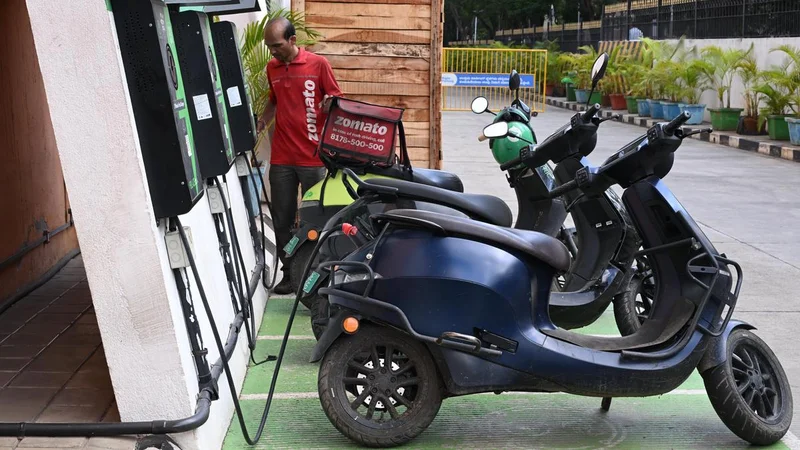
Karnataka has emerged as one of India’s leading States in electric vehicle (EV) charging infrastructure, with 6,805 electric vehicle charging stations (EVCS) installed as of July 29 this year, according to data by the Ministry of Heavy Industries.
The data, released in response to an unstarred question on August 7 in the Rajya Sabha, shows that Karnataka has the second-highest number of installed EV charging stations in the country, marginally behind Maharashtra, which has 6,985 stations. Karnataka’s tally is 180 stations lower than Maharashtra’s and accounts for nearly 13% of the 52,718 charging stations installed across India.
Karnataka’s charging infrastructure is also substantially higher than that of neighbouring southern States. Tamil Nadu has 3,839 charging stations, Telangana 3,739 and Kerala 3,399. Andhra Pradesh has 1,976 stations, while Goa has 314.
At the national level, Uttar Pradesh has 4,493 charging stations, followed by Tamil Nadu, Telangana, Kerala and Rajasthan, which has 2,827. The annexure to the Rajya Sabha reply shows wide variation among States, with several northeastern and smaller Union Territories having fewer than 100 stations.
However, the Ministry clarified that centralised data on the number of fast- and slow-charging stations is not maintained. Setting up EV charging stations is also an unlicenced activity, allowing private players to establish charging stations in accordance with the Ministry of Power’s guidelines issued on September 17, 2024.
Karnataka’s EV charging network
6,805
52,718
2nd
Maharashtra with 6,985 stations
12.9%
July 29, 2026
Source: Ministry of Heavy Industries; data from BHEL
The government said that under the PM E-DRIVE scheme, Central ministries, Central Public Sector Enterprises, States and Union Territories and their PSUs are eligible to submit proposals for public charging stations. They can establish and operate the facilities themselves or engage charge point operators.
Proactive policy
Meanwhile, experts attribute Karnataka’s success in EV infrastructure to the State’s early and proactive policy decisions, particularly its 2017 EV policy. “The extensive network of charging stations in Bengaluru demonstrates how infrastructure can help build consumer confidence. However, the focus must now shift towards improving interoperability, standardising charging tariffs and providing real-time information on charger availability to enhance the overall user experience,” said transport expert M.N. Srihari.
“The next phase should not be measured merely by the number of charging stations added. What matters is how accessible and reliable these stations are for EV users. Charging infrastructure needs to expand beyond major urban centres and along key highways and inter-city routes, so that range anxiety is reduced and EV adoption can grow across Karnataka,” he added.
Published - August 10, 2026 07:05 pm IST