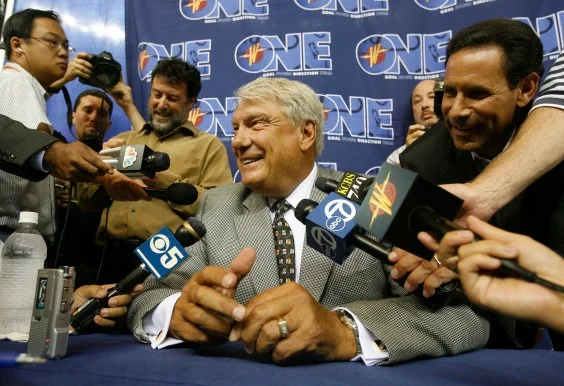
The notice from Don Nelson's family announcing his death on Sunday at the age of 86 said he "peacefully went to be with the Lord, surrounded by his loving family.” This immediately convinces us that the deity in question here likes uptempo basketball, beer, blunts, and cards, and who wouldn't want a final judge who leans into those pastimes?
Every Nelson obit, including this one, will note that he was the second-winningest coach in NBA history—1,335 wins, not including 75 playoff victories. That is maybe the 17th most interesting thing about him. He was the iconoclast's iconoclast, devoted not just to winning basketball games but to finding ways to win them in the manner of his choosing. The manner he chose favored teams that were improbably fast and impossibly small, and he used it to take bad teams and swiftly make them infuriatingly good. He irked his bosses and enraged his superiors everywhere he went; he befriended players and took money from sportswriters unwise enough to sit at his poker table. He took three different teams to the playoffs as seventh or eighth seeds and won the first-round series, still the only coach to do so, and he also coached a team to 48 wins and missed the playoffs. He was in short the single liveliest underdog in the field wherever that field happened to be. He is almost certainly the only coach to have a distinct playing style named for him—Nellie Ball, by far the least creative thing about it—probably because nobody else had dared to try it.
They do now, though. Big men at the arc, three- and four-guard sets, treating the shot clock like a stopwatch that should never expire—Nelson was into all that decades ago, and while he might have been an old fud compared to some of today's hoops accelerationists, none of those teams would have even dared be who they are now if he hadn't done it back in the long ago.
Nelson was a lifer in a business that chews up devotion and spits it out as just another sunk cost. He played 14 seasons in Chicago (with the Zephyrs, not the Bulls), Los Angeles, and Boston, and upon retirement told his family his next step would either be selling cars, becoming an NBA referee, or coaching for Larry Costello in Milwaukee. The family chose the latter, depriving thousands of Midwestern motorists their first high-performance Rambler Ambassador and thousands more NBA players their most memorable technical fouls.
He chose coaching, and as though he'd been tipped off ahead of time, eighteen games into his first season, Costello was fired for the temerity of starting 3-15. Suddenly, Honest Don The Reffing Retailer became an NBA head coach. A year later, he was also named the team's general manager, a stunningly rapid rise by any measure, and the Bucks were reinvented as the quirkiest good team in the sport. Five years earlier, Kareem Abdul-Jabbar had led them to their first title; one can only wonder what Nelson would have done with him instead of him destroying the field with a thousand blocked shots, 10,000 rebounds, and a million indefensible sky hooks. Instead, Kareem found his bliss in Los Angeles and the rest of humanity was robbed of a delicious alternate universe.
Nelson fell crosswise with Bucks management despite winning 50 games every year, quit, and relocated in Oakland, where former Bucks owner Jim Fitzgerald had bought the hapless Warriors. There he ratcheted up the Nellie Ball with Chris Mullin, Tim Hardaway, Mitch Richmond, and the first of a series of intrepid foreign players, Sarunas Marciulionis, who was a shorter, slower, but utterly ferocious and fearless precursor of sorts to Dirk Nowitzki. None of those players was taller than 6-foot-7, and few of the taller players on the roster offered much more than high-energy support, but that roster became the million-piece one-color jigsaw puzzle Nelson always wanted his teams to be.
After coaching the U.S. national team to a wholly expected gold medal in the 1994 FIBA World Championships, Nelson went to New York in what was in retrospect his one serious career misstep. He led the Knicks to a winning record, of course, but was fired because Nellie Ball clashed with the Knicks' slower, bigger, defense-emphasized roster. This was the one time his signature personality transplant didn't take, but that wasn't the case when he moved on to Dallas. There his eponymous methodology reached his one and only conference final, which he lost to a man he hired and schooled, then turned loose on a league Nelson himself could never fully conquer: Gregg Popovich.
Because that was as close as he ever got to last-word glory as a coach—he won five titles as a supporting player on Bill Russell's dynastic Celtics teams—Nelson waited years to be inducted into the Hall of Fame, at a time when the committee was significantly smaller and more political. Nelson's claims to immortality included all that résumé-filling, plus a classic bear-in-a-sleeping-bag fashion sense that included fish-themed ties at a time when most coaches had leaned into expensive suits and ties as the uniform.
And after Nelson left Oakland a second time in 2010, he did the most sensible thing a retiree who minds his money can do: He bought a farm in Hawaii and grew flowers, coffee, and cannabis. In a 2025 feature in The Believer, Nelson told Joseph Bien-Kahn that he hadn't added marijuana to his passions until after he retired, and more specifically after trying it at a poker game hosted by Willie Nelson. "Owen Wilson and Woody Harrelson both played in the games, and Woody kept saying, 'Come on, try a little marijuana. You’ll like it,'" Nelson told Bien-Kahn. "So after I was done coaching, I said, 'I’ll give it a go.' And I liked it. And then I smoked for ten years after that." That version of Nelson hosted poker games and enjoyed life without the stresses of coaching, owners, and players, during his life in Hawaii with his second wife, whom everyone knew as Miss Joy. They got married at that most religious of shrines, the Oakland Coliseum.
Nelson was the rarest of beasts, the honest cartoon character. Whatever he did, he did with waving arms and a booming voice, a sly smile and a look that advertised, "I can see inside your soul, and if you had something I wanted, I'd steal it right from under your nose. But since you don't, how 'bout a beer?"
It is hard to project what kind of coach he might have been in the present day, because so many of his innovations are now dogma in the modern NBA. The dynastic Warriors under Steve Kerr applied a great many Nellie Ball principles, for example, and there were hints of those principles with Mike Brown's championship Knicks. On the other hand, he would have been all swords-and-shields with any of the league's current owners—one of Joe Lacob's first acts upon buying the Warriors in 2010 was to fire Nelson, although in Nelson's defense he spent his last years as a coach flailing with a young roster that included an injury-stunted Stephen Curry, Nelson's last great talent find—and would have found taking orders from billionaire basketball neophytes intolerable. Besides, how many early February redeyes out of Memphis to Detroit must a man endure when the alternative is pot and poker in Maui? Nellie left when he should have, for the best reason of all—his own contentment and delight, which he identified and pursued with admirable vigor before and after retirement. When you measure it all out, that surely beats a ring. Maybe not two, mind you, but one for sure.