- READ MORE: Inside the wedding album of Dame Joan Collins' son Alexander Newley, 60, as he marries his bride at romantic castle in Austria
- See more Daily Mail on Google - save us as a Preferred Source
When singer Sheela Newley married Dame Joan Collins’s son, Alexander Newley, at a lakeside castle in Salzburg last year, it looked every inch a fairytale wedding.
The Dynasty star, 93, proudly walked her artist son, 60, to his place at the altar, while the couple’s daughter Deia, now four, scattered petals as a flower girl.
But for Sheela, 42, the day was also proof of how far she had come after battling a debilitating illness that had put her life at risk and persisted despite medical treatment.
The years-long ordeal began when she was 23 and a series of worrying symptoms emerged. Sheela had just graduated from Brown University and was working as a reporter for a local newspaper in Florida, when she began to grow extremely and inexplicably tired.
Having previously been fit and healthy, she was baffled by how quickly her body seemed to be failing her – including with dramatic, unintentional weight loss from her already-slender frame.
Sharing her story with the Daily Mail, Sheela said: ‘My health began to seriously fall apart.
'I used to run three miles several times a week to keep fit, and I found myself becoming totally exhausted from these runs, and over time, even from running for just a few minutes. I switched to walking, and then even that became too much.
‘I lost weight, dropped from around 110lbs (7 stone 12) to under 100 (7 stone) despite eating well, and I could not understand why.’
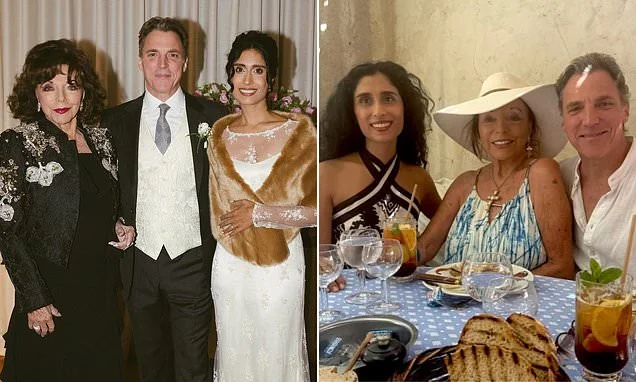
When singer Sheela Newley (pictured right) married Dame Joan Collins ’s son, Alexander Newley (pictured centre), at a lakeside castle in Salzburg last year, it looked every inch a fairytale wedding. Pictured left, Dame Joan Collins
She added: ‘My hormones were completely out of whack; my periods became unbearably painful, and I was experiencing chronically disturbed sleep and brain fog, which for me was perhaps the worst symptom of all, as I had always had a quick mind.’
Sheela saw a doctor, who found that her thyroid levels were slightly abnormal. He suggested anxiety or depression could be contributing to her symptoms and so prescribed anti-anxiety medication. But Sheela wasn't convinced.
‘I felt in my gut that there was more to the story, and that something was deeply physically wrong with me,’ she said.
She tried to continue life as normal until one day, while driving to work, she was so overcome by nausea and dizziness that she had to pull over.
‘That was when I knew I had to leave that job, move back to New York near my family, and figure out what was wrong with me,’ she said.
Doctors in New York discovered inflammatory nodules on her thyroid and diagnosed her with Hashimoto’s disease, an autoimmune condition in which the body attacks the thyroid gland.
It can cause an underactive thyroid and is normally treated with the hormone-replacement medicine levothyroxine. Sheela began taking the drug but says that although her blood-test results improved, many of her symptoms did not.
‘In some ways, I actually felt worse,’ she said. ‘My heart raced constantly, the brain fog remained, the chronic fatigue remained, and my autoimmune markers stayed stubbornly high.’
The Dynasty star (pictured centre), 93, proudly walked her artist son, 60, to his place at the altar, while the couple’s daughter Deia, now four, scattered petals as a flower girl
But for Sheela (pictured), 42, the day was also proof of how far she had come after battling a debilitating illness that had put her life at risk and persisted despite medical treatment
She later developed muscle pain, along with numbness and tingling in her legs. At one stage, she was given intravenous antibiotics for a suspected Lyme infection, a bacterial illness spread to humans through the bite of an infected tick.
But the treatment was halted after only three days when she developed severe shooting pains and was taken to hospital.
‘The doctors there told me I had to stop the treatment immediately,’ she said. ‘My liver enzymes were four times above normal, and they were concerned about the effect the medication was having on my body.’
It was then that she realised how serious the situation had become.
‘The emergency room doctor told me that the level of liver stress the medication had caused had put my life in danger,’ she explained. ‘Because of my low body weight and fragile state of health at that time, a medication which most people can tolerate had been far too strong for me to handle. That really brought home to me how weak I had become.
‘What frightened me most was the feeling that I had run out of safe and obvious options. I had placed so much hope in this treatment and now found myself even sicker than before.’
By 26, Sheela was so ill that she had to leave the New York flat she had only just moved into to be closer to home, stop her freelance work and move back in with her parents in Princeton, New Jersey – which is where she then reached her lowest point.
‘As I was getting dressed one morning, I looked in the mirror, saw the red circles under my eyes and my pale, thin face, and started weeping,’ Sheela recalled.
‘I was grieving the loss of my youthful brilliance, and of my ability to follow through on the gifts and passions that had always felt so central to who I was. In that moment, I truly had no idea what to do next.’
Her love of music became her lifeline. ‘While I was ill, I really had to re-evaluate what I wanted out of life,’ she said.
‘Music was the one thing that kept coming back to me, a nagging urge that kept growing stronger all the time, even, and especially, as my illness worsened.’
The daughter of Indian immigrants who valued economic security, Sheela had wanted to sing and write songs since childhood. But her parents regarded a career in music ‘as a big threat to the stability that they had sacrificed so much for’, and she chose journalism instead.
Sheela pictured in her twenties when living in New York
Alexander – whose portraits of Gore Vidal and Christopher Reeve hang in the Smithsonian's National Portrait Gallery in Washington – was living in New York at the time of meeting Sheela
While she was ill, a friend introduced her to New York jazz pianist Matt Ray, who helped her record a demo. ‘Looking back, I realise that those afternoons singing in Brooklyn were my first tentative steps back towards myself,’ she said.
Disheartened by doctors' lack of answers, Sheela hoped a more peaceful way of living could help her cope with her symptoms. She sold her car and moved to Tuscany, where she tutored English and lived quietly among other artists.
It was while living there that, through mutual friends, she met Alexander, the only son of Dame Joan and her ex-husband, the late singer-songwriter Anthony Newley.
Alexander – whose portraits of Gore Vidal and Christopher Reeve hang in the Smithsonian's National Portrait Gallery in Washington – was living in New York at the time. Sheela had told him about her illness, but he didn't realise how severe it was until he visited Tuscany and they attempted a long walk.
‘Alexander sat down on a rock and looked at me standing there, with my limbs aching and completely out of breath, and said, “Wow, you are really not well, are you?”’ she said. ‘I felt my worst fears coming true. Surely now that he had seen the reality of my life, he would back away.’
Instead, Alexander became her biggest support and fiercest source of encouragement.
‘When I was at my worst, he helped me with many of the everyday tasks that had become physically difficult for me – grocery shopping, washing dishes, chopping vegetables, and cooking, when necessary, even though these were hardly his favourite activities,’ she recalled.
‘He did these things as he saw me researching as much as I could to try and find solutions, and he really believed that I would get there.
'He also saw that relieving the load a bit for me gave me a bit of energy left to sing and be creative, and that those tiny moments would get me through and give me the will to keep fighting.
‘I cannot overstate how grateful I am for his support during those years. It has been a big part of how I have made it this far.’
She added: ‘Our relationship was never one-way. Alexander very much appreciated finding in me a partner who shared his passion for art and literature, and with whom he could freely share his thoughts about life and creativity and always get interesting feedback.'
The couple moved to London in 2015, where Sheela began looking for other ways to improve her health, since modern medicine had offered little relief.
In 2022, aged 38, Sheela moved to Vienna shortly before giving birth to her and Alexander’s daughter, Deia. ‘We waited until I truly felt ready, physically and emotionally, before trying for a child, and that was in my late thirties,’ she explained
Alexander Newley and Sheela Raman attend The Extraordinary Collection charity auction in aid of Willow at Coutts Bank on September 25, 2019
‘The doctors agreed that complicated cases like mine, involving complex autoimmune issues, did not have a great prognosis nor a straightforward cure – only long-term management of often crippling symptoms,’ she said. ‘At the point when many conventional therapies failed to help, I started to turn to alternative therapies.’
She explored Ayurvedic medicine, the traditional Indian system that views health as a balance of body, mind and spirit. In its teachings, the thyroid sits at the ‘throat chakra’ – seen as the body's centre of communication and creative self-expression.
‘Whether or not one chooses to interpret that literally, I could not ignore the fact that while I was ill, music and singing kept re-entering my consciousness,’ Sheela said. ‘The pull towards it became stronger the more ill I got.
'Without music, I had little desire to keep fighting for my future; with music, I suddenly had something beautiful to fight for.
‘Once I started freeing up my voice, I was less depressed by my condition and more able to continue searching for solutions to the physical aspects of my illness.’
Allowing herself to sing again reawakened her will to get well – and, with it, her determination to tackle the physical side of her illness.
Sheela’s research eventually led her to an alternative health practitioner in London who used hair mineral analysis, which examines mineral and metal concentrations in a hair sample to tailor a health plan.
They gave her a strict diet excluding sugar, gluten and most dairy, while including a large variety of cooked vegetables and high-quality animal protein. They also recommended supplements tailored to her metabolic type and near-infrared sauna sessions.
The programme seemed to be a major turning point in her recovery. ‘I noticed a significant improvement in my energy and concentration within a month or so of starting this programme, and this was very exciting,' Sheela said.
Over the next few months, the numbness in her legs diminished, her antibody levels fell and scans showed an improvement in her thyroid.
She later underwent a liver flush, an alternative practice which usually involves drinking olive oil and fruit juice, sometimes with Epsom salts or herbs, in an attempt to remove toxins.
She also used natural peptides – short chains of amino acids that can act as chemical messengers in the body, helping to regulate functions including hormones, metabolism and tissue repair – which brought further gains.
Hair mineral analysis and liver-flushing are not standard treatments for Hashimoto’s disease, and patients should seek medical advice before changing prescribed treatment or taking supplements.
Sheela also stresses that she is describing her personal experience rather than offering medical advice. ‘Recovery, for me, was never about one magic bullet or one miracle intervention,’ she said.
‘If there was one thing that made the greatest difference, it was the decision to become an active participant in my own healing, and the refusal to give up on the possibility that life could become beautiful again.’
As her strength returned, the music that had sustained her through her illness began to blossom into a career. In 2018, in the West London flat she shared with Alexander, she borrowed a guitar from their neighbour Howie Payne, frontman of The Stands, and wrote Shapeshifter in one sitting.
Another song, Driftwood, was later inspired by battered pieces of wood she saw on a Cornish beach. ‘There were these pieces of washed-up old wood, having been tossed around and battered by the sea, and now they stood as these smooth, beautiful sculptures,’ she said.
‘I felt a bit like that, having been through my intense and long health ordeal, and now emerging as something unexpectedly beautiful, perhaps more beautiful than what was there before.’
She recalls how her bond with Dame Joan started to deepen around that time. ‘In the early years of my relationship with Alexander, we were not yet married, and Joan was travelling quite a bit and very busy with her career, so we did not have the opportunity to talk in depth about my health,’ Sheela said. ‘By the time we started to become closer, I had already made quite a few strides forward with my health and had started to create music.’
She added: ‘She has been very supportive and encouraging of my path in music and always asks about it whenever we speak. When I played a few of my songs for her recently in the South of France, she said she loved them, and that Shapeshifter – which will be my next release – was her favourite.’
In 2022, aged 38, Sheela moved to Vienna shortly before giving birth to her and Alexander’s daughter, Deia. ‘We waited until I truly felt ready, physically and emotionally, before trying for a child, and that was in my late thirties,’ she explained.
‘By then, I developed a much deeper understanding of my body and trust in my own resilience. I knew there was always a risk of relapse, but I had come so far by that point and had learned so much about my body and about healing that I trusted I would be able to find my way through it if I had to.’
Sheela released her debut single Zeros and Ones, about the misleading images of beauty and success presented online, earlier this year. It will soon be followed by the release of Shapeshifter and Driftwood from her forthcoming debut album. She is also planning UK performances next spring.
‘Today I am a mother, I perform live regularly, I write and record music, I dance, strength train, and live a full creative life,’ Sheela said. ‘There were many years when I genuinely believed none of those things would ever be possible for me.
‘As a result of my experience, I have so many rich stories to tell in my songs – and more strength than ever to sing.’