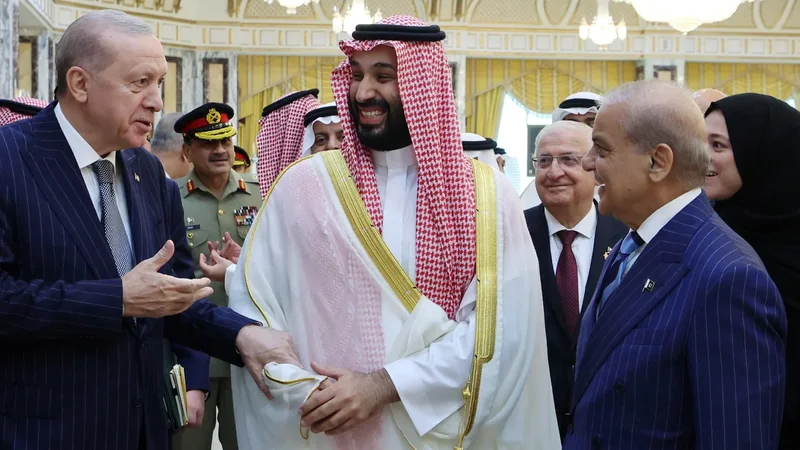
David Hearst argues that American weakness has prompted this necessary reshaping of the Middle East order, with the three biggest regional powers choosing to break the cycle of colonial domination by Israel
On paper - at least - a military pact between these three powers is formidable. Pakistan, Turkey and Saudi Arabia have respective nominal GDPs of $452bn, $1.6 trillion and $1.3 trillion.
Between the three countries, they could field over 5,600 main battle tanks, over 1,100 combat fighter jets, a fleet of drones, ballistic missiles and a nuclear deterrent and well over a million soldiers.
Each partner in the Mecca Joint Defence Agreement has a different motivation.
Pakistan, which is battling at least two insurgencies, needs money.
Turkey needs a nuclear deterrent, particularly against frequent Israeli threats. It also needs to help the new government in Syria to force a withdrawal of Israeli forces from Southern Syria.
Saudi Arabia needs a lever over Iran and Yemen’s Houthis (officially known as Ansar Allah), which have recently closed the strait at the mouth of the Red Sea, and have begun bombarding oil fields in the kingdom.