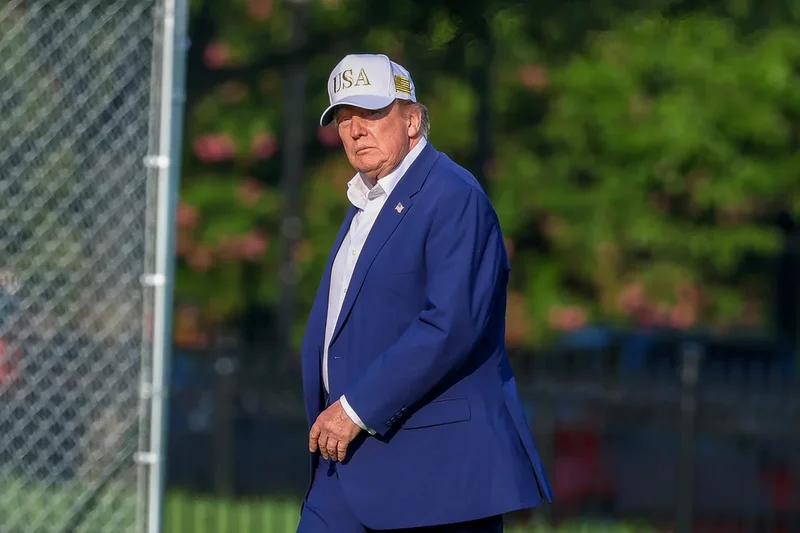
President Donald Trump said he is demanding that Iran pay compensation to American victims of Iranian-backed attacks going back decades, responding to Tehran's own demand for war reparations by turning the idea back on the country he started a war against five months ago.
In a post on Truth Social, Trump said he had "instructed my representatives to put this firmly into any, and all, future negotiations" — casting Iran's compensation demand as a novel idea he was happy to borrow.
"I see that Representatives of the Islamic Republic of Iran are asking for compensation for the damage done to them during the last five month Military Conflict (started because, THEY WILL NOT HAVE A NUCLEAR WEAPON), even though it was never mentioned in any of our negotiations or meetings!" he wrote.
He then called Tehran’s demand for compensation “an interesting idea” and said he was in turn demanding the same “for all of the people that they have killed and gravely wounded with their roadside bombs and many conflicts, for which they are famous” as well as “thousands of others killed in combat” in addition to the nearly 40 killed in the 2000 bombing of the U.S.S. Cole even though that attack was carried out by al-Qaeda, not anyone affiliated with Iran.
Trump also claimed that Iran should pay some recompense to families of "the hundreds of thousands of innocent protestors that Iran has killed over the last 50 years, not to mention the 52,000 that have been killed in the last five months."
It’s unclear how the president came to the idea that there’ve been 52,000 killed in the five-month-old war he started, as official American and Israeli estimates have placed the actual number of casualties at somewhere just north of 6,000.
Trump’s latest social media missive comes amid a delicate stretch of negotiations to bring an end to the conflict as the U.S. continues to grapple with a munitions shortage with the war nearing the half-year mark.
On Saturday, Mohammad Bagher Zolghadr, secretary of Iran's Supreme National Security Council, published a list of six conditions Tehran says the United States must meet before the Strait of Hormuz reopens: an end to US threats and to what he called insults to Iran's national and religious values; a permanent halt to attacks on Iran and its allies in Lebanon, Palestine, Yemen and Iraq; the lifting of the US naval blockade and withdrawal of American naval and air forces from the region; compensation for damage from what he described as two "imposed wars"; an end to sanctions; and the unconditional release of frozen Iranian assets.
Iranian officials also said over the weekend they were close to a separate agreement with Oman on control of the waterway, but that no deal would actually reopen it to traffic unless Washington met the six conditions first.
Both sanctions relief and some form of reparations were supposed to be handled in talks pursuant to interim memorandum of understanding signed by American and Iranian representatives at the start of what was supposed to be a 60-day ceasefire period starting in June.
That two-month period ends in just over a week, and it’s unclear whether there will be any extension agreed to.