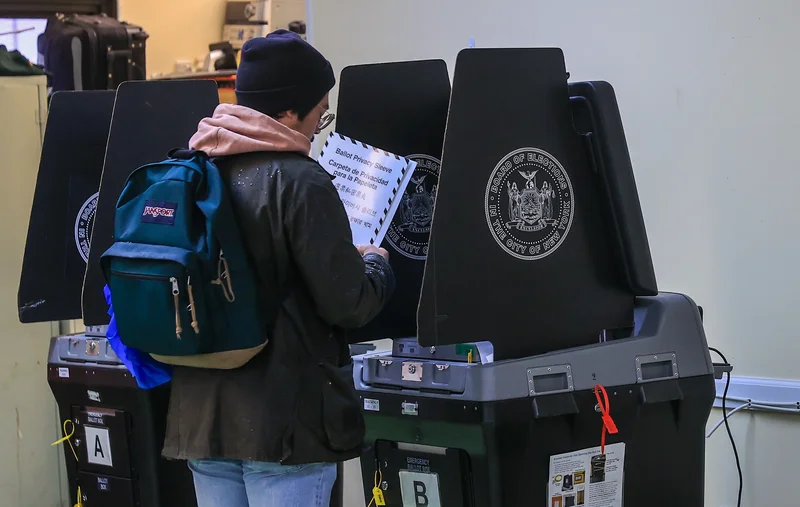
Voters in Connecticut, Minnesota, Vermont, and Wisconsin will head to the polls this Tuesday, August 11, to take part in primary elections that will help determine the candidates for the November midterm elections. The contests include races for governor, the Senate, and the House of Representatives, as well as numerous state legislative offices.
The election comes 84 days before the November midterms and will be particularly significant for the Democratic Party, which is facing an internal dispute between its moderate and progressive factions. In Minnesota and Wisconsin, two of the most closely watched contests will pit candidates associated with different wings of the party against one another, while Connecticut will also put the political futures of two veteran Democrats to the test.
In Vermont, Democrats will make a sixth attempt to find a candidate capable of defeating Republican Gov. Phil Scott, while Minnesota Republicans will seek to end a long drought in statewide elections.
What is on the ballot in each state?
In Connecticut, the main contest will be the Democratic primary for governor. Incumbent Gov. Ned Lamont is seeking a third term against state Rep. Josh Elliott. The winner will face Republican state Sen. Ryan Fazio in November. Republicans have not controlled the governor’s mansion since 2011, and Lamont was reelected in 2022 with 56% of the vote.
There will also be a Democratic primary in the 1st Congressional District, where 78-year-old Rep. John Larson is seeking a 15th term. It is the first time since his election in 1998 that he has faced a primary challenge, with former Hartford Mayor Luke Bronin, Ruth Fortune, and state Rep. Jillian Gilchrest as his opponents.
In Minnesota, attention is focused on the Democratic primary for the U.S. Senate. Rep. Angie Craig and Lt. Gov. Peggy Flanagan are competing to replace Sen. Tina Smith. Flanagan has the backing of progressive figures including Elizabeth Warren, Bernie Sanders, and Ilhan Omar, while Craig has the support of Hakeem Jeffries, Nancy Pelosi, and Pete Buttigieg.
Republicans will also choose their Senate nominee from a nine-candidate field that includes former sports commentator Michele Tafoya.
In Vermont, Democrats are seeking to defeat Republican Gov. Phil Scott. Economist Amanda Janoo and Aly Richards are competing for the nomination. Richards has the backing of former Democratic governors Howard Dean and Madeleine Kunin. Scott faces no opposition in the Republican primary and enters the general election with a significant advantage: he won 73% of the vote in his 2024 reelection. He has also distinguished himself through his criticism of Donald Trump and has said he voted for Kamala Harris in the 2024 presidential election.
In Wisconsin, the main contest will be the Democratic primary for governor, which will determine Tony Evers’ successor. Four candidates remain in the race: state Rep. Francesca Hong, Milwaukee County Executive David Crowley, former state cabinet secretary Joel Brennan, and state Sen. Kelda Roys. Hong, a democratic socialist, has emerged as one of the leading candidates. Crowley briefly dropped out of the race in July and later returned with Evers’ endorsement. The winner will likely face Republican Rep. Tom Tiffany, who is endorsed by Trump.
What is at stake for the parties?
The primaries come after Abdul El-Sayed’s victory in the Democratic Senate primary in Michigan on August 4, a result that intensified attention on the struggle between the party’s progressive wing and its moderate factions.
Wisconsin is also one of the country’s key battleground states. The governor’s race could determine which party controls the state government, while a competitive House race could help determine the balance of power in Congress.
Minnesota, meanwhile, has gone decades without electing a Republican in a statewide race. The last Republican to win a statewide contest was Gov. Tim Pawlenty in 2006, while Norm Coleman was the last Republican to win a Senate election, in 2002.
In Connecticut, Democrats hold two-to-one majorities in both chambers of the state Legislature. In Wisconsin, Republicans currently hold narrow majorities in the state Senate and Assembly.
When do polls close, and when will results come in?
In Vermont, polls close at 7:00 om ET. Connecticut and Wisconsin will close at 8:00 pm, while Minnesota will close at 8:00 pm CT, equivalent to 9.00 pm ET.
The first results will begin to come in shortly after polls close, although the pace of counting will depend on local jurisdictions.