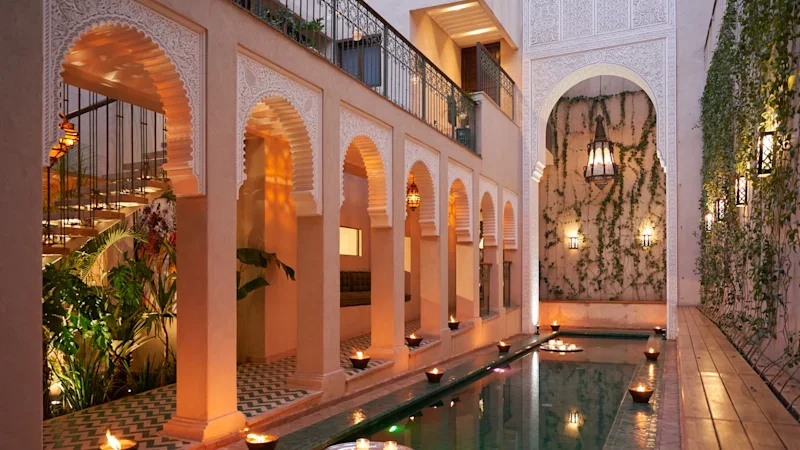
If you asked me to name my favourite style of hotel, I would without hesitation say the Moroccan riad.
A riad is a traditional Moorish house built around a central garden. In North Africa, particularly Morocco, it more often means a guesthouse in a heritage building where the rooms are arranged facing a shared courtyard.
Some riads are quite simple, run by the family that has lived there for generations.
The rooms can be small but even in the modest households, they open to courtyards covered in mosaic tiles, known as zellige, with a splashing fountain in the centre and surrounded by greenery, usually citrus trees planted in pots.
This style of inward-facing architecture that keeps families cool was perfected in the 12th century and little has changed.
Get exclusive travel deals delivered straight to your inbox. Sign up now.
They’re beautiful buildings. The houses are constructed from rammed earth or mud bricks, and they’re unadorned from the outside, except for the painted or metal doors that distinguish them from their neighbours in the labyrinth of lanes.
The interior walls are covered with tadelakt plaster, a time-intensive technique that brings colour and lustre to plain walls.
Carved horseshoe arches, decorative timberwork and hand-crafted lanterns are common features. The houses are usually two or three storeys high, so the rooftop terraces have mesmerising views across the city to other terraces and roofs.
Apart from the astounding aesthetic beauty, there are many other things I love about staying in a Moroccan riad.
Breakfasts are almost always included. Served with gallons of mint tea, they’re extravagant and dangerous for the waistline, especially msemen pancakes and baghrir crumpets, drizzled with honey.
And I love the price. Staying in a riad can be surprisingly good value. Many will barely set you back $200 to $300, often less, in the centre of the city.
Even more than this, I love the sense of place.
The oldest houses are concentrated within the medina walls, which means guests are immersed in local culture as soon as they step outside the door.
Moroccans are extremely hospitable, so you’re not just invited into their house – you become part of their neighbourhood.
But many riads fall into ruin because of the immense cost of labour-intensive repairs.
The medinas of Marrakesh, Rabat, Essaouira and Fes have UNESCO World Heritage status. Increasingly, the houses in them are being bought and renovated by foreigners – it’s often only foreigners who have the money required to restore a heritage building.
Thankfully, many have been captivated by the magic of the medina. The restorations have sustained the skills of the traditional artisans, which might have been lost without private support.
Last year, I stayed at Riad Romeo, which is in one of the oldest parts of the Marrakesh medina. It’s owned by Italian fashion designer Romeo Gigli, who moved to Marrakesh when he retired from fashion more than 20 years ago.
Gigli collaborated with local artisans on the traditional work such as the zellige tiling in the bathrooms and in the spectacular yellow-tiled waterfall in the courtyard, and on modern furnishings he designed himself. The result is a modern take on the riad that still retains many of the traditional features.
Known as the “house of friends”, Izza was inspired by the bohemians of the 1970s who flocked to Marrakesh, such as Yves Saint Laurent, Talitha Getty and Marianne Faithfull, and the 14 rooms are named for each of them.
British tech entrepreneur Neil Hutchinson bought and restored eight interlinked riads, transforming them into one to create Izza and filling it with about €5 million ($8 million) worth of art from his collection.
Izza is gorgeous, rambling across three courtyards and multiple rooftops, full of arresting art and contemporary furniture as well as magnificent zellige wherever the eye lands.
Belgian artist Laurence Leenaert and her partner Ayoub Boualam opened Riad Rosemary the week of the 2023 Moroccan earthquake. The lovely five-bedroom riad is full of her bright ceramic plates and pots, which luckily mostly survived the upheaval.
Riad Botanica is owned by Angela and Mohamed Mallak (she’s from Melbourne; he’s from Morocco). It’s another small Marrakesh riad that has had a painstaking restoration and makeover.
Traditional Moroccan mosaics, plasterwork and ornate cedar doors have been teamed with art deco wallpaper by Florence Broadhurst, an Australian contemporary twist.
There are so many riads in Marrakesh, I could probably spend a year there and not stay in them all.
Keep the mint tea warm for me.
The writer was a guest of Riad Romeo and Izza.