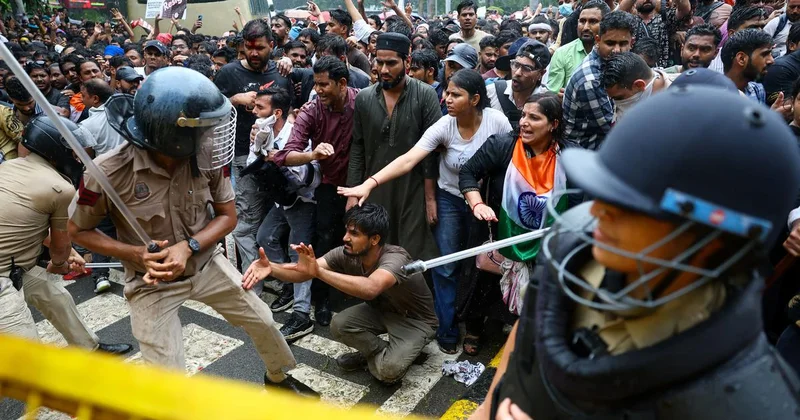
On Monday, social media was filled with images of the march to Parliament called by the Cockroach Janta Party political campaign. The Delhi Police said it had not given permission for the march. Some participants crossed barricades and allegedly threw stones.
The police and Rapid Action Force appear to be responding with disproportionate force. Videos show the men in uniform firing tear gas and raining baton blows upon protesters, many of whom were retreating, surrounded by the police and visibly not attacking anyone. These accounts require verification, but the imbalance is apparent.
In the Supreme Court on Wednesday, Chief Justice Surya Kant refused to urgently hear a petition alleging that the police had used excessive force against protesters. “Don’t waste our time and don’t waste your time,” Live Law quoted Chief Justice Surya Kant as saying.
The lawyer who sought that the plea be listed for hearing on Thursday told the court that he could present video evidence of the police excesses. However, Live Law quoted Justice Kant as saying, “We don’t have time to watch.”
A day earlier, on Tuesday, a public interest litigation alleging excessive force by the police forces was urgently mentioned before the Delhi High Court. “Don’t drag the court into all this,” the bench reportedly remarked. The next day, however, the court sought the Delhi Police’s response on the allegations of “brutalities”.
The response of the Supreme Court is unsettling because the Constitution tasks the judiciary with checking the abuse of power by the other branches of the government. The public interest litigation had merely asked the court to examine the constitutional limits on coercion exercised in the name of the Republic.
In the landmark 1952 decision in State of Madras vs VG Row, Chief Justice Patanjali Sastri described the Supreme Court as a “sentinel on the qui vive” – a vigilant guardian of fundamental rights against state overreach.
The court’s refusals brought back memories of another situation in Delhi when the police in 2011 descended upon Ramlila Maidan at midnight to evict thousands of citizens protesting against the corruption of the Congress-led United Progressive Alliance government.
At that time, the Supreme Court acted on its own. It found the police action to be unreasonable and excessive. It spoke of “least invasion”, requiring the state to choose the course that intrudes least upon rights and of “care perception”, recognising that the police remain responsible for the safety of a gathering even while dispersing it.
In Dr Ram Manohar Lohia v State of Bihar in 1965, Justice M Hidayatullah described law and order, public order and the security of the state as concentric circles. The judge warned against magnifying every disturbance into the gravest threat to political order.
Article 14 guarantees everyone equality before law and the equal protection of laws in India while under Article 21 guarantees protection of life and liberty. These constitutional provisions mean the state is obligated to distinguish between the violent and peaceful bystanders at the protest, as well as ensure that the actions of its security forces are fair and proportionate. A protest march that was denied permission does not invalidate these constitutional rights.
Then there is the allegation that some members of the Delhi Police and other forces were on duty in Central Delhi without nameplates and were not in uniform. In DK Basu vs the State of West Bengal in 1996, the Supreme Court required police personnel making arrests to bear clear identification. The direction arose in the context of custody, but its animating principle that public force must be traceable.
A uniform and badge establishes that force flows from public authority, which is accountable. Otherwise, a citizen enters the world of Franz Kafka’s The Trial, where authority is everywhere and responsibility nowhere.
After immense criticism on social media, the Delhi Police directed its personnel to report for duty in uniform, according to The Indian Express.
The first task after the events on Monday is to preserve the conditions in which the truth can be established. CCTV and body-camera footage, wireless communications, deployment charts, station diaries and orders authorising tear gas or baton charges should be secured before they are deleted or overwritten.
If plainclothes personnel participated in detentions or the use of force, their identities, units and orders must be placed in the public domain. A state that monitors its citizens cannot become anonymous the moment it exercises coercion.
Medical evidence relating to injured protesters and police personnel must also be preserved. Allegations of stone throwing and police excess must be investigated together. There must be an independent fact-finding team or judicial monitoring of the investigation. The judiciary must ensure that evidence survives, identities are traceable and that state force is answerable to the law.
In her essay The Iliad, or the Poem of Force, French philosopher Simone Weil notes that force injures but also turns a person with a voice and a claim upon the Republic into a body to be restrained or dragged away.
But Weil warned that force petrifies both those who suffer it and those who wield it. It dehumanises the wielder too, dulling judgment, eroding restraint and allowing lawful authority to slip into domination.
Constitutional law is safeguard against this “petrification”. Its purpose is not to prevent the state from maintaining public order, but to ensure that every exercise of force remains identifiable, necessary and capable of legal justification. The Republic does not weaken its authority by holding the police accountable; it proves that its authority is constitutional.
The author is a constitutional lawyer and an alumnus of the University of Delhi and NALSAR University of Law.
The author gratefully acknowledges the conversations with Divyansh Singh of Delhi School of Economics and Aishani Gupta of Indraprastha College for Women, whose experiences at the Delhi protest followed helped shape to the central argument of this piece.