Market research exists to make companies faster and the machinery of it has spent forty years making them slower. A single ambitious study at a consumer goods company can combine qualitative and quantitative methods, narrow participant criteria, observation, longitudinal fieldwork and multiple countries, all chained to a launch deadline, and running it means assembling a supply chain of recruiters, panels, moderators, translators, analysts and production teams in which every stage waits on the one before it.
The researchers nominally in charge of insight spend most of their hours coordinating vendors instead of interpreting customers, and the industry has quietly accepted that the operation behind the answer takes longer than the decision it was meant to inform. Then the supply chain developed a second problem, which is that its raw material started rotting: NORC calculates that 40 per cent of nonprobability interviews in 2025 were likely fraudulent, an audit across six leading sample sources flagged roughly 30 per cent of respondents as suspicious in every single panel tested, including one user who attempted more than 1,100 surveys in a day, and Kantar's own research found teams discarding up to 38 per cent of everything they collect.
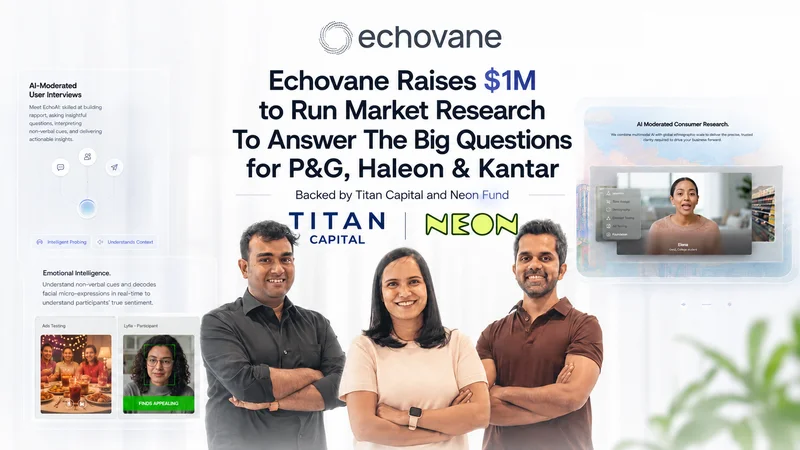
Echovane raised $1 million, co-led by Titan Capital and Neon Fund, to replace that supply chain with something that behaves less like a chain and more like a service. Founded by Smriti Gupta, Vipul Nair and Himadri Roy, product and technology leaders out of Amazon, Stripe, Gojek and Razorpay and graduates of the Indian Institutes of Technology, the San Francisco company runs what it calls a permanently done-for-you research service: a client provides the business question, and Echovane's AI agents carry the study from brief to answer, designing and coordinating the project, recruiting and verifying the exact participants required, conducting interviews, observations and surveys across voice, video and text, analysing the qualitative and quantitative evidence together, and delivering the result as presentations, dashboards, datasets, participant quotations and video reels that a decision-maker can actually use. The funding goes into three things, deeper agent infrastructure, expanded multimodal capability, and the global participant network underneath it all.
The pitch is unusual for an AI company in 2026, because the differentiation is a legal and commercial posture rather than a model. Nearly every AI research product on the market sells software and leaves the customer holding the outcome, while Echovane sells the outcome itself, combining what it describes as agency ownership with the speed and economics of AI, and that single word, ownership, is doing enormous work. It is why the customer list reads the way it does at a check size this small: P&G and Haleon do not experiment with unaccountable tools on launch-critical studies, and Kantar, the largest insights company in the world, buying research execution from a seed-stage startup is the kind of detail that says more about where this industry is heading than any forecast could. Trustly's chief product officer, Adam D'arcy, supplied the number that makes the proposition concrete, reporting that Echovane turned a month of product research into two days, across multiple audiences, countries and product variants inside a single continuous study.
The Most Expensive Coordination Problem in the Insights Industry
The market Echovane is entering is large, growing, and structurally ready to be re-platformed. The global insights industry passed $150 billion, having grown 47 per cent in three years, and within it the market research services sector alone accounts for roughly $54 billion of largely manual, project-based work. Adoption of AI has crossed from experiment to expectation, with 72 per cent of insights buyers now using generative AI in at least one stage of a project, up from 23 per cent in 2023, and the economics underneath that shift are not subtle: AI-moderated qualitative interviews now cost $8 to $15 per completion against $150 to $300 for human-moderated equivalents, a collapse of roughly 95 per cent in the largest variable cost qualitative research carries.
What the cost collapse has not solved on its own is trust, and this is where the fraud data stops being background and becomes the thesis. Cheap, fast fieldwork run against panels where a third of respondents are suspect produces cheap, fast, wrong answers, which is why the industry's efficiency gains keep leaking away into verification, re-fielding and discarded data. Echovane's answer is to own the participant layer directly, building infrastructure to find, verify and engage precisely described people anywhere in the world, however narrow the behavioural criteria, which makes possible the studies conventional panels structurally cannot support: hard-to-reach communities, small but commercially decisive audiences, and multi-country work that keeps its consistency across borders.
Gupta's account of the company's evolution explains why the scope is this wide, because the founders began by building an AI moderator for consumer interviews and discovered, in her words, that the interview was only one step in one methodology, while the real complexity lived in finding niche participants, completing fieldwork on time and holding quality across the whole operation. The product expanded to match the problem, and the problem turned out to be the entire execution layer.
The Investor Thesis: The Smallest Check on the Cap Table's Client List
A $1 million round serving three of the world's largest consumer and insights companies is a financing that inverts the usual sequence, and the inversion is the thesis. Most AI startups raise on a promise and spend the capital searching for customers, while Echovane arrived at its first institutional round with P&G, Haleon and Kantar already paying, which means this check was priced against evidence rather than narrative, and the investors who wrote it are worth reading closely because both are pattern-matching from unusually relevant experience.
Titan Capital is the fund of Snapdeal founders Kunal Bahl and Rohit Bansal, whose early-stage record includes some of India's most consequential seed checks, Razorpay among them, and there is a specific signal in the fund that seeded Razorpay now backing a founding team that includes Razorpay alumni: this is capital re-underwriting people it has already watched execute, which is the private-market equivalent of a reference that cannot be faked. The firm's stated reasoning goes to the durability of the model rather than its speed, arguing that Echovane is encoding each client's context into a system that gets sharper with every study, turning research from a recurring expense into compounding infrastructure, and that framing deserves unpacking because it is the difference between a services business and a platform: if every completed study genuinely makes the next one better for that client, switching costs accumulate with usage, and the done-for-you service quietly becomes the system of record for what a company knows about its customers.
Neon Fund's logic runs through the buyer rather than the model. Udit, a principal at the firm, anchored the conviction in category stakes, observing that consumer research sits behind every product decision and that the consequences concentrate hardest in CPG, where shelf space is brutal to win and a failed launch is expensive and slow to unwind, which is exactly the segment Echovane's earliest logos come from. His second point, that the co-founders have known each other a long time and have scaled products at Amazon, Stripe and Razorpay, reads like biography but functions as risk analysis, because done-for-you services live or die on operational reliability, and a founding trio with long shared history and shipped systems at that scale is the profile you underwrite when the product is a promise to deliver. The round's most telling attribute, finally, is its size relative to its evidence, since a team that reached Fortune 500 production deployments on roughly this much capital is demonstrating the capital efficiency Titan explicitly cited, and in a funding environment that has rewarded AI companies for burning toward promises, a seed priced on paying enterprise logos is a quietly contrarian document.
What Has to Go Right
Honest analysis requires naming the hard parts, and Echovane has four worth naming.
The first is that the ambition is priced in tens of millions and the round is one, because a global network of verified participants spanning arbitrary geographies and behaviours is infrastructure, and infrastructure eats capital. One million dollars extends a capital-efficient team meaningfully but does not build a worldwide recruitment and verification apparatus, which means the real function of this round is to convert the current logo list into retention and expansion evidence for a much larger financing, and the metric that will price that next round is whether P&G, Haleon and Kantar are still there and buying more.
The second is the economics of ownership, since a company that owns the outcome owns the exceptions too, and the margin question for every done-for-you service is what share of the work the agents genuinely absorb versus what humans quietly backfill when a study gets strange. If the automation share is high, Echovane compounds like software; if it drifts low, the company becomes a well-tooled agency with agency margins, and gross margin over the next eighteen months is the number that reveals which.
The third is that the client list contains a competitor, because Kantar as a customer is simultaneously the strongest validation in this story and its most delicate relationship, given that the world's largest insights firms have the data, the client base and now the visible incentive to build execution agents of their own. Echovane's defense is speed and the accumulating context Titan described, and the history of startups supplying the incumbents they threaten suggests the window in which that defense must become a moat is measured in a couple of years rather than many.
The fourth is the synthetic-respondent question, which cuts at the foundation. A growing share of researchers now incorporate synthetic data into their work, and if simulated respondents prove good enough for most everyday studies, the value of a painstakingly verified human network narrows to the hardest research. Echovane's bet is the opposite of the synthetic wave, that a fraud-saturated industry will pay a premium for verified real humans and traceability back to genuine evidence, and the fraud numbers argue the bet is sound, but it is a bet, and the article of faith underneath this company is that the truth about customers still has to come from customers.
Final Thoughts
Every industry that runs on coordination eventually meets software that removes the coordination, and market research has resisted longer than most because its product is trust, which software alone has never been able to carry. What makes Echovane's version of the attempt interesting is that it does not ask the industry to trust software, it asks the industry to hold a company accountable for an answer, with every conclusion traceable back to the interview, observation or response behind it, and the earliest verdicts have come from the least forgiving jury available: the largest consumer companies on earth, and the largest insights company on earth buying from the startup built to disrupt it.
Funding stories are easy to tell and hard to interpret, but this one comes with an unusually clean test, and the test is retention. Either the marquee logos are still on the client list in eighteen months, buying more studies across more markets while the gross margins prove the agents rather than hidden humans are doing the work, in which case the smallest check on this cap table's client list will look like the cheapest entry anyone got into the re-platforming of a $150 billion industry, or the incumbents rebuild the execution layer themselves and the window closes. A company whose entire pitch is accountability has, at least, chosen the one test it cannot argue with.
Don't forget to like and share the story!
Vested Interest Disclosure: HackerNoon has reviewed the report for quality, but the claims herein belong to the author. #DYOR.