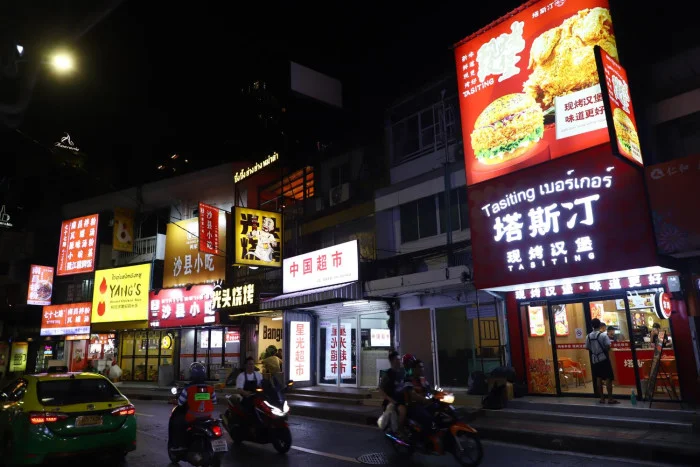
The online debate over whether restaurants in Thailand should accept orders only in Thai highlights an underlying issue in the industry: a persistent labour shortage, as many Thais do not want to work in the sector.
Well-known tech creator Pongsuk Hiranprueck recently shared on Facebook his experience at a restaurant in Bangkok, where he was served by a foreign waitress who could speak Thai, but discovered that most other staff members could not.
This is not the first time the issue has been raised. Psisamutt, a user on the X platform, said he always orders in Thai, and if a waiter or waitress does not understand him, he simply switches to someone who does. He said that since he is in Thailand, he wants to speak Thai.
Chanon Koetcharoen, president of the Restaurant Association, said his association comprises mainly SME restaurant operators. The industry is facing a significant labour shortage, as Thai nationals are typically not interested in these types of jobs.
This prompts operators to hire workers from other countries who are willing to work hard and show resilience.
He said that increasing the daily minimum wage could encourage more Thais to return to restaurant work. However, he cautioned that this would lead to higher operating costs and inevitably higher menu prices.
He added that Thais typically oversee operations, while foreign workers are more likely to fill lower-level positions.
Mr Chanon said that most migrant workers in the sector are from Myanmar, with the majority able to communicate in Thai. Lao workers, whose language is similar to Thai, make up the next largest group.
He estimated that the restaurants most likely to hire migrant workers are in the buffet category, such as moo krata and shabushabu restaurants, which require a large number of workers due to the labour-intensive nature of the work.
Regarding the online discussion, he believes restaurants should have at least some Thai-speaking staff, but not every employee needs to speak Thai.
He also pointed out that restaurants in tourist locations, where diners are more diverse, may benefit from hiring staff who can speak multiple languages.
Thaniwan Kulmongkol, president of the Thai Restaurant Association, echoed the view that many Thais see the industry as labour-intensive and are generally unwilling to work in it.
She urged operators who employ Thai or migrant workers to comply with regulations such as the Food Handler Certificate to ensure food safety for consumers.