Latin America · Trade
Key Facts
—Rate and timing. A 50% tariff on Canadian exports was announced in July 2026, effective in 30 days.
—Exempt sectors. Canadian energy, potash, critical minerals and fish remain tariff-free or low-tariff.
—Brazil precedent. The U.S. imposed a 50% tariff on Brazil in August 2025 over political disputes.
—Mexico risk. Mexico already faces a 35% tariff on non-USMCA goods, with energy taxed at 10%.
—Trade diversion. Exempt Canadian goods may crowd out Latin American energy and mineral exports to the U.S.
The Trump Canada tariff of 50% announced in July 2026 threatens to divert trade flows away from Latin America, even as it punishes Ottawa for alleged discrimination against U.S. vehicles, dairy and alcohol.
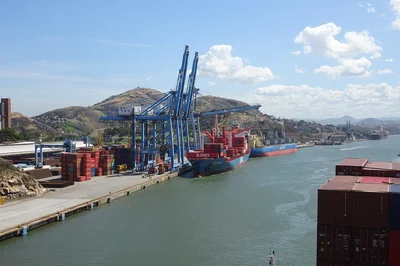
Container ports handle the Latin American trade flows that new US tariffs could redirect. (Photo internet reproduction)
One-stop reference
Company Intelligence
Every listed company in Latin America — financials, ownership and structure for 1,450+ companies across 26 exchanges, in one place.
How the Trump Canada Tariff Diverts Trade from Latin America
The new levy excludes Canadian energy, potash, critical minerals and fish, leaving those sectors tariff-free or at a low 10% rate.
Because those goods remain cheap for U.S. buyers, demand may shift toward Canada and away from Latin American suppliers of similar commodities.
Brazilian iron ore, Mexican copper and Argentine soy could face stiffer competition as U.S. importers lock in exempt Canadian supply.
Simulation models suggest Canadian exports could drop up to 28% under full retaliation, but exempt sectors may actually gain U.S. market share.
Latin American exporters in tariffed categories such as steel, cement and alcohol might see short-term gains if U.S. buyers seek Canadian alternatives.
However, the net effect for the region leans negative because energy and minerals represent a far larger share of Latin America’s U.S.-bound trade.
This trade arbitrage opportunity means U.S. companies can source critical raw materials from Canada without penalty, while Latin American producers face a relative price disadvantage.
For foreign readers unfamiliar with the region’s export profile, commodities like iron ore, copper and soybeans are the economic backbone of Brazil, Chile and Argentina, making any demand shift deeply consequential.
A 50% Penalty Rate Becomes the New Normal
The Trump Canada tariff reinforces a pattern where political disputes trigger maximum-tier levies, overriding existing free-trade agreements.
Brazil was hit with an identical 50% tariff in August 2025 after the prosecution of former President Jair Bolsonaro, though aircraft and orange juice were spared.
Mexico already operates under a 35% tariff on non-USMCA goods, with energy taxed at 10%, a structure imposed under IEEPA authority.
The Canada case now validates 50% as a standard penalty rate, raising the ceiling for what Brazil and Mexico could face in future disputes.
For foreign investors watching Latin America, this precedent signals that no free-trade pact guarantees stable U.S. market access.
A migration or drug-enforcement clash with Mexico, or a new political row with Brazil, could swiftly escalate to the same 50% level.
The USMCA, which was designed to provide tariff-free trade across North America, has now been effectively overridden for covered Canadian goods, eroding the treaty’s reliability.
This development matters deeply for expats and retirees who hold assets in pesos or reais, as currency values often tumble when tariff risks spike.
Live Market IntelligenceBrazil — Live Market BoardInside: market breadth, the sector heatmap, currencies \& rates, the Latin America scoreboard and the full instrument board.
Rio Times · Live Market Intelligence
Brazil — Live Market Board
B3 · São Paulo
Jul 21, 2026 · 05:30
Ibovespa · benchmark
173,371.35
-0.20%
+29.22% over 12 months
Market breadth · 15 names
40% advancing
6 ▲ advancing9 declining ▼
Currencies, rates \& key inputs
Sector heatmap · average move today
Consumer Staples
+1.02%
ABEV3
Energy
+0.17%
PETR4, PRIO3
Financials
+0.08%
ITUB4, BBDC4, BBAS3, B3SA3
Mining
-0.91%
VALE3, CSNA3, GGBR4
Industrials
-1.55%
WEGE3, RENT3
Consumer Disc.
-2.26%
AZZA3
Latin America scoreboard
IndexLastTodayStrength
IbovespaBrazil
173,371.35
-0.20%
S\&P/BMV IPCMexico
66,125.27
-0.74%
S\&P IPSAChile
10,896.87
+0.10%
S\&P MERVALArgentina
3,223,652
+0.74%
MSCI COLCAPColombia
2,298.34
+0.00%
BVL S\&P PerúPeru
55,645.90
—
Full instrument board
| Instrument | Last | Change | YoY | Prev. | High | Low | Volume |
| --- | --- | --- | --- | --- | --- | --- | --- |
| IBOV | 173,371.35 | -0.20% | +29.22% | 173,714.08 | — | — | — |
| USD/BRL | 5.08 | -0.17% | -8.90% | 5.09 | 5.09 | 5.08 | — |
| SELIC | 14.25% | | — | — | — | — | — |
| PETR4 | 41.15 | +0.61% | +32.53% | 40.90 | 41.44 | 40.47 | 26,963,500 |
| VALE3 | 71.93 | -1.38% | +28.33% | 72.94 | 73.25 | 71.71 | 13,089,900 |
| ITUB4 | 42.30 | +0.81% | +22.80% | 41.96 | 42.53 | 42.10 | 12,611,000 |
| BBDC4 | 18.41 | +0.66% | +17.41% | 18.29 | 18.51 | 18.28 | 12,802,000 |
| BBAS3 | 20.17 | -1.56% | +1.56% | 20.49 | 20.54 | 20.13 | 15,053,800 |
| B3SA3 | 15.26 | +0.39% | +16.49% | 15.20 | 15.43 | 15.14 | 16,307,500 |
| ABEV3 | 15.79 | +1.02% | +17.66% | 15.63 | 15.83 | 15.58 | 24,319,200 |
| WEGE3 | 43.13 | -1.15% | +2.76% | 43.63 | 43.79 | 43.02 | 3,973,600 |
| PRIO3 | 57.69 | -0.28% | +34.92% | 57.85 | 58.72 | 57.62 | 4,922,600 |
| SUZB3 | 41.89 | -0.10% | -17.86% | 41.93 | 42.03 | 41.11 | 4,464,600 |
| RENT3 | 37.49 | -1.94% | +4.66% | 38.23 | 38.38 | 37.41 | 5,725,800 |
| AZZA3 | 18.17 | -2.26% | -48.86% | 18.59 | 18.75 | 18.16 | 906,100 |
| CSNA3 | 5.07 | +0.40% | -36.55% | 5.05 | 5.12 | 5.03 | 6,881,700 |
| GGBR4 | 23.62 | -1.75% | +42.12% | 24.04 | 24.25 | 23.53 | 4,280,300 |
| ENEV3 | 25.65 | -0.12% | +85.87% | 25.68 | 25.84 | 25.47 | 6,953,200 |
Largest moves today
AZZA3
18.17
-2.26%
RENT3
37.49
-1.94%
GGBR4
23.62
-1.75%
BBAS3
20.17
-1.56%
VALE3
71.93
-1.38%
WEGE3
43.13
-1.15%
ABEV3
15.79
+1.02%
ITUB4
42.30
+0.81%
The session read
The Ibovespa eased 0.20%, with breadth negative — 6 of 15 names higher. Consumer Staples led, while Consumer Disc. lagged.
From The Rio Times
Related coverage · 21 Jul 2026
Brazil Markets: Ibovespa \& the Real — July 21, 2026
Read →
Winners and Losers Among Latin American Exporters
Brazilian iron ore producers, already navigating a 50% U.S. tariff on other goods, now face a Canadian competitor with privileged access for critical minerals.
Mexican copper and manufactured goods could lose ground if U.S. firms substitute exempt Canadian energy and raw materials for Latin American inputs.
Argentine soy and Brazilian beef exporters may encounter new scrutiny if Washington expands retaliation criteria to food and alcohol sectors.
Meanwhile, Chilean and Colombian exporters with stable U.S. relations could attract capital fleeing uncertainty in Canada and larger Latin American economies.
Currency volatility is a near-term risk for Brazil’s real, trading near R$5.1 per US$1, and Mexico’s peso at about 18.5 per US$1.
Investors may price in higher tariff risk premiums on Brazilian and Mexican bonds if they view the Canada move as a template for future action.
Chile, the world’s largest copper producer, and Colombia, a major coal and coffee exporter, have so far avoided direct U.S. tariff escalations, making them relative safe havens.
For tourists and expats, a weaker real or peso means their dollars stretch further locally, but it also signals deeper economic instability that could affect services and infrastructure.
What This Means for Regional Investment Strategies
U.S. firms may accelerate supply-chain shifts into Mexico or other Latin American nations to bypass Canadian tariffs on non-exempt goods.
However, the same firms must weigh the risk that Mexico itself could become a 50% tariff target if bilateral tensions flare.
Capital that might have flowed to Canadian energy or mining projects could redirect toward Latin American markets with more predictable U.S. trade ties.
Chile, Colombia and Peru, which have avoided recent tariff escalations, stand to benefit as investors seek havens within the region.
The longer-term question is whether the U.S. will weaponize tariffs against any Latin American country that pursues independent trade or foreign policies.
For now, the Trump Canada tariff serves as both a trade shock and a warning: political disputes can rapidly become economic penalties.
Investors holding Brazilian or Mexican government bonds should monitor political rhetoric closely, as a single tweet or executive order could trigger a sell-off.
Expats planning property purchases or business ventures in the region may want to favor countries with quieter U.S. relations until the trade landscape stabilizes.
Background: How Trade Tensions Reached This Point
The July 2026 tariff escalation traces back to long-simmering disputes over Canadian protection of its dairy and alcohol industries, which Washington has long called discriminatory.
President Trump’s trade strategy increasingly treats tariffs not just as economic tools but as diplomatic leverage, a shift that began during his first term and has accelerated since.
The USMCA, signed in 2020 to replace NAFTA, was supposed to prevent exactly this kind of unilateral action, but its enforcement mechanisms have proven too slow to stop rapid tariff impositions.
For Latin America, the pattern is familiar: the U.S. has used tariffs to pressure Mexico on migration and Brazil on political issues, blending trade policy with foreign policy.
This history helps explain why the Canada case matters so much to the region: it shows that even a wealthy, closely integrated neighbor like Canada is not immune, so no Latin American country should assume it is safe.
What Happens Next for Latin America
In the short term, Latin American commodity exporters should brace for a potential dip in U.S. orders as buyers test the reliability of exempt Canadian supply chains.
Over the medium term, the 50% benchmark could embolden U.S. trade negotiators to demand steeper concessions from Brazil and Mexico under threat of matching tariffs.
Diplomatic channels will likely intensify as Latin American governments seek assurances that their own disputes will not automatically trigger the maximum penalty rate.
For expats and foreign investors, the key indicator to watch is whether the U.S. extends the 50% rate to any new country before the end of 2026, which would confirm a permanent shift in trade policy.
The Trump Canada tariff may ultimately accelerate Latin America’s efforts to diversify export markets toward China and Europe, reducing long-term dependence on the U.S. market.
Frequently Asked Questions
Does the Trump Canada tariff directly apply to Latin American countries?
No, the 50% tariff applies only to Canadian goods, but it indirectly affects Latin America by diverting U.S. demand toward exempt Canadian exports such as energy, potash, critical minerals and fish. This shift can reduce market share for Latin American producers of similar commodities, even though their own goods are not directly taxed by this specific measure.
Which Latin American countries already face similar U.S. tariffs?
Brazil has faced a 50% U.S. tariff since August 2025, imposed after the prosecution of former President Jair Bolsonaro, though key sectors like aircraft and orange juice were exempted. Mexico pays 35% on non-USMCA goods and 10% on energy exports, a structure originally imposed under IEEPA authority and later adjusted upward.
Could Mexico or Brazil be hit with a new 50% tariff?
The Canada precedent shows that 50% is now an established penalty rate for political or trade disputes, so any future clash over migration, drug enforcement, labor laws or political prosecutions could trigger a similar levy on Mexico or Brazil. Investors and businesses in both countries should factor this elevated risk into their planning, as the threshold for maximum-tier tariffs appears to have permanently lowered.