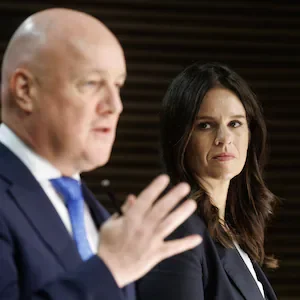
Prime Minister Christopher Luxon (left) and Education Minister Erica Stanford, pictured during a post-Cabinet media conference. Photo / Mark Mitchell
This opinion piece is republished from Liam Hehir’s Substack with his permission. You can read more of his work here.
The phones are reportedly buzzing in National’s caucus again, over Christopher Luxon’s captain’s call on an MMP referendum.
In a rapidly evolving situation, this afternoon thePrime Minister called an urgent in-person caucus meeting for 9.30am tomorrow, saying it was clear from media reports and conversations that there is “increased speculation” about his leadership, and that “division and disunity are a major distraction only 90 days out from the election”.
Whether tomorrow means a formal vote or simply a very frank meeting, nobody outside the caucus room knows yet (possibly not even the Prime Minister).
We have, of course, been here before. April was a press gallery circus. But when we look at the facts, all we really know is that there was some number of malcontents, supplying anonymous quotes, a press pack feeding frenzy over those quotes and, in the end, no resignation, no challenger and no vote beyond the one that Luxon staged himself — which is more or less the move he has just made again.
Which is not to say the same outcome is destined to repeat. The moral of the boy who cried wolf isn’t that there are no wolves. It’s that there are wolves, that they’re dangerous and that this is precisely why false alarms are to be avoided.
I think the point I would make to National MPs who can’t help themselves here is that they should simply ask themselves this: when has a governing party ever successfully rolled its leader months out from an election while still in the contest? Almost never. Precisely one exception comes to mind, and it is more of a warning than an invitation.
The state of the polls is exactly what makes this proposal extraordinary rather than what excuses it.
Parties turn on their Prime Ministers when the position is hopeless. A good example is Justin Trudeau in late 2024 and early 2025. His Liberal Party was roughly 20 points down and had nothing left to lose but the leader’s ego.
National isn’t there. In fact, we can’t even really see there from here. On the most recent published numbers, if an election were held tomorrow, National and its coalition partners would more likely than not form the next Government.
And the plan, if the phone calls are to be believed, is to use tomorrow morning to try to knife the sitting Prime Minister anyway, over a rough fortnight and a referendum comment nobody will care about by polling day. Try to say out loud National’s rationale here: we are ahead, or close enough that either outcome is live, and our considered response is to roll our own Prime Minister.
In terms of precedent, the closest parallel is almost certainly Julia Gillard’s move against Kevin Rudd in June 2010. Labor wasn’t cratering when that happened and in fact the party held a two-party lead of 52-48, improving to 53-47 the weekend after Rudd was rolled. Gillard got her honeymoon bounce, as new leaders do. Within weeks it had evaporated and by August, she was fighting an election to a draw that cost Labor its majority and left her running a hung Parliament for the rest of the term.
The spill didn’t rescue the Government. It did, however, become the explanation for everything that went wrong afterwards, including things that had nothing to do with it. Gillard and her supporters can argue that they probably salvaged a better result than Rudd could have achieved but that argument can never be proven.
Whoever replaced Luxon would be staking their entire political career on being able to generate a sustained surge in the polls. Say Chris Bishop or Erica Stanford gets the votes and say National loses in November. That person spends the rest of their political life fielding the same accusation: National was just ahead or at least even in the polls, you became the leader and we lost. There’s no answer to that charge that lands, because the counterfactual can’t be run.
None of this asks for blind loyalty to Luxon. If National were 20 points behind with a year to run, the calculation would look very different, especially if there was a contender popular both with the public and his or her colleagues. But those are not the circumstances and there are no challengers who meet both criteria.
So the sensible course, as it was in April, is to hold your nerve and fight the actual Opposition instead of each other: 90 days of disciplined campaigning on the message of fiscal repair while the numbers still allow for victory. We will find out at half past nine tomorrow morning whether that is the course the party takes.
But what would I know? Maybe feeding anonymous quotes to the press gallery is also a good strategy. I mean, I’m sure they have the party’s best interests at heart.
Liam Hehir is a Palmerston North-based lawyer, a National Party member and a former activist.
Catch up on the debates that dominated the week by signing up to our Opinion newsletter – a weekly round-up of our best commentary.