ASO discovery and design
Individualized ASOs were designed for two patients with intractable epilepsy with GOF and mixed GOF/LOF causal variants associated with DEE11. WGS identified SNPs on the reference haplotype, allowing the design of ASOs targeting only the pathogenic haplotype. A common benign SNP on the wild-type allele in each patient was used to develop a selective ASO for the mutant allele. These ASOs were designed to promote selective degradation of the mutant SCN2A transcript through recruitment of RNase H1 to the RNA–ASO heteroduplex16,17. Over 500 2’-methoxyethyl gapmers with mixed backbone (phosphorothioate/phosphodiester) were designed to single-nucleotide differences between the two alleles in the patients’ SCN2A gene. ASOs targeted either the SNP or the consensus sequence phased to the pathogenic allele as previously described16.
We mapped informative heterozygous SNPs using long-read sequencing in both Patient 1 and Patient 2. We were unable to identify a single ASO that could be used to treat both patients, so instead we identified individual ASOs for each patient. Multiple potent, allele-selective ASOs identified in a single-dose in vitro assay in each induced pluripotent stem cell (iPSC)-derived neuronal line were tested via dose–response assays. Excitatory neurons were generated from iPSCs using the Quick-Neuron Excitatory Sendai Virus (SeV) system (Elixirgen Scientific) following the manufacturer’s protocol.
A distinct lead ASO was identified for each patient and assessed for allele selectivity in patient iPSCs (Extended Data Fig. 3). Allele selectivity was observed for both individualized ASOs; the ASO demonstrated 42-fold selectivity in patient 1 and 53-fold selectivity in patient 2, based on IC50 values for mutant versus wild-type transcripts. The SNPs used for allele selectivity in Patients 1 and 2 had population allele frequencies of 0.27 and 0.18 (that is, 27% and 18% in most sampled populations), respectively, suggesting other patients could potentially be treated with these same ASOs in the future (Extended Data Fig. 4). The respective ASOs were assessed for potency and selectivity using in vitro assays in patient-derived iPSCs for inflammation and off-target vulnerability.
ASOs meeting minimal criteria for potency and selectivity were assessed for their potential to trigger innate immunity by measuring CCL22 levels in BJAB cells treated with high ASO concentrations (up to 8 µM) as described in ref. 18, followed by in vitro confirmation of allele specificity. In silico identification of human primary transcripts with partial complementarity to lead ASOs (1–2 mismatches or 3 mismatches with ≥17 consecutive matches) was assessed. Transcripts lacking expression in GTEx were excluded, and the remaining candidates were tested in a cell-based assay across several ASO concentrations. Of these, two genes (ANKS1B and TXK) showed dose-dependent reduction following treatment with nL-SCN2-001, while one (CFAP47) could not be evaluated due to a lack of expression in available cell lines. Thus, gene-specific assessment indicated a low off-target liability. TXK had no predicted LOF concern (gnomAD observed/expected (O/E) \= 0.53, pLI \= 0), showed no phenotype in knockout mice, suggesting reduction was tolerated. ANKS1B showed LOF constraint (O/E \= 0.1, pLI \= 1.0), but the knockout mouse was phenotypically normal. CFAP47 was associated with infertility in male mice, but this risk was not considered relevant for intrathecal (IT) dosing. Overall, the combined in silico, in vitro and genetic evidence supported a low off-target safety risk for both ASOs.
ASOs were then assessed for in vivo tolerability in two non-Good Laboratory Practice studies (an 8-week single intracerebroventricular dose study in mice and an 8-week single IT dose study in rats)[19](/articles/s41591-026-04527-y#ref-CR19 "O’Rourke J. G. et al. Reversable acute sedation response of phosphorothioate antisense oligonucleotides following local delivery to the central nervous system. Preprint at bioRxiv
https://doi.org/10.1101/2025.02.13.638136
(2025)."),[20](/articles/s41591-026-04527-y#ref-CR20 "Bravo-Hernandez, M. et al. Transient acute neuronal activation response caused by high concentrations of oligonucleotides in the cerebral spinal fluid. Nucleic Acids Res. 54, gkag057 (2026)."). These steps led to the identification of an optimal ASO for each patient. The lead ASOs were then evaluated in two distinct 13-week Good Laboratory Practice repeat-dose toxicology studies in which 10 rats of each sex were given 0, 0.3 or 1 mg per dose by IT administration on Days 1, 29, 57 and 85, with necropsy performed on Day 92\.
In both studies, the ASOs were considered to be well tolerated, with transient postdose clinical and neurobehavioral observations of abnormal gait, incoordination, limited use and/or decreased grip strength, low carriage, reduced arousal, decreased alertness, reduced rearing events, decreased body temperature, decreased body tone, impaired tail-pinch response/tactile reflex and/or decreased activity noted at 1 mg per dose, which recovered within 24 h. Microscopic findings were observed at ≥0.3 mg per dose and included vacuolated macrophages and mononuclear or mixed-cell infiltration in the spinal cord, injection site, meninges, nerve roots, brain, liver, dorsal root ganglion and/or kidney, as expected. In addition, basophilic granules and/or tubular degeneration/regeneration were noted in the kidney, and minimal-to-mild nerve fiber degeneration was observed in the spinal cord, nerve roots and/or injection site, as expected.
All findings were considered nonadverse and were similar to those observed in commercial ASOs, and the no-observed-adverse-effect level was established at 1 mg per dose for both ASOs.
Patients and study design
Research investigational new drug applications were authorized by the FDA for investigator-initiated, open-label, single-center, single-patient (n \= 1) clinical studies of distinct pathogenic SCN2A variants with predefined safety and efficacy measures tailored to individual phenotype.
The research studies were approved by experimental treatment ethics committees and institutional review boards (IRBs) of the respective academic institutions. Written informed consent or assent, including reporting of indirect identifiers, was obtained from study participants’ legally authorized representatives before study initiation according to CARE guidelines and in compliance with the Declaration of Helsinki principles. Rush University IRB approval was received under compassionate use in May 2023, and consent and enrollment occurred in June 2023 (Rush ORA 2305010), with 24 months of follow-up until the data cutoff in June 2025. UCSD Rady IRB approval was received in November 2023, and consent and enrollment occurred in February 2024 (UCSD NCT06314490), with 16 months of follow-up at the data review in June 2025.
The allele-selective ASOs were delivered intrathecally by lumbar injection in these two first-in-human clinical trials. Each trial was customized to the patient-specific SCN2A-RD phenotype, with predefined outcome measures assessing seizures, behavior, communication, gastrointestinal issues, dyskinesias and motor skills.
Inclusion criteria for both patients included confirmation of a causal SCN2A variant, informed consent or assent, stable dosing of concomitant medications, the ability to travel to the study site and adhere to study-related procedures and the ability to notify the research team of any adverse events. Additional inclusion criteria for Patient 1 included refractory epilepsy with at least four seizures per month on daily ASM.
Exclusion criteria for both patients included use of other investigational medications within five half-lives at study enrollment and contraindicated conditions to safe or effective IT lumbar puncture or related sedation beyond standard risk (for example, thrombocytopenia or other bleeding diathesis, space-occupying intracranial lesions, or infection of skin or subcutaneous tissues near the lumbar puncture site). Additional exclusion criteria included any comorbid condition that, in the opinion of the respective investigators, would prevent completion of study procedures or exacerbate the patient’s underlying condition (for example, seizures).
Following baseline assessments, ASOs were dose-escalated according to each individualized protocol schedule of activities. Each patient-specific protocol was amended in response to FDA feedback to optimize dosing based on emerging clinical data, with regulatory-driven refinement of endpoints and dosing strategy. For both patients, early amendments refined dose-escalation criteria for seizure-related outcomes and allowed flexible dosing intervals (60–90 days), with criteria for shortening intervals based on waning seizure control and rescue medication use. For Patient 2, additional early amendments expanded the primary endpoints beyond seizure frequency to include assessments of motor and gastrointestinal domains. Later amendments incorporated additional outcome measures due to patient improvement and developmental skills gained (including gait). Dosing interval flexibility (60–90 days) was authorized to incorporate multidomain clinical criteria (seizure, motor and gastrointestinal changes) in guiding dosing interval adjustments. All amendments were approved by the FDA and local IRBs before implementation. There were no protocol deviations in either clinical trial, which remain active at their respective academic institution.
Primary endpoints
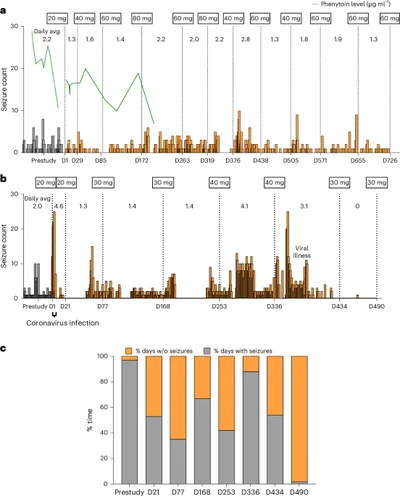
For both patients, primary endpoints were predefined as the change from baseline in countable motor seizure frequency at 12 and 24 months after ASO administration. Statistical analysis of seizure counts was conducted using a generalized linear model.
Additional primary endpoints for Patient 2 included change in neurodevelopmental scores from baseline at 12 and 24 months after initiation of ASO, including movement and motor domain scores on the Vineland Adaptive Behavior Scales–Version 3 (Vineland-3), BSID-4 with GSVs, and Dyskinetic Cerebral Palsy Functional Impact Scale (D-FIS). Outcome assessments were predefined for phenotype to assess change pre-ASO and post-ASO, including GSV scores, which can demonstrate meaningful clinical change in developmentally delayed individuals who may not be assessed on Bayley-4 against standard neurotypical scores.
The primary endpoint for Patient 2 also included the change in score from baseline at 12 and 24 months post-ASO on the Bristol Stool Form Scale as a surrogate marker of gastrointestinal dysfunction.
Secondary endpoints
For both patients, secondary endpoints included change from baseline at 12 and 24 months after ASO in behavioral assessments, including the ORCA and the Aberrant Behavior Checklist. GSV scores were not necessary for the ORCA, as it was initially designed for patients with neurodevelopmental disorders.
The Vineland-3 and BSID-4 with GSVs were also assessed as secondary neurodevelopmental endpoints in Patient 1.
Additional secondary assessments for Patient 1 included the Repetitive Behavior Scale-Revised and Short Sensory Profile Version 2.
Reporting summary
Further information on research design is available in the Nature Portfolio Reporting Summary linked to this article.