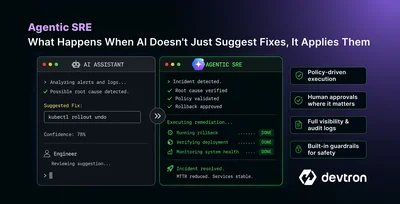
For years, AI has played an advisory role in operations. It analyzed logs, correlated alerts, identified probable root causes, and suggested remediation steps, while engineers remained responsible for deciding what to do next.
With the rise of Agentic AI, systems are no longer limited to recommending actions they can execute. An AI agent can restart a service, roll back a deployment, scale infrastructure, or trigger a remediation workflow without waiting for human intervention. For engineering teams, this promises faster incident response, lower operational overhead, and reduced mean time to resolution (MTTR).
But moving from recommending actions to executing them fundamentally changes the risk profile of production operations , AI can’t do that.
The question is no longer whether AI can identify the right remediation. The real question is whether it should execute that remediation autonomously, especially in complex production environments where every action can have cascading effects.
Recent incidents at AWS and Cloudflare demonstrate why this distinction matters.
When Execution Becomes the Risk
Suggesting a rollback and automatically performing one are fundamentally different decisions.
When AI recommends an action, it still needs validation of the broader context dependencies, business impact, recent deployments, ongoing incidents, or any other operational signals that may not be immediately visible.
Autonomous execution removes that validation layer.
Modern production environments are highly distributed, with hundreds of interconnected services, shared infrastructure, and constantly evolving workloads. A remediation that appears correct for one service may unintentionally degrade another. Acting quickly is valuable, but only when the action itself is appropriate.
This is where Agentic SRE becomes fundamentally different from traditional automation. The challenge isn't enabling AI to act, it's ensuring AI acts within clearly defined operational boundaries.
As organisations begin adopting Agentic SRE, the focus is shifting from whether AI can automate incident response to how it can do so safely. Platforms like **Devtron **are designed around this principle combining AI-powered investigation with policy-driven execution, approvals, and guardrails so autonomous actions remain controlled rather than unrestricted.
AWS: When Recovery Automation Amplified the Incident
In October 2025, AWS experienced one of the most significant outages in the history of its us-east-1 region, affecting a broad range of cloud services used by organizations worldwide.
According to AWS's post-incident analysis, the incident began with an internal automation defect affecting DynamoDB's DNS management. A bug in an automated process accidentally removed a critical DNS record required for DynamoDB to remain reachable. Because DynamoDB serves as a foundational dependency for numerous AWS services, including EC2, Lambda, ECS, EKS, and internal control planes, the impact quickly spread beyond a single service.
As DynamoDB became unavailable, automated recovery mechanisms began responding to failing health checks. Load balancers initiated automatic failovers to maintain service availability, but those failovers reduced available capacity across the region. As capacity decreased, request failures increased, triggering additional recovery actions that further amplified the disruption.
In effect, systems designed to improve resilience continued executing recovery logic based on assumptions that were no longer valid.
Restoring service required engineers to manually identify the faulty automation, disable it, restore the missing DNS configuration, and carefully recover dependent services. AWS later confirmed that the problematic automation was disabled across all regions while a permanent fix was developed.
The incident wasn't a failure of automation itself. It demonstrated that autonomous execution, when operating without sufficient safeguards, can propagate failures faster than we can intervene.
Cloudflare: Different Incidents, Same Operational Lesson
AWS wasn't an isolated example.
In November 2025, Cloudflare experienced a global outage following what appeared to be a routine operational change. A database update unexpectedly caused a configuration artifact used by Cloudflare's bot detection systems to grow significantly larger than anticipated. That artifact was automatically propagated across Cloudflare's global network, eventually exhausting resources within the software responsible for routing customer traffic.
The incident was particularly challenging because engineers initially suspected an external cyberattack before discovering that the disruption originated from an internal automated deployment process.
Only weeks later, Cloudflare encountered another production incident. A routine security update activated an existing defect within legacy infrastructure, causing another portion of its network to fail. Although the trigger was different, the operational outcome was remarkably similar.
In both incidents, automation executed exactly as designed.
What it lacked was the contextual awareness to recognize that continuing those actions was worsening the situation rather than resolving it.
Recovery ultimately depended on engineers identifying the underlying issue, stopping the automation, and restoring services manually.
The Real Lesson for Agentic SRE
The AWS and Cloudflare outages are often cited as examples of automation failures. In reality, they illustrate a more important engineering principle.
The issue wasn't that automated systems could execute actions.
The issue was that they continued executing those actions after the assumptions behind them had become invalid. This distinction becomes even more important as organizations adopt Agentic AI.
Unlike traditional automation, AI agents don't simply execute predefined scripts. They can observe system state, reason over multiple signals, decide on an action, and execute remediation autonomously. That additional capability dramatically expands what can be automated, but it also increases the impact of incorrect decisions.
An AI agent capable of modifying production systems across hundreds of services can reduce incident response times significantly. The same capability can also propagate an incorrect remediation just as quickly.
The objective of Agentic SRE, therefore, shouldn't be unrestricted autonomy. It should be controlled execution.
AI should autonomously handle operational tasks that engineering teams have already validated, such as restarting unhealthy workloads, executing approved rollback procedures, scaling applications within predefined thresholds, or resolving known failure conditions.
When incidents fall outside those validated patterns, the agent should escalate instead of improvising.
From Autonomous Execution to Autonomous Operations
The next evolution of SRE isn't just AI that identifies incidents , it's AI that can investigate, reason, and execute remediation while operating within engineering-defined policies.
Devtron Atlas brings this vision of Agentic SRE into practice. It continuously monitors applications, correlates signals across your stack, investigates probable root causes, and recommends or executes remediation through human-approved runbooks. With built-in safety guardrails, verification, and complete operational visibility, Atlas helps engineering teams automate repetitive incident response while ensuring every production action remains governed and auditable.
Explore Devtron Atlas to learn how AI-powered incident investigation and autonomous remediation can help your team resolve incidents faster while maintaining confidence in every production change.
Conclusion
The transition from AI-assisted operations to Agentic SRE marks a fundamental shift in how production systems are managed. AI is no longer limited to surfacing insights or recommending remediation, it is increasingly becoming an active participant in incident response.
As the AWS and Cloudflare incidents demonstrate, the challenge isn't enabling AI to take action. It's ensuring those actions are informed, governed, and aligned with established operational practices. Autonomous execution without context can amplify failures just as quickly as it can resolve them.
The future of Agentic SRE, therefore, isn't about giving AI complete control over production. It's about combining AI's speed and consistency with engineering-defined policies, validated workflows, and human oversight where it matters most. Organisations that strike this balance won't just automate incident response , they'll build more resilient, reliable, and trustworthy production systems.