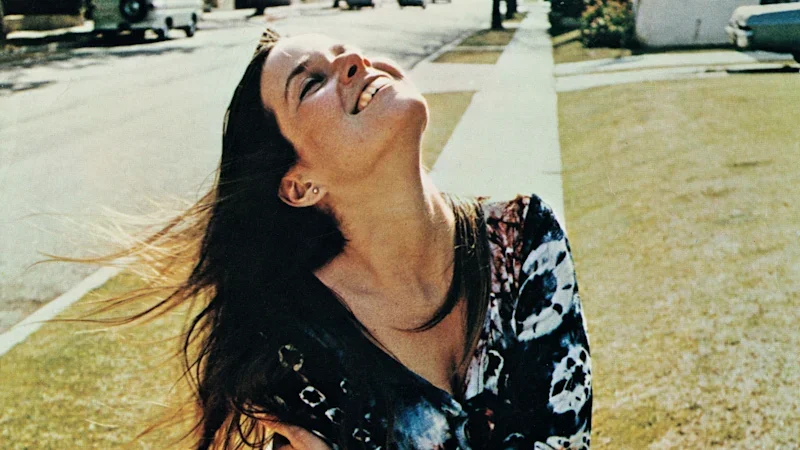
In the ’80s I wished it was the ’60s. I wanted to be a hippie chick. This might have been a reaction to my uptight Catholic upbringing, but I can’t discount the nostalgia pendulum swinging back. It brought Kennedy-Miller’s Vietnam series, starring young Nicole Kidman, and my surprise attachment to The Wonder Years (surely I was too old for it). There were repeated viewings of Woodstock, delighting in lighting designer Chip Monck’s announcement about the brown acid being “not specifically too good”.
I lived for late-night TV movies and was often rewarded with Hollywood hippies: Leigh Taylor-Young corrupting Peter Sellers in I Love You, Alice B. Toklas, and Barbara Hershey (nee Seagull) playing a foxy surrogate in The Baby Maker. To me, these freewheeling girl-women were so much cooler than the 1980s model with her shoulder pads and Xanax.
I grew my hair long and carried around a patchwork vinyl bag. I got into my Byrds box set, and tried to frug like Goldie Hawn in Cactus Flower, but breeziness was hard to fake. Because in the real world, aside from the regular teenage trauma, the Gulf War was happening, and the Menendez brothers had offed their parents, and people were dying of AIDS and the country was heading into a recession. I now wish I hadn’t been so hard on myself for not being fictional.
My questing extended to books, of course. I wanted hippie-era girl’s own adventure stories. I devoured super-groupie Pamela Des Barres’ memoir I’m with the Band, poring over pictures of her looking freaky in vintage dresses with feather boas and spider-leg eyelashes. I tried Go Ask Alice, the anonymous diary that had inspired diary-writing of my own, but Alice was joyless, a cautionary tale (and fake, we later found out, written by a middle-aged psychologist named Beatrice).
Mountain Girl (Carolyn Garcia) loomed large in my imagination. She was the sideways star of Tom Wolfe’s The Electric Kool-Aid Acid Test about Ken Kesey and his Merry Pranksters driving their bus, Further, across the US dispensing mirth and psychedelics. Wolfe described her as “a tall girl, big and beautiful, with dark brown hair falling down to her shoulders except that the lower two-thirds of her falling hair looks like a paint brush dipped in cadmium yellow from where she dyed it blond in Mexico”.
Mountain Girl was, in her own words, “a teenager dedicated to experimentation”. It was what I aspired to be – only I had to get braver. My problem was that I was better at watching other people be wild than actually being wild myself. But I was taking notes.
The book that came closest to my imagined girl’s own adventure into hippie-dom was actually written by a man: The Season of the Witch by James Leo Herlihy, who was mostly known for writing Midnight Cowboy. I bought my copy at the Ringwood Book Exchange, drawn by the teenage girl in flares on the cover, the pronouncement: This is Gloria’s Book!
Herlihy specialised in outsiders, unlikely connections, and the loneliness of city life. He wrote The Season of the Witch after a period of road-tripping, hitchhiking, staying in communes, attending anti-war protests, meeting heads and the “beautiful creatures” that were then migrating in patchouli waves across the country. He was 42, and thought America was about to enter a golden age and that technology would be the key to social change. His great friend and mentor Anais Nin had told him that “really the best thing [one] can give to the world is one fulfilled person: herself”. Herlihy gifted this imperative to Gloria Random.
So, it’s the summer of 1969 and Gloria and John, her ugly-beautiful gay best friend, are escaping to New York on a Greyhound bus. John got his conscription letter, and Gloria’s mother wouldn’t let her go to Woodstock – reasons enough for leaving. She changes her name to Witch Gliz, a nod to the father she’s never met, and dubs John “Roy” (after Royal Prince).
Witch is, in a very teenage way, too much. She loves everyone. She digs everything. Witch promises “a simple flat report of the truth, no flourishes, no bullshit” but she is prone to flights of wishful writing. When she runs out of present, she reflects on the past. Sometimes she transcribes (rap sessions, the bulletin board of the Canal Street share-house) but, aside from when Roy hijacks her journal, it is Witch’s voice all the way, what author Janet Burroway called “an uncompromising medley of conceit, warmth, gush, exuberance and cliche”.
In Daughters of Aquarius, Gretchen Lemke-Santangelo writes about the enduring myth of the hippie woman, presented variously as nymph or earth mother, goddess or groupie. Her book uses firsthand reports of women in the counterculture to interrogate these stereotypes.
“The vast majority of hippie women experienced little control over their own image and were often too preoccupied with creating an alternative culture or personal identity to offer a correction.”
What saves Witch Gliz from feeling too much like a male fantasy is Herlihy’s attention to her voice. Witch can blab gauchely about a sexual experience, showing inbuilt teenage bluff, and then bring it back to the real with a simple line: “It’s a bummer to run all the way home from a foolish, lonesome experience and not have somebody to hug.”
For Witch and Roy, self-actualisation, becoming “the highest head”, was the goal. By 18, I was almost there. I wore my Ishka crushed-velvet loon pants and said “man” a lot. And, after years of informal research, I finally tried acid. I was with my friend A, Roy to my Witch. We decided to document the event: he had his camera, I brought my typewriter. We were at his house (his parents were away) and we did all the things we’d normally do – watching videos, listening to music, talking about books and movies – only this time we were doing them on acid.
We had decided that, like the Beats, the best way to become a writer was to hang around interesting people, but we were in deep suburbia and didn’t really know where to find them. I think now of artist Jenny Watson saying there is nowhere on earth like Australian suburbs, how the conformity has a neutralising effect that makes it near impossible to feel special. That day we made ourselves laugh by quoting the terrible dialogue from the terrible Doors film: “You gotta make the myths, Morrison! Make the myths!” Nothing in our lives felt as dramatic or urgent as representations of the 1960s did.
There were other times, but they didn’t compare – I concluded I didn’t have a head for psychedelics. I’d get too introspective, and spend all my time staring at the mirror or the palm of my hand and freaking myself out. I see this period in my life as a reel of rambling talk and video fines, of driving dark streets listening to Funkadelic’s Maggot Brain – the true end of childhood, fledgling days. Eventually, A and I moved out of home, away from the outer east and bogans and bungalows and pine trees – and each other. And I did not become an acid head, but I did become a writer.
The ’90s arrived and put an end to my hippie era. I got into grunge. I wore flannelette shirts and Vans and cut my hair short. I dropped in and out of uni, and worked in pubs. For years, I kept my typewritten “acid report”. It made me laugh (it was gibberish) but there was something “holy relic” about it too; evidence from a time when everything interesting seemed just out of reach and pretending was the way you made it through.