Sign in. It’s quick, free and it’s up to you.
An account is an optional way to support the work we do. Find out more.
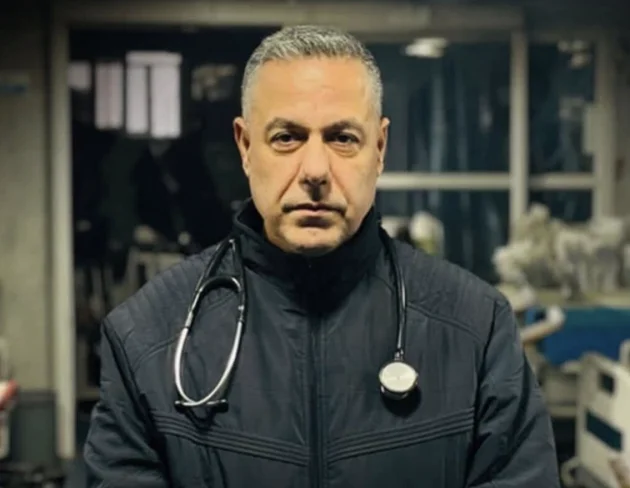
ON 27 DECEMBER 2024, Israeli forces surrounded and then stormed Kamal Adwan Hospital, the only one still operational in northern Gaza. Dr Hussam Abu Safiya, the hospital’s director, was arrested.
He has since been held in Israeli prisons without charge or trial, under a law that classifies him as an ‘unlawful combatant’. At the time of writing, more than 575 days later, Dr Abu Safiya remains detained in Israel, in conditions such that his life is now in danger.
His case is by no means an isolated incident. Like Dr Abu Safiya, nearly 100 Palestinian doctors remain detained by Israel. These detentions, most of which are arbitrary, form part of a broader policy of systematically targeting Palestinian healthcare workers, which has been extensively documented by human rights organisations and UN experts.
From the very first hours of the war, on 7 October 2023, Israeli forces struck the Indonesian Hospital in northern Gaza and Nasser Hospital in the south. In less than two months, the Israeli army had put 21 of Gaza’s 35 hospitals out of action. No medical facility will emerge unscathed from these three years of war.
According to estimates compiled by the World Health Organisation, more than 1,500 healthcare workers have been killed in Gaza. No contemporary conflict has seen such a high level of violence against healthcare staff.
The arrest and murder of healthcare workers form part of a policy whose framework was set out unambiguously by the Israeli Defence Minister, Yoav Gallant, who, as early as 9 October 2023, declared: “We are imposing a complete siege on Gaza. No electricity, no water, no food, no fuel. Everything is shut down. We are fighting human animals, and we are acting accordingly.”
The impact is immediate and brutal. Every Palestinian in Gaza finds themselves caught in a vicious cycle: injured or ill, treated if a doctor is still available, then exposed to danger once more, re-injured, re-traumatised.
Their survival depends entirely on the Israeli authorities, who control everything that can – and, above all, cannot – enter Gaza. Any dependency, whether on insulin, surgical care or pain management, can be suddenly cut off. Everything is subject to an external decision, imposed by force.
When the Israeli authorities arrest doctors, the right to medical care ceases to be a given; it becomes something permitted only at the discretion of the occupation authorities.
The message to the Palestinian medical profession is clear: their ability and duty to provide care are now subject to arbitrary control. Doctors practise under surveillance, under duress, and face the threat of punishment. Consequently, providing care means risking crossing an invisible line, beyond which offering assistance can suddenly become a crime. Yet what is truly criminal is attacking those who provide care.
A doctor is not merely a practitioner. They are also a figure who, faced with a ravaged body, affirms that that body retains an unwavering dignity despite its injuries. To attack doctors is to attack the very idea that there exists a space, however small, where care takes precedence over domination and where the restoration of a body is worth more than its control.
Helping a person to survive is not merely a matter of keeping them alive: it is defending their existence as a subject, not as an object of domination. It is undoubtedly for this reason that doctors are perceived as dangerous by Israel: they restore to bodies a capacity for action that the occupying power strives to confiscate. Through every wound sutured, every patient stabilised, every chronic illness managed despite the shortages, doctors offer a concrete rejection of the idea that a people can be reduced to the sum of their traumas.
The doctor is also a witness. Their testimony is forged in the very act of providing care. It is not a retrospective account, but a presence alongside the bodies which, through their injuries, their scars and their very survival, bear witness to what has been done.
The wounds on the mutilated bodies of civilians, transported by the dozens to hospitals, reveal something about the way the war is being waged. Dr Abu Safiya, like so many others, was targeted not only because he was a doctor, but because he was a witness.
Through publicly released videos, he implored the international community to put a stop to the attacks on Kamal Adwan Hospital.
And perhaps this is where the true threat posed by healthcare lies: not only does it keep alive those whom one seeks to erase, but it also preserves, through the endurance of bodies, a memory that no official narrative can erase.
A dead person is forgotten, fades away, becomes a statistic. Mutilated flesh remains, for decades, like a living archive. Within the logic of a project of annihilation, a life saved is an anomaly. Every patient a doctor stabilises, every wounded person he snatches from death, constitutes a departure from the logic of dehumanisation.
In his cell, Dr Abu Safiya embodies the ultimate consequence of this logic: the Palestinian body must never be fully its own, neither in life, nor in sickness, nor in death. “The pain, treatment and survival of the Palestinian body must remain subject to the will of the occupier.”
Filipe Ribeiro is Médecins Sans Frontières/Doctors Without Borders (MSF) Head of Mission for Palestine and former Director-General of MSF. MSF.ie. First published in French in Libération.
To embed this post, copy the code below on your site