SEOUL, Aug. 12 (Yonhap) -- The government on Wednesday announced key projects to nurture advanced technologies in seven sectors, including renewable energy and space science, as part of broader efforts to seek new growth engines.
The projects are part of the "strategic emerging engines for disruptive innovation," or SEED, initiative announced during a policy briefing at Cheong Wa Dae by the Ministry of Science and ICT and the Ministry of Trade, Industry and Resources.
The SEED initiative aims to secure new growth engines for South Korea by focusing on three areas: renewable energy, frontier technologies and an advanced supply chain ecosystem, the government said.
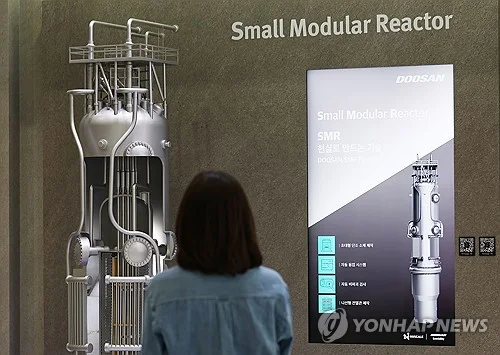
In the renewable energy area, the government plans to commercialize water-cooled small modular reactors (SMRs) by 2035, while beginning construction of non-water-cooled SMRs around 2030.
In particular, for advanced modular reactors, the government plans to establish a special purpose company (SPC) in cooperation with the private sector to oversee the project from the development stage.
South Korea also seeks to build a locally developed nuclear fusion reactor by 2035 through a partnership with the private sector, the ministry said.
Nuclear fusion technology is widely considered a safe and potentially limitless energy source because it mimics the natural process that powers the sun and stars.
Projects in frontier technologies will focus on quantum computing, space science and advanced biotechnology, the ministry said.
Among them is a project to develop a locally made 100-qubit quantum computer by 2029, along with plans to foster the country's quantum chip manufacturing capabilities with the goal of becoming a global leader within the next 10 years.
In space science, South Korea aims to become a global player by completing the development of a low-Earth-orbit satellite communications network by 2035.
In biotechnology, the government plans to establish artificial intelligence (AI)-based bio infrastructure by 2030, including AI models designed to predict changes in cancer cells.
The government will also seek to develop core technologies for brain-computer interfaces (BCIs), with the goal of producing a commercial product using the technology by 2035, the ministry said.
The project also includes efforts to establish supply chains for critical minerals and equipment needed to support such projects.
The government plans to increase the recycling rate of 10 key minerals to up to 20 percent by 2030, while investing 10 trillion won (US$7.1 billion) over the next five years in research and development of key equipment, the ministry added.
"We plan to provide the future generation with new opportunities to challenge, and complete an 'irreplaceable South Korea' that no one can rival," the government said in a release.
fairydust@yna.co.kr
(END)
- From 'BTS Boulevard' to U.S. governor's praise: BTS sweeps N. America on 'Arirang' tour
- TWICE's Jeongyeon leaves JYP to pursue acting career
- Gemini, BTS collaboration on display at Las Vegas Sphere
- U.S. Marines stage live-fire drills involving FPV drones for 1st time in S. Korea
-
Pyeongtaek city fails to reach U.S. military via hotline over reported white phosphorus leak: official
-
From 'BTS Boulevard' to U.S. governor's praise: BTS sweeps N. America on 'Arirang' tour
- TWICE's Jeongyeon leaves JYP to pursue acting career
- U.S. Marines stage live-fire drills involving FPV drones for 1st time in S. Korea
- Pyeongtaek city fails to reach U.S. military via hotline over reported white phosphorus leak: official
-
(LEAD) Pyeongtaek city fails to reach U.S. military via hotline over reported white phosphorus leak: official
-
Actor Ha Young apologizes over controversy surrounding family's pro-Japanese past
- 2 ex-Chinese military officers arrested over alleged eavesdropping, leaks
- (2nd LD) N. Korea fires 1 ballistic missile toward East Sea: S. Korean military
- N. Korea fires unidentified projectile eastward: S. Korean military
- (LEAD) N. Korea fires at least 1 ballistic missile toward East Sea: S. Korean military