The Battle of Falkirk in July, 1298 was a major battle for Scottish Independence. Led by King Edward I of England, the English army defeated the Scots, led by William Wallace. Sir John de Segrave led the forces into Scotland. When he was the commander of Edinburgh Castle, he fell in love with Lady Margaret Ramsey of Dalhousie. But, Margaret wanted to marry Sir Henry St. Clair of Rosslyn. Their engagement in 1302 left Segrave enraged and he requested for permission to invade Scotland. It was granted and in mid-February and an army of 30,000 soldiers crossed the border under cover of darkness and landed in Melrose. There they split into three: one group was instructed to attack the Borthwick Castle near Gorebridge, the second was to take over Lady Margaret’s home —Dalhousie Castle and the third, led by de Segrave himself, was against Rosslyn and Sir Henry St. Clair. The army moved fast, but a former Templar knight of Scotland sent monks on horseback to raise an alarm. An army of 8,000 people, mostly commoners, gathered at Biggar and set off to meet the invaders. Sir John Comyn was elected the commander and Sir Symon Fraser, the leader of the army. They then moved north and by the evening of February 23, the combined army had assembled in Bilston Wood, ready to strike.
The battle
Prior Abernethy of Mount Lothian helped the Scottish army round up the first contingent of the English army by the river Esk on February 24. He knew the lay of the land and this gave him an advantage. Segrave was one among the many captured for a ransom. The Scots drove the English knights over the steep sides of Roslin Glen (a park in Scotland). The English soldiers were shocked when they were ambushed and slaughtered. A few managed to escape and they alerted the second group, requesting them for help.
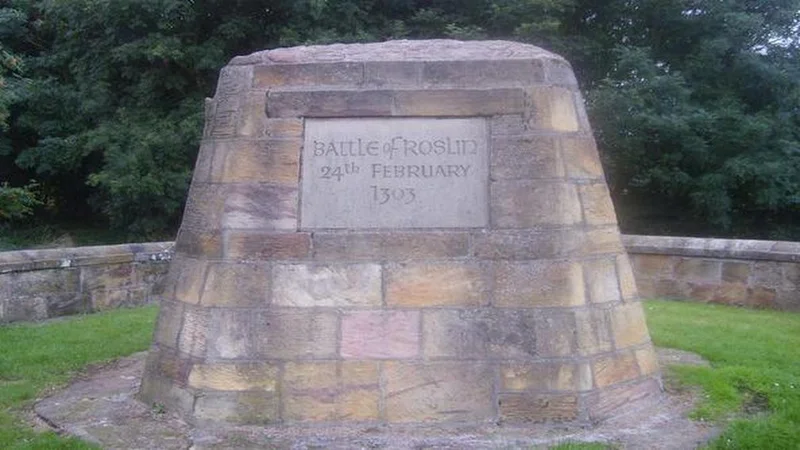
The second group, positioned in a defensive line across the summit of Langhill, were charged by the Scottish archers and driven back. They were later caught and slaughtered. So many people were killed in that area that it came to be known as Shinbanes Field. (In the 19th century, five cartloads of bones were removed by farmworkers for reburial). The third group’s arrival was not a matter of concern for the Scottish army as they were already on a high and with renewed energy they killed all the soldiers resulting in a Scottish victory. The tired but victorious soldiers sat near the River Esk and this is where the the monument to the battle was erected in 1994.
Published - February 23, 2017 05:00 pm IST