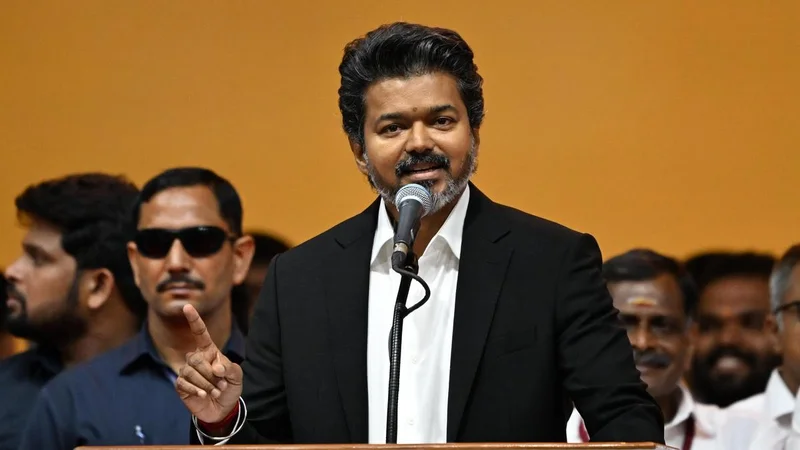
Changes in nomenclature of schemes, government buildings, or streets are not new to Tamil Nadu, especially when there is a regime change in the State. This explains the spate of renaming of schemes by the current Tamilaga Vettri Kazhagam (TVK)-led government headed by Chief Minister C. Joseph Vijay.
Prominent among the schemes whose titles have been changed are: “free distribution of goats/sheep,” launched by the All India Anna Dravida Munnetra Kazhagam (AIADMK) government in 2011, into “Vetri Magalir Goat Rearing Scheme” and “free distribution of laptops to students” into “Vetri Laptop Scheme.” The “Kalaignar Veedu Vazhangum Thittam,” introduced by the DMK regime during 2006-11, underwent the first change as the “Chief Minister’s Solar-Powered Green Houses Scheme,” and it was carried out by the AIADMK government during 2011-16. When the DMK was back in the office in 2021, the scheme came to be known as “Kalaignar Kanavu Illam Thittam”; now, it will be called “Vetri Veedu Thittam.” As for the flagship scheme of the previous regime of the DMK, “Kalaignar Magalir Urimai Thogai” (KMUT), the idea is to rename it “Madhippumigu Magalir Thittam.” The prefix “Kalaignar” has already been dropped in some official messages.
At the time of Independence, the Congress, which was the ruling party both at the all-India level and in the State, was not averse to the idea of changing the names of schemes, roads, and other public places. However, the party did not rush through the process. In fact, Prime Minister Jawaharlal Nehru, according to The Nehru Archive, wrote in August 1962 to then Governor of Uttar Pradesh Biswanath Das not to permit the renaming of Deer Park in Sarnath which, he said, “is full of history and is associated closely with the Buddha.”
The 1950s saw the spirit of nationalism and sub-nationalism becoming the predominant factor in the political discourse. The Congress, which ruled Tamil Nadu between 1946 and 1967 at a stretch, had deliberated, for years, over the question of changing the nomenclature of the State and the capital: from Madras to Tamil Nadu and Chennai, respectively. The main reason why the ruling party took time was that it did not want to give space to fissiparous tendencies, which had been in operation in the State.
Eventually, the Congress had decided to use the terms Tamil Nadu and Chennai in the State government’s communication in Tamil. Following the DMK’s rise to power in 1967, the party went into top gear with regard to the nomenclature change after its founder C.N. Annadurai died in February 1969. Mount Road was named Anna Salai after him, so was a host of places and schemes. Gradually, the name of his successor, M. Karunanidhi, came to be used.
When the AIADMK’s founder M.G. Ramachandran became Chief Minister in 1977, his regime did as much as it could in the arena of change of names. Within six months of capturing power, MGR, in January 1978, decided that public buildings should not have the names of living personalities and wherever such names had been given, they should be removed.
It was an open secret that this move was targeted at his principal adversary, Karunanidhi. In fact, the DMK chief had urged the Chief Minister to spare other figures, including the DMK founder’s widow Rani Annadurai, who was alive then, from the government’s direction, as a marriage hall in Ashok Nagar had been named after her.
Months later, the Municipal Council of the Madurai Corporation, headed by S. Muthu, once a diehard follower of Karunanidhi, adopted a resolution to change the name of Kalaignar Karunanidhi Nagar, popularly called K.K. Nagar, into Kalaivanar N.S. Krishnan Nagar, also K.K. Nagar.
The nomenclature change did not leave out bus routes operated by the State Transport Corporation in Chennai: the Pallavan Transport Corporation (PTC), which was the precursor to the Metropolitan Transport Corporation (MTC). According to a report in The Hindu on October 1, 1989, the Corporation had decided to do away with ‘V,’ ‘VV,’ ‘J’, and ‘JJ’ signs for the limited-stop services. The introduction of the signs ‘V’ and ‘J’ was done during the MGR regime and the signs were the first letters of two prominent leaders of the AIADMK, R.M. Veerappan and J. Jayalalithaa. When the DMK regime returned to power, it chose to give up the signs.
When Jayalalithaa became Chief Minister for the first time in June 1991, one of the early moves of her government was to change the Anjugam Ammaiyar Memorial Inter-Caste Marriage Assistance Scheme to the Tamil Nadu Inter Caste Marriage Assistance Scheme.
Announcing this in Chennai on July 30, then Social Welfare Minister R. Indira Kumari, who later defected to the DMK, told reporters that the scheme, introduced during Annadurai’s rule, was continued without any change in its name by MGR. But during Karunanidhi’s regime, he chose to give importance to his family members, and named the scheme in question after his mother, said this newspaper on July 31, 1991.
Twenty years later, when she came back to power, Jayalalithaa got the Kalaignar Medical Insurance Scheme changed to Chief Minister’s Comprehensive Health Insurance Scheme. Following in the footsteps of one of his predecessors, Chief Minister C. Joseph Vijay has got the Chief Minister’s Breakfast Scheme, one of the key schemes of the previous DMK regime, rechristened after former Chief Minister K. Kamaraj.
Only players change over the years but their actions remain more or less the same.
Published - August 12, 2026 06:15 am IST