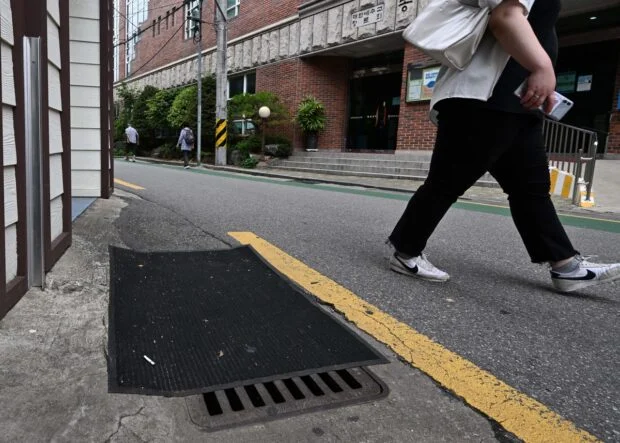
Why Seoul can’t shake its sewer smell
Occasionally, a sharp odor hits pedestrians as they walk along Seoul’s sidewalks.
Although the smell often disappears within seconds, complaints have been repeatedly raised by residents and visitors. Posts describing sudden bursts of sewer-like odors can easily be found in both Korean and international online communities.
According to a 2025 report by the Seoul Institute, sewer-related smells account for about half of the city’s civil complaints regarding bad odors. While complaints declined after Seoul launched sewer odor reduction measures in 2015, they have since rebounded.
Article continues after this advertisement
The city has made efforts to tackle the issue for more than a decade, but the growth in complaints raises questions over whether it has been doing enough.
READ: South Korea’s odor pollution problem
What causes Seoul’s sewer odor, and why has it been so difficult to address?
Organic matter rotting beneath the streets
The main source of the smell is hydrogen sulfide, a gas known for its rotten egg-like odor. It forms when organic matter in sewage decomposes in oxygen-deprived environments.
Seoul’s sewer system has struggled to keep pace with the city’s rapid urban growth, and many buildings have installed septic tanks as an interim measure before sewage is discharged into underground sewer pipes.
Article continues after this advertisement
While these tanks remove some solid waste, dissolved organic matter remains in the wastewater that flows into the sewers.
During heavy rainfall, increased water flow helps flush sewage through the system and reduces the buildup of odor-causing gases. But during hot, dry periods with little rainfall, hydrogen sulfide can accumulate in the sewers and escape through openings such as storm drains and maintenance holes.
Article continues after this advertisement
“Odors can be caused by diverse and complex factors, so they must be addressed based on expert diagnoses and on a case-by-case basis,” a Seoul city official said.
READ: Gas from sewer caused blast?
“High declines in wastewater flow and sediment buildup inside sewer pipes can contribute to odors, so the city is considering measures such as changing sewer structures and dredging accumulated sediment.”
Another city official said Seoul’s combined sewer system, where wastewater from buildings and stormwater from streets flow through the same underground pipes, can also contribute to odor problems.
Since the early 1990s, Seoul has considered converting the system into one in which wastewater and stormwater are carried through separate pipes.
However, progress has been slow due to the difficulty and high cost of replacing underground sewer networks. As of 2025, only 20.4 percent of Seoul’s sewer network had been converted to separate systems.
Why the problem persists
Seoul has made sewer odor reduction a priority in its environmental policies, with a dedicated team overseeing odor mitigation projects.
The current legal framework mainly focuses on managing odors that exceed allowable limits, rather than requiring local governments to proactively prevent sewer odors.
READ: A dirty job in Mexico City: sewer diver
The number of sewer odor complaints in Seoul fell from 3,095 in 2015 to 1,660 in 2020, partly due to the city’s efforts, including the installation of odor reduction devices in large septic tanks. However, complaints rose again to 2,302 in 2024.
Ki Dong-won, a researcher at the Seoul Institute, said a complaint-driven approach has made it difficult to establish long-term and standardized solutions.
“Korea has yet to develop models that can predict how sewer odors spread above ground or analyze their diffusion paths, making it difficult to identify areas vulnerable to odor complaints,” Ki said.
“Efforts such as creating sewer odor maps are underway, but they are not yet linked to performance indicators or evaluation standards for odor reduction facilities.”
Park Seok-soon, an environmental engineering professor emeritus at Ewha Womans University, said that water should be artificially circulated through sewer pipes to prevent sewage from stagnating and decomposing, given the difficulty of replacing combined sewer systems.
“When water remains stagnant in storage facilities for a long time, water quality deteriorates. I believe introducing water from hydrants or other facilities could help circulate water through sewers,” Park said.
“Many major cities in Japan and other developed countries still use combined sewer systems. Ultimately, it comes down to how strictly they are managed.” /dl