- READ MORE: Temperatures will drop 'several degrees' due to the eclipse
- See more Daily Mail on Google - save us as a Preferred Source
The conditions are practically perfect. For most people, this evening offers the best chance in a lifetime to see an almost total solar eclipse – with the added bonus of meteor showers.
Across the country, from about 6.15pm, the moon will gradually slide across the face of the sun until it covers up to 96 per cent.
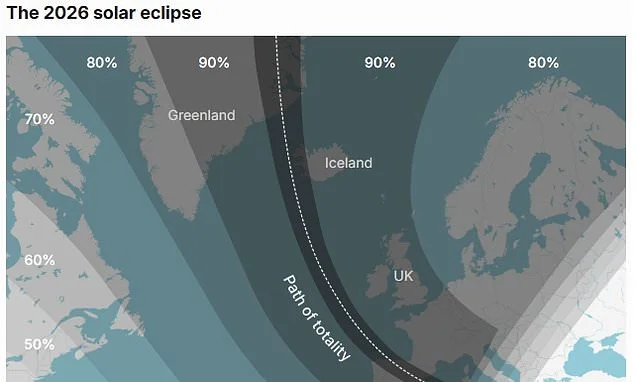
The precise moment this begins, and how complete the darkness will be, depends on where you are (see below), but everywhere can expect at least a 90 per cent blackout.
This coincides with the peak of the annual Perseids meteor shower, when thousands of space rocks burn up in Earth's atmosphere as our planet passes through a belt of debris from comets.
To make this all the more spectacular, clear skies are expected across most of the country.
Even in cities, there ought to be comparatively little light pollution in early evening, though inevitably many street lights will come on automatically. Out in the countryside, the skies will be magnificently dark.
Scotland will see the effect soonest, with the eclipse reaching its maximum at 7.05pm in Edinburgh and Glasgow.
In Cornwall, at Truro, that moment will come 11 minutes later. But it doesn't last long, with the darkness beginning to lift just two minutes after it reaches its most intense.
When and where to see the eclipse
First contact – the moment the moon's shadow will first appear on the sun – will kick off at 18:06 in Glasgow and Edinburgh, 18:13 in Manchester and Liverpool, 18:15 in Birmingham, 18:17 in London, Bristol and Cardiff, and finally at 18:18 in Cornwall.
Viewers, taking the appropriate safety precautions, will see a small 'bite' disappear from the sun's right–hand corner before slowly spreading to cover most of the disc.
At the point of greatest coverage, observers will see only a tiny inverted crescent of fire hanging in the sky.
That will happen just under an hour later, at 19:05 in Glasgow and Edinburgh, 19:10 in Manchester and Liverpool, 19:11 in Birmingham, 19:12 in London, Bristol and Cardiff, and at 19:16 in Cornwall.
After that moment, you'll be able to watch as the moon slowly moves out of alignment with the sun until its shadow completely vanishes.
Dr Megan Argo, an astrophysicist from the University of Lancashire, told the Daily Mail: 'For those of us in the UK and elsewhere watching the partial solar eclipse, the sky will not go completely dark and the stars will not be visible.
'It will still get darker though as the Sun is gradually eclipsed by the Moon, but it will look more like an overcast day as the Sun's light is reduced.'
Starting at 18:00 BST today, the UK will witness the best partial solar eclipse since 1999, with up to 96 per cent of the sun obscured
Scientists say that you should also feel the temperature plummet during the moment of maximum coverage.
A spokesperson for the Royal Astronomical Society told the Daily Mail: 'It's hard to say exactly as it depends on the time of day and amount of coverage of the Sun, but usually about 1°C to 3°C during a partial solar eclipse and around 5°C during a total solar eclipse.'
Exactly how much of the sun vanishes will depend on where you are in the UK, with areas towards the Southwest seeing a deeper eclipse.
The very best place in the UK to see the eclipse will be Bishop Rock in the Isles of Scilly, where 96.5 per cent of the sun will be obscured.
Meanwhile, viewers in Land's End and Lizard Point on the mainland will see over 95 per cent of the sun obscured.
That drops to just over 90 per cent for viewers up in Inverness, while London, Birmingham, Manchester and Edinburgh will all see roughly 91 per cent.
However, even in the very far north of the Shetland Isles, the eclipse will still be deep enough for 88 per cent of the sun to vanish from view.
But Dr Argo says that anyone who wants to see the full spectacle of totality will have to 'plan a trip'.
Outside of the UK, totality will be visible from Northern Spain, Greenland, Iceland, and parts of the Atlantic Ocean
Travelling to see the total eclipse
The total eclipse will be visible as it passes across Greenland, Iceland, the Atlantic Ocean and northern Spain.
However, as budding astronomers flock to the path of totality, hotel prices have soared.
Keen travellers are reportedly spending thousands for a front row seat at the celestial event of the decade.
An extra 1.5 million people are expected to travel to Spain for the eclipse, leading hotel prices to more than double, according to data group Lighthouse.
High-end retreats have even begun offering luxury eclipse viewing packages for the wealthiest space enthusiasts.
At the St Regis Mardavall in Mallorca, guests can shell out €15,000 (£13,000) for a stay in the hotel, a trip to see the eclipse on a private yacht, and meditation classes at sea.
Meanwhile, in Iceland's capital Reykjavík, hotel rooms were priced at more than $1,000 on average on the night of the eclipse, 140 per cent more than normal.
Spain is braced to receive an extra 1.5 million eclipse mad travellers to the path of totality, with some shelling out thousands for the experience. Pictured: NASA researchers prepare for the eclipse in Burgos, Spain
How to get the best view of the solar eclipse
'Anywhere with clear skies and a good view to the west will provide a great view of the eclipse,' says Dr Argo.
'Assuming that the weather cooperates, you will be able to see it from anywhere in the British Isles.'
However, with the eclipse happening so late in the evening, the sun will be very low on the horizon at first contact, and even lower during maximum coverage.
Even a few small trees or a low hill could completely ruin the view, so it's important to find a spot where you can actually see the sun touch the horizon.
If you're absolutely determined not to miss the action, consider heading out to your intended spot a few days in advance to check that the sun will be visible.
Since the sun sets in a slightly different location each day, a spot that had a great view earlier this year might not be perfect by now.
Current weather forecasts suggest that the south of England and Wales will have clear conditions during the eclipse. However, Scotland and Northern Ireland will be less fortunate
Once you've found a spot to watch, it cannot be stressed enough that you must absolutely not look at the sun with your bare eyes at any point during the eclipse.
Even looking at the sun for a short amount of time can cause serious damage to your retina, which may lead to permanent vision loss.
Mohamed Elalfy, a consultant ophthalmologist and president of the Royal College of Ophthalmologists, says: 'Crucially, the retina has no pain receptors, so people will not feel the damage as it happens.
'Symptoms may only become apparent several hours later and can include blurred vision, a central blind or dark spot, distorted vision, reduced colour perception and increased sensitivity to light. While some people recover over weeks or months, others can be left with permanent visual impairment.'
That means you need to plan in advance to find a safe way of viewing the eclipse.
Dr Greg Brown, astronomer at the Royal Observatory Greenwich, told the Daily Mail: 'By far the safest way to view the eclipse is with a simple pinhole projector.
'This can be a box or piece of card with a small hole punched through which projects the view onto the ground or another piece of card. This way you never look at the sunlight directly, ensuring it is safe.'
Similarly, a colander can be used as a simple projector, producing dozens of little images of the Sun.
The safest way to view the eclipse is indirectly. You can use something like a colander to project an image of the sun onto a piece of card
Alternatively, you can use specially made eclipse glasses to watch the spectacle directly without harming your eyes.
Look for those bearing the ISO 12312–2 safety standard and make sure to purchase them from a reputable retailer to avoid any chance of picking up a fake.
Due to immense demand, new eclipse glasses have become exceedingly difficult to purchase in many areas.
However, do not be tempted to use an old pair that might have been lying in a drawer since the 1999 eclipse.
'It is possible for the film on older solar eclipse glasses to degrade over time, so it is recommended to only use eclipse glasses manufactured within the last decade,' says Dr Bloomer.
You should also check to ensure that the lenses aren't scratched or scraped, which would ruin their protection.
If you can't make it out to watch the eclipse, or your view is scuppered by bad weather, there will be several livestreams available to watch.
You can tune into one provided by the Royal Observatory Greenwich at this link here.
You can also use eclipse glasses with the ISO 12312-2 safety standard. Be sure to wear them the entire time you are looking at the sun
What is an eclipse?
Dr Shyam Balaji, an astrophysicist at King's College London, told the Daily Mail: 'During a total solar eclipse, the moon's orbit puts it directly in front of the sun.
'This obscures the sunlight that can pass directly towards the Earth, enabling us to see just the corona of the sun, which is the outer rim.'
Although the moon is between Earth and the sun every new moon, solar eclipses are much rarer, only occurring once every 18 months or so.
This is because the moon's orbit is tilted by about five degrees relative to the plane on which the Earth travels around the sun.
That means that it is quite rare for all three bodies to be precisely lined up in such a way that the moon perfectly blocks the sun.
In fact, it is only due to an incredible cosmic coincidence that such a perfect solar eclipse can occur on Earth.
While the moon is about 400 times smaller than the sun, it also happens to be about 400 times closer to Earth.
The solar eclipse coincides with the peak of the Perseid meteor shower. So, after the sun sets, there will still be an incredible celestial display to watch. Pictured: The Perseids seen over Corfe Castle, England
By pure chance, this allows the moon to perfectly obscure the sun, something which is completely unique in the solar system.
What to do once the sun has set
In another fantastic coincidence, this total solar eclipse also happens to coincide with the Perseid Meteor shower.
That means you can simply stick around outside for a full night of spectacular stargazing.
The shower, which is caused by debris left by the comet Swift–Tuttle, will actually peak on August 12 and 13, with up to 100 shooting stars per hour.
Dr Balaji says: 'The best place to view the Perseid meteor shower is in the North East near the constellation Perseus.
'While you can look at the whole sky and are likely to see a meteor, that's the target location in order to get the best viewing experience.'
And the great news is that you don't even need any special equipment to make the most of this incredibly well–timed display.