Argentina · Economy
Key Facts
- Salta salesFruit and vegetable sales down close to 50% year-on-year, per the Cofruthos cooperative.
- Rosario dropProducer market reports a 50% decline so far this year, with one official saying “50% and even a bit more.”
- Chaco retractionHorticultural cooperative sees sales off 30% to 40%, with an estimate of 40% fewer sales.
- Mendoza trendFamilies buying smaller quantities despite some lower prices; no single percentage given.
- Income squeezeFalling real wages and high inflation are forcing households to cut perishable food first.
- Purchasing powerProduce is a leading indicator of consumer stress because it is discretionary and non-storable.
When people stop buying tomatoes and apples, it is rarely about taste. It is about what is left in the wallet after rent and utilities — and that signal is flashing red across Argentina’s provinces.
If you live in Argentina or watch it from abroad, you have heard the inflation numbers and the wage negotiations. But the real read on purchasing power is not in the indexes — it is in the produce aisle.
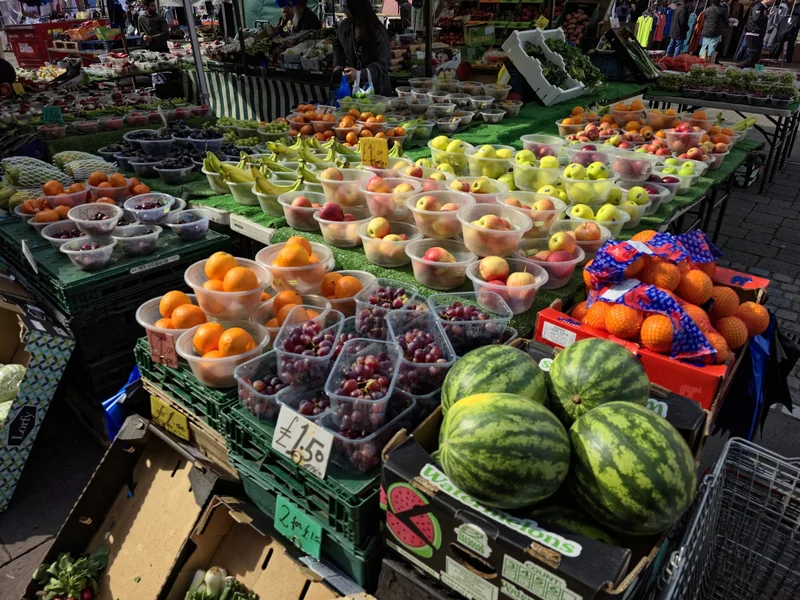
Right now, that aisle is emptying out. Across Salta, Rosario, Chaco, and Mendoza, fruit and vegetable sales are falling sharply.
The worst cases show a 50% drop. This is not a niche market problem.
It is a direct measurement of how much money ordinary households have left after the essentials. It says Argentina’s food consumption is under severe strain.
The Numbers Tell a Stark Story
Start in Salta, where the Cofruthos cooperative reports fruit and vegetable sales down close to 50% compared to last year. That is not a rounding error or a seasonal blip.
It is a collapse. In Rosario, the producer market is seeing the same magnitude — a 50% decline so far this year.
One market official says the real number might be “50% and even a bit more.”
Chaco’s horticultural cooperative reports a retraction of 30% to 40%. It has an internal estimate of 40% fewer sales.
Mendoza does not have a single headline number. But the description is consistent: families are buying smaller quantities, even when some prices have come down.
The pattern is uniform across geography and climate. It runs from the northwest to the central farm belt to the northeast.
Live Market IntelligenceArgentina — Live Market Board
Rio Times · Live Market Intelligence
Argentina — Live Market Board
-3.19%
167,874.64
-2.50%
65,878.37
-0.84%
11,128.56
-1.25%
3,022,485
-3.19%
2,423.37
+2.14%
59,693.55
-1.60%
| Instrument | Last | Change | YoY | Prev. | High | Low | Volume |
|---|---|---|---|---|---|---|---|
| MERVAL | 3,022,485 | -3.19% | +31.22% | 3,122,065 | 3,185,663 | 2,994,004 | — |
| USD/ARS | 1,491 | -0.53% | +12.81% | 1,498 | 1,491 | 1,491 | — |
| YPF | 7,790 | -3.41% | +71.21% | 8,065 | 8,370 | 7,670 | 4,463,801 |
| GGAL | 7,035 | -4.42% | +3.76% | 7,360 | 7,520 | 6,955 | 4,230,270 |
| PAMPA | 5,080 | -3.05% | +27.00% | 5,240 | 5,350 | 5,025 | 1,301,416 |
| TXAR | 765.50 | +1.46% | +19.61% | 754.50 | 770.00 | 723.00 | 2,806,892 |
| ALUAR | 949.50 | -0.21% | +32.98% | 951.50 | 955.50 | 925.00 | 427,079 |
| TGS | 8,885 | -4.77% | +15.84% | 9,330 | 9,445 | 8,720 | 248,801 |
| CEPU | 2,117 | -3.25% | +24.90% | 2,188 | 2,227 | 2,083 | 996,760 |
| MIRGOR | 1,670 | -1.18% | -92.97% | 1,690 | 1,710 | 1,610 | 78,820 |
| COME | 41.23 | -0.19% | -32.83% | 41.31 | 44.24 | 40.80 | 14,998,561 |
| LOMA NEGRA | 3,128 | -4.21% | +4.08% | 3,265 | 3,320 | 3,113 | 482,293 |
| BYMA | 279.75 | +0.00% | +36.80% | 279.75 | 290.00 | 275.00 | 2,678,987 |
| TELECOM ARG | 4,263 | -5.70% | +58.46% | 4,520 | 4,650 | 4,180 | 134,425 |
| GLOBANT | 38.99 | +1.14% | -48.64% | 38.55 | 39.88 | 37.36 | 1,886,276 |
| MERCADOLIBRE | 1,940 | +6.34% | -17.48% | 1,824 | 1,946 | 1,830 | 802,696 |
3 of 13names higher.
Consumer Disc.led, while
Telecomlagged.
Why Produce Is the First Thing to Go
Fruits and vegetables are not like bread or rice. They are perishable, they require refrigeration, and they are easy to skip.
When a household’s real income shrinks, the first cuts are almost always in fresh food. You can stretch a bag of pasta.
You cannot stretch a head of lettuce. That makes produce the canary in the coal mine for consumer spending.
In Argentina’s current economic squeeze, with inflation running high and wages lagging, the math is brutal. A family that used to buy two kilos of oranges now buys one.
A shopper who bought a full basket of vegetables now picks three items. The cooperative leaders in Salta and Chaco are not talking about a preference shift.
They are talking about necessity. One Rosario official put it bluntly.
The decline is not because people changed their diets. It is because they cannot afford the basket they used to buy.
What This Means for Argentina’s Food Consumption
Argentina’s food consumption is becoming more calorie-dense and less nutritious. When fresh produce falls by half, households substitute with cheaper, shelf-stable staples.
Those staples include pasta, rice, flour, and processed goods. That is a public health issue in the making.
But it is also an economic signal. It means the domestic market for fresh produce is shrinking.
That pressures small farmers and cooperatives that depend on local sales.
For a country that prides itself on agricultural abundance, this is a paradox. Argentina exports beef, soy, and wine.
But its own citizens are eating fewer vegetables. The gap between what the country produces and what its people can afford is widening.
That gap is not captured in export statistics or GDP figures. It shows up in cooperative sales reports and in empty crates at the market.
Why You Should Care
If you are living in Latin America or have money invested here, this is a leading indicator you cannot ignore. Consumer staples are supposed to be resilient.
When even those are cut, it means the household budget is under extreme pressure. For investors, this signals weaker domestic demand across the board.
That includes clothing, appliances, and services, not just produce. For expats and nomads, it means the cost-of-living crisis is not abstract.
It is visible in every market stall and supermarket aisle.
The situation also carries political weight. Food consumption is a visceral issue.
When people feel they cannot feed their families properly, patience wears thin. Argentina has seen this before.
The social consequences are rarely mild. The produce data is not just a market report.
It is a measure of social stress. And right now, that stress is high.
Frequently Asked Questions
Is the drop in fruit and vegetable sales uniform across Argentina?
No. The most severe declines are reported in Salta and Rosario, both around 50%. Chaco is at 30% to 40%.
Mendoza shows smaller quantities purchased but no single percentage. The trend is consistent.
But the intensity varies by region and by the local mix of producers and markets.
What is causing the decline in produce consumption?
The primary driver is shrinking real household income under high inflation. Wages have not kept pace with prices.
So families cut discretionary and perishable purchases first. Produce is a classic first cut because it is non-storable and easy to replace with cheaper staples.
Does this affect small farmers and cooperatives?
Yes, directly. Cooperatives like Cofruthos in Salta and the horticultural cooperative in Chaco are reporting sales drops of 40% to 50%.
These organizations depend on local demand. When that demand falls, their revenue falls with it.
That can lead to reduced planting, layoffs, or consolidation in the sector.
Connected Coverage
Sources: Cofruthos (Salta); Rosario producers’ market; Chaco cooperative; Ámbito, August 2026.
This article was produced by The Rio Times’ automated newsroom system. How we use AI · Report an error