Rotorua Lakes Council has asked the government for a four-week extension to enter its Head Start local government reform process.
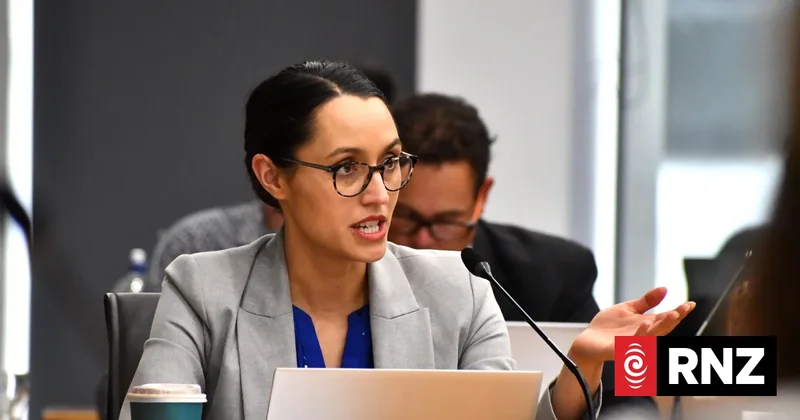
Mayor Tania Tapsell said she had asked Local Government Minister Simon Watts for more time to resolve councillors' concerns and formally submit the proposal.
Introduced in May, Head Start gave councils three months to propose voluntary reforms, with those not progressing facing a compulsory backstop, in which the government will design the future structure for them after the 2028 elections.
The request follows the collapse of a co-ordinated plan to create three unitary authorities: Tauranga-Western Bay, Rotorua, and an Eastern Bay authority covering Whakatāne, Kawerau and Ōpōtiki.
Each would develop its own structure while the councils presented a unified regional approach through a shared cover letter.
However, the plan unravelled before the 9 August deadline.
On Thursday, Western Bay voted against Head Start, by one vote, and the Eastern Bay councils submitted their own proposal, leaving Rotorua with Tauranga as its only potential partner.
Rotorua chief executive Andrew Moraes said the council had been advised by the Ministry for Cities, Environment, Regions and Transport (MCERT) that it needed at least one other council to qualify for Head Start.
A Tauranga-Rotorua proposal covering a Baywide approach, minus the Eastern Bay, would have required including Western Bay despite its opposition, dividing Rotorua councillors. A proposal including only Tauranga and Rotorua would not qualify.
The council voted 6-5 against the Tauranga-Western Bay alternative and the backstop option, leaving Rotorua without an approved proposal or an obvious route into Head Start.
Tapsell said Rotorua had previously resolved to pursue a Head Start proposal, but the rejection at the final meeting on Friday left it without an "approved" final proposal.
The minister now has Rotorua's draft proposal, Tapsell said, and the council is waiting to see whether the extension will be granted.
Whakatāne Mayor Nándor Tánczos said the Eastern Bay councils had always intended to submit their own proposal, supported by the cover letter demonstrating a co-ordinated regional approach.
"We were all committed to signing it," he said.
The Eastern Bay councils waited for Western Bay's decision before submitting, but Tánczos said there was too little time to change tack and develop a new arrangement with Rotorua.
"It's Thursday night we're talking about," he said.
The intention had been for the three sub-regions to move together, even if their proposals were submitted separately.
"We wanted it to be seen that the Bay of Plenty was coming up with a solution for the whole Bay together," Tánczos said.
He said that principle had not changed despite the collapse of the co-ordinated process.
"If there is a possibility that there's still this idea of an across-the-Bay three sub-regional authorities' approach, we'd still support that," he said.
"It still seems the best idea for the Bay of Plenty."
Tapsell said she "understood and supported" the Eastern Bay councils proceeding independently, saying it was "ultimately the best decision" for them to "determine and be part of their own future".
She said the three-authority concept reflected what the region's mayors believed was the most realistic option.
"We understood and agreed that we have three very clear and distinct sub-regions," she said.
Tapsell said she still believed the three-authority model was the best solution for the region and remained viable.
She said Tauranga and Western Bay were the most logical parts of the region to merge because of their geography and infrastructure, but Rotorua councillors had been reluctant to support a model that would effectively force Western Bay into an arrangement it had rejected.
Tánczos also questioned whether councils had been given enough time to make decisions of such magnitude, saying the process had placed enormous pressure on councils and strained relationships.
"Everyone's been put in this extremely difficult position with really impossible time frames," he said.
Watts rejected the suggestion that the government's process had failed in Rotorua.
"Head Start is a voluntary process for councils that are ready and able to work together to simplify local government," he said.
Councils without a Head Start proposal proceeding to detailed design would enter the Backstop, he said, with its design to be determined by the government in 2027.
Watts declined to comment specifically on Rotorua's position but said the detailed design phase would allow successful proposals to be expanded, communities consulted, and legislation developed before the 2028 elections.
He said the government had received 18 proposals covering 48 councils by the 9 August deadline, including proposals from the Eastern Bay councils and one from Tauranga City Council, without a willing partner.
Moraes said Rotorua's options beyond Head Start remained unclear, with the government yet to set out what the Backstop process would look like.
"The Head Start process is closed," he said. "Anything that happens outside of that process will depend on future government policy announcements."
For Tapsell, that is why the extension matters.
"Head Start was the only option available to determine our own future," she said.
"I'm genuinely gutted that we're on the edge of losing this opportunity."
LDR is local body journalism co-funded by RNZ and NZ On Air.