Drafting S’pore laws demands political judgment, not just legal expertise: SM Lee
AI generated
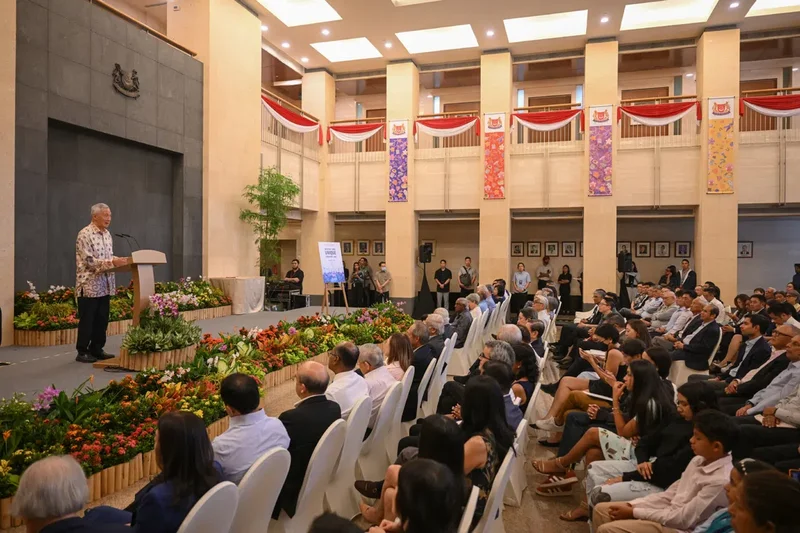
SINGAPORE - Creating a Constitution and laws that meet the specific needs and circumstances of a country is never a purely legal process, said Senior Minister Lee Hsien Loong on Aug 12.
Instead, it demands a keen understanding of the society: its vulnerabilities, the likely problems, and solutions to these problems that have the best chance of working. This requires political experience and judgment, Lee said at the launch of a new book on three uniquely Singaporean laws.
The book, by former Cabinet minister and jurist S. Jayakumar, provides a ringside view of the creation of the elected presidency, the Group Representation Constituency (GRC) and the Non-Constituency MP (NCMP) schemes.
These three laws each had a clear purpose and made sense for Singapore’s context, Lee said at the event held at the Ministry of Foreign Affairs.
The elected presidency was to protect the Republic’s past reserves and to safeguard the integrity of its public service, while GRCs were to ensure adequate representation of the minority races in the House. Meanwhile, the NCMP scheme ensured that opposition voices were never shut out of Parliament, he noted.
While all three laws were originally conceived by Mr Lee Kuan Yew at around the same time, they were mooted to Cabinet and discussed extensively, said Lee. There were many disagreements, and many possible models were suggested and discarded, he added.
“From conceptual idea to implemented scheme, the team revised their thinking quite significantly,” he noted. The Constitution was amended in 1984 to institutionalise the NCMP scheme, in 1988 for GRCs and in 1991 for the EP.
The laws were the work of practical men who governed Singapore, not scholars or philosophers, said Lee.
“They were acutely conscious of what made Singapore tick, where our faultlines were, and how very easily things could go wrong,” he said. “They were not chasing ideological purity or conceptual tidiness, but what worked, and would benefit Singapore.”
These constitutional innovations cannot be divorced from the political context of their time, nor from the larger changes in the nation’s demographics, added Lee.
The elected presidency, for instance, was introduced two decades after independence when the pioneer generation that had run budget surpluses and built up the reserves was fading away.
Meanwhile, the use of blatant racial appeals by some candidates in the 1984 general election gave renewed urgency to ensuring multi-racial representation in Parliament, and Lee said GRCs were “the solution to this enduring vulnerability".
Beyond the immediate circumstances when they created these institutions, Mr Lee and his team sought to build a constitutional framework that would last. The true test was how these laws would work in practice across decades and successive governments.
“Having introduced these major constitutional changes, Mr Lee Kuan Yew and the 2G ministers faithfully subjected themselves to what they had created,” he said.
“Looking back now after nearly half a century, we can safely say that these three institutions have indeed served Singapore well.”
The second key mechanism of the elected presidency, for example, has worked as intended, said Lee.
This could be seen in how political parties advocating more generous social spending during normal times have been forced to explain how they will be funded, or make the case for changing the rules to spend more from the reserves, he added. Yet during emergencies such as the Covid-19 pandemic, the government of the day has been able to fund substantial emergency packages with the approval of the President.
But the elected presidency is not a panacea. Effectively wielding the second key requires a President that is convinced that this is his proper role and responsibility, and who is equal to the heavy task, said Lee.
At the same time, he has to win popular support to get elected in the first place, and experience has shown that it is not a given that voters in a presidential election will judge candidates solely on who is best qualified for the task.
“Unfortunately, no mechanism, no matter how carefully designed, can give absolute assurance that only persons who are fit for the responsibilities stand for office, or are elected by voters...But on the whole, Singapore’s political system and long-term stability are much better served with the check and balance afforded by an Elected President than without,” he said.
On GRCs, Lee said it is no longer seriously doubted that they have been necessary to ensure that minority races are always adequately represented in Parliament. There is also no question that the minority member of a GRC team enjoys the same mandate and political standing as his teammates.
“Importantly, the GRC scheme has also discouraged race-based politics. Parties that make overt racial appeals to one group risk losing support from other groups,” he said.
As for the NCMP scheme, it was from an era where it was quite possible for the winning party to make a clean sweep at general elections. While this is no longer a plausible scenario, Lee noted that the public’s expectations for more alternative voices in Parliament have gone up.
Opposition parties have also made full use of the scheme to raise the public profile of their narrowly-losing candidates in the hope of winning outright in the next election, he added.
Lee said the book sheds light on how Singapore’s leaders worked behind closed doors - they argued intensely but objectively with each other, and were open to radical, out-of-the-box ideas.
While Mr Lee Kuan Yew had put forth his views robustly as prime minister, he also repeatedly and obsessively sought alternate perspectives, noted the senior minister.
“It shows what it means for the Prime Minister to be primus inter pares (first among equals) in the Cabinet, and how Cabinet collective responsibility is meant to work,” he said.