The ancient Greek city of Aspendos, located in modern-day Turkey, is perhaps most famous for its grand amphitheater and intricate aqueducts. New findings now suggest that sportsâpossibly wrestlingâmight have been part of the spectacle on display at Aspendos.
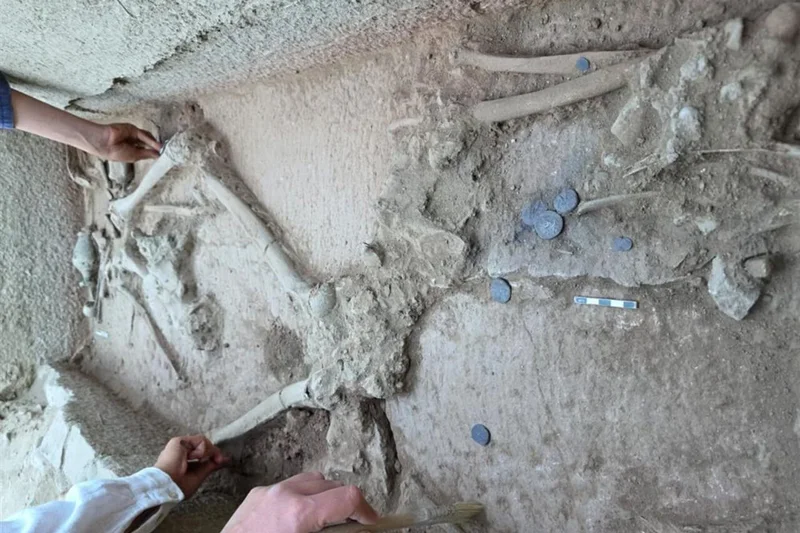
Recently, authorities affiliated with Turkeyâs Ministry of Culture and Tourism found a previously unknown necropolis, or an ancient cemetery, in the eastern part of Aspendos. Investigations turned up a box-type tomb made of stone slabs, dated to between the 5th and 4th centuries BCE. Inside, researchers found a single individual buried with coins depicting wrestling. Although further analyses are in order, as of now, the team believes this person could have been an athlete and perhaps even a wrestler. The Ministry announced the findings in a statement yesterday.
âAspendos coins with depictions of wrestlers and other finds found in the tomb indicate that the person buried here may have been involved in sports, perhaps even a wrestler from Aspendos,” Mehmet Nuri Ersoy, minister of culture and tourism, said in the statement (translated via Google).
An ancient settlement
Aspendos was founded by Greek migrants around 1,000 BCE. The cityâs ideal location near the Eurymedon River helped it thrive economically, according to a report on the site by UNESCO. The Aspendos amphitheater and aqueducts are some of the most intact monuments of their type in the world and have accordingly allowed archaeologists to study the cultural and engineering history of the region.
But to archaeologists and history nerds, Aspendos is also famous for its intricate silver coins, and the city was wealthy enough to mint its own coins. Over centuries, the city fell under the rule of different governments but still appeared to have the resources to produce their coins, which suggests that they still had a relatively large degree of independence.
Tribute or coincidence?
One particularly iconic design on an Aspendos coin concerns an image of two wrestlers grappling, with the letters delta and alpha etched between their legs. These were the coins unearthed next to the individual in the tomb from the latest discovery. The designs on coins werenât just for show; for instance, the opposite side of the wrestler coin shows a slinger wearing a short chiton, which ârepresents the soldiery for which Aspendus was famous in antiquity,â according to an 1888 catalogue of Greek coins compiled by the British Museumâs Department of Coins and Medals. Whatâs more, previous research, such as a 2000 study, has suggested that the prominence of wrestlers on Aspendian coins points to a reverence for the sport in the ancient city.
All things considered, Turkish officials currently believe that the individual in the tomb could have been an athlete, although, again, archaeologists have yet to find definitive, non-circumstantial proof for this hypothesis. To Live Science, Sarah E. Bond, a historian at the University of Iowa uninvolved in the discovery, commented that âcoins alone cannot indicate that this was a Classical-era Greek wrestler.â Further analyses will have to find distinct signs, such as injuries to the face.
As tends to be the case for archaeological interpretations, the Turkish team’s initial theory might be wrong. Still, the findings do offer a rare look into the life of an individual from a key city from antiquityâand that’s reason enough for researchers to continue work at the site.
“With every new find in Aspendos, we will continue to complete the missing pages of our history, protect our cultural heritage through scientific studies, and carry it into the future,” Ersoy said.