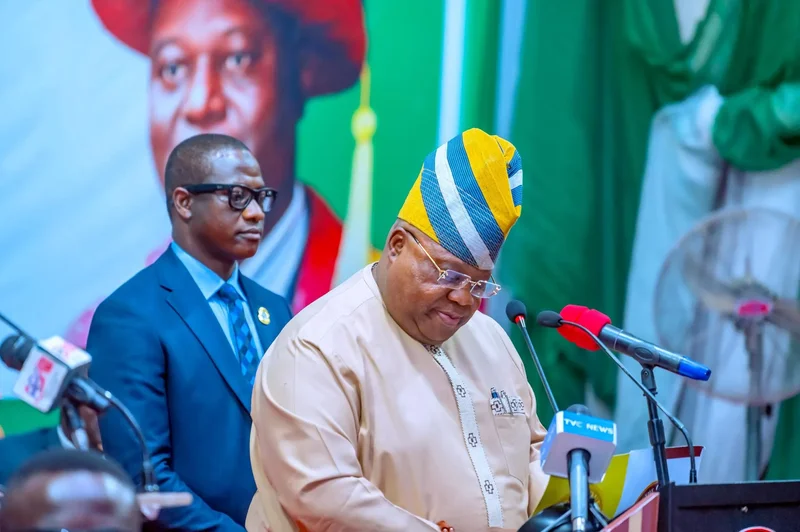
Governor Ademola Adeleke’s administration has reduced Osun State’s domestic debt by N69.18 billion since taking office, moving the state from among Nigeria’s 10 most indebted states to 18th on the domestic debt ranking, an analysis of data from the Debt Management Office (DMO) has shown.
Mr Adeleke became Osun governor on 27 November 2022.
The state’s domestic debt stood at N148.37 billion as of 31 December 2022, according to the DMO’s domestic debt data for the 36 states of the federation and the Federal Capital Territory.
At the time, Osun was the ninth most indebted state in terms of domestic debt.
| | |
|---|
The debt declined gradually during the first year of Mr Adeleke’s administration, falling to N147.05 billion by March 2023, N145.71 billion by June, N145.27 billion by September and N144.60 billion by December 2023.
The decline became more pronounced in 2024.
By 31 March 2024, Osun’s domestic debt had dropped to N87.01 billion, representing a reduction of N57.59 billion from the December 2023 figure.
The debt continued to decline to N86.06 billion by June 2024, N85.18 billion by September and N84.27 billion by December.
The downward trend continued throughout 2025.
The state’s domestic debt stood at N83.32 billion in March 2025, N82.34 billion in June, N81.33 billion in September and N80.28 billion by the end of December.
The latest DMO domestic debt report, covering the period to 31 March 2026, puts Osun’s domestic debt at N79.19 billion.
This represents a reduction of N69.18 billion, or about 46.6 per cent, from the N148.37 billion recorded before Mr Adeleke assumed office.
The reduction has also changed Osun’s position among Nigeria’s most indebted states. From ninth place in December 2022, the state had moved to 18th place by March 2026.
Debt servicing continues
In a bid to cause a decline in the domestic debt stock, Osun has incurred substantial expenditure on debt servicing.
The state’s 2023 audited financial statements show that it spent N16.73 billion on public debt charges during the year.
The statement defines public debt charges as “interest and other expenses” incurred by the state government in connection with borrowing funds for qualifying assets.
Of the N16.73 billion spent in 2023, N1.57 billion was recorded as domestic interest discount, while N15.15 billion went towards payment of domestic principal.
The state’s debt servicing expenditure increased substantially in 2024, when N23.05 billion was recorded as public debt charges.
However, unlike the previous year, virtually all of the payment was directed towards foreign debt.
The 2024 audited financial statements show that only N500,000 was paid towards domestic debt during the year.
The figures rose again in 2025, with the state recording N27.44 billion as public debt charges.
Of that amount, as reported in the 2025 audited financial statements, N4.56 billion was spent on interest on domestic debt, while N22.89 billion was used to repay domestic principal.
The figures show that while Osun’s domestic debt stock has consistently declined under Mr Adeleke, the state has continued to devote significant resources to meeting its debt obligations.
The sharpest reduction in the debt stock occurred between December 2023 and March 2024, when the domestic debt fell from N144.60 billion to N87.01 billion.
The DMO data do not, by themselves, explain the specific transactions responsible for the N57.59 billion reduction during that period.
The figures also relate specifically to domestic debt and should not be interpreted as the total indebtedness of Osun State, which includes other debt obligations.
As of March 2026, Osun’s domestic debt of N79.19 billion remains a major financial obligation, even though the state’s position on the DMO’s domestic debt ranking has improved considerably since Mr Adeleke assumed office.