Your support helps us to tell the story
From reproductive rights to climate change to Big Tech, The Independent is on the ground when the story is developing. Whether it's investigating the financials of Elon Musk's pro-Trump PAC or producing our latest documentary, 'The A Word', which shines a light on the American women fighting for reproductive rights, we know how important it is to parse out the facts from the messaging.
At such a critical moment in US history, we need reporters on the ground. Your donation allows us to keep sending journalists to speak to both sides of the story.
The Independent is trusted by Americans across the entire political spectrum. And unlike many other quality news outlets, we choose not to lock Americans out of our reporting and analysis with paywalls. We believe quality journalism should be available to everyone, paid for by those who can afford it.
Your support makes all the difference.
Read more
Secretary of State Marco Rubio arrived in Southeast Asia as U.S. allies warned of mounting global threats, with wars in the Middle East, rising tensions in the South China Sea and Myanmar's civil conflict dominating a high-stakes regional summit.
Rubio is attending meetings led by the Association of Southeast Asian Nations, or ASEAN, alongside Chinese Foreign Minister Wang Yi and senior officials from Japan, South Korea, India, Australia, Russia, Britain and the European Union.
Ahead of the gathering, Rubio reaffirmed U.S. support for freedom of navigation in the South China Sea, warning in an opinion piece published in Philippine newspapers that the region faced growing risks if critical shipping lanes fell under the control of "a power willing to use commerce as a geopolitical weapon."
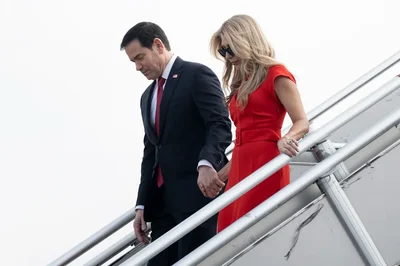
Secretary of State Marco Rubio and his wife Jeanette Dousdebes Rubio arrive at Ninoy Aquino International Airport in Manila Tuesday, July 21 (AP)
While he did not name China, Rubio said such a scenario would pose "dire new threats" to the sovereignty, security and economic future of both the United States and ASEAN nations.
Rubio also reiterated U.S. support for a 2016 international arbitration ruling that rejected China's sweeping territorial claims in the South China Sea. Beijing rejects the ruling.
The summit comes as ASEAN foreign ministers grapple with a wave of international crises.
U.S. Ambassador to the Philippines Lee Lipton, second right, listens to U.S. Ambassador to ASEAN Kevin Kim, second left, speaking with Rubio (AP)
In a joint statement after a closed-door meeting, ministers said they were "deeply concerned" that renewed conflict involving the United States and Iran was undermining diplomatic efforts and reducing the chances of a peaceful resolution.
The conflict has heightened fears over global energy supplies flowing through the Strait of Hormuz after Yemen's Iran-aligned Houthi movement announced a naval blockade on Saudi Arabia, raising concerns about oil prices, inflation and economic growth.
The 10-member ASEAN bloc, whose economies rely heavily on imported energy, has been exploring ways to accelerate a regional oil-sharing mechanism to help cushion any supply disruption.
Vessels at the Strait of Hormuz, as seen from Musandam, Oman, July 21 (Reuters)
Regional leaders are also confronting the ongoing civil war in Myanmar, where consultations continue over a stalled peace plan five years after the military seized power.
The South China Sea remains another flashpoint.
Philippine and Chinese officials are expected to hold talks after both sides accused each other of dangerous actions near the disputed Second Thomas Shoal.
The Philippine military said Chinese Coast Guard personnel struck one of its sailors with a baton during a confrontation, an allegation that further escalated tensions. Both governments have accused the other of provocation.
Philippine President Ferdinand Marcos Jr. is expected to summon China's ambassador in Manila following the incident.
In this photo taken from video from the Armed Forces of the Philippines, China Coast Guard personnel, left, on rigid hull inflatable boat confronts Philippine Navy personnel (AP)
China's foreign ministry said ASEAN was not the proper venue for resolving bilateral maritime disputes and urged the Philippines, this year's ASEAN chair, to promote dialogue instead of advancing its own political interests.
The U.S. State Department condemned what it called China's "dangerous and aggressive" actions, saying they reflected a troubling pattern of conduct against Philippine maritime operations.
Against that backdrop, Rubio's meetings with regional leaders are expected to focus on security, trade and Washington's commitment to allies facing what he has described as growing coercive pressure in the Indo-Pacific.